Tommy Tuberville’s warning about airline pilots, flight attendants, and air traffic controllers belonging to the furry community gives the opening stretch an appropriately absurd target. Rather than seriously debating the senator’s stated concern, the comedy attacks the premise by asking why a pilot’s private interests would matter to passengers in the first place. The resulting jokes are deliberately crude, but there is a recognizable satirical argument underneath them: the segment portrays the furry issue as a bizarre political distraction at a time when candidates are facing much larger electoral questions.
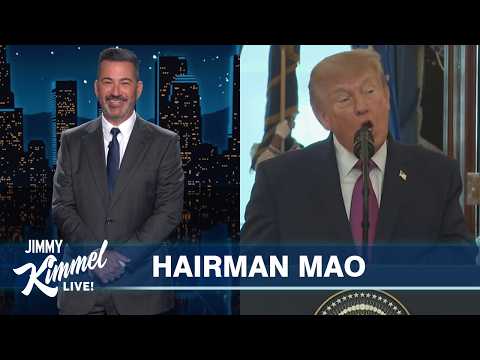
From there, the focus shifts to Donald Trump’s meeting with Xi Jinping, with the show finding comedy in ceremonial details rather than attempting a substantive examination of the diplomatic agenda. Trump being startled during the B-1 bomber flyover becomes an extended joke about projecting strength, while his praise for the helipad is treated as evidence of misplaced attention. The segment mentions major subjects including trade, AI, and the war with Iran, but these function mainly as background for jokes rather than topics the show meaningfully analyzes.
The announcement that two pandas are coming to Atlanta provides one of the cleaner comic pivots. The hosts contrast the cheerful panda news with their much darker characterization of the United States’ strategic competition with China, turning an appealing diplomatic gesture into a punchline about priorities. That contrast works as satire, although assertions about China’s global position and America’s decline are delivered rhetorically rather than developed or supported within the piece, so they are better understood as part of the show’s political framing than as demonstrated conclusions.
Senator John Kennedy’s comments give the writers their most productive material. His description of Iran, China, North Korea, and Russia as reptiles expands into football, prostitution, time-share salesmen, and other comparisons, allowing the show to mock the escalating mixture of metaphors simply by following it to increasingly ridiculous destinations. The sequence is funny because it has a clear structural idea: every new comparison makes the original statement harder to visualize, and the hosts repeatedly pretend they are struggling to keep track of the creatures, occupations, and activities involved.
Jordan Klepper’s White House appearance then ties the disparate stories together by adopting an exaggerated defense of Trump. His argument that apparent humiliation, military setbacks, and chaos are all components of an ingenious long-term strategy is plainly presented as comic inversion rather than serious political analysis. The escalating metaphor game also pays off here, as Klepper deliberately reproduces Kennedy’s convoluted style until almost every sentence becomes an absurd collection of animals, professions, and sexual references.
That callback-heavy construction gives the closing exchange satisfying cohesion, culminating in the idea that Trump’s master plan is simply to acquire more pandas. At the same time, the segment sometimes stretches its strongest jokes beyond their natural endpoint. The furry material relies heavily on sexual punchlines, while the Kennedy-inspired metaphor routine becomes intentionally exhausting; viewers who enjoy rapid escalation may find that persistence funny, but several jokes repeat the same basic comic mechanism after the point has already landed.
As political satire, the piece is much more interested in ridicule and comic framing than in giving viewers enough information to independently evaluate the political and foreign-policy claims passing through it. That is consistent with its entertainment-first approach, and the performers maintain an energetic rhythm while repeatedly connecting earlier jokes to later material. The best moments turn politicians’ own remarks or behavior into setups for larger comic patterns, while the weaker ones depend on exaggeration so heavily that the underlying issues nearly disappear.
Pros
- Tuberville’s furry comments provide a clear satirical premise built around questioning the relevance of a pilot’s private interests to doing the job.
- The B-1 flyover and helipad material efficiently turns ceremonial moments from the Trump-Xi meeting into visual and verbal comedy.
- Kennedy’s rapidly multiplying metaphors inspire the segment’s most coherent and memorable running joke.
- Klepper’s exaggerated “long game” defense creates an effective satirical reversal and connects several earlier topics.
- The panda callback gives the otherwise wide-ranging political material a satisfying closing payoff.
Cons
- Significant claims about China, Iran, American power, and military circumstances are used as comedic premises without substantive explanation or supporting evidence within the segment.
- The furry discussion leans so heavily on sexual jokes that its underlying criticism of Tuberville’s argument becomes secondary.
- Kennedy’s metaphor routine is extended through so many variations that repetition begins to weaken the original joke.
- Major subjects such as trade, AI, and international conflict are mentioned primarily as setups, leaving little meaningful examination of the issues supposedly surrounding the Xi meeting.
Sharp callbacks and committed performances turn a scattered collection of political stories into a surprisingly cohesive comedy segment, with Kennedy’s metaphors and the panda storyline providing its strongest connective tissue. The relentless exaggeration produces plenty of punchlines, but it also leaves substantial political and foreign-policy claims largely unexplored beneath the satire.