Donald Trump's repeated fascination with Republican Senator Jon Husted's appearance provides the centerpiece of a politically charged comedy segment that finds absurdity in the final weeks of the 2026 midterm elections. Michael Kosta moves between a controversial family attack advertisement, a disastrous local candidate interview, and the president's unusually detailed observations about male politicians. The result is a fast-moving collection of political embarrassments that prioritizes sharp punchlines and escalating ridiculousness over conventional election analysis.
The opening story focuses on Ohio's gubernatorial race, where Republican candidate Vivek Ramaswamy is portrayed as trailing Democrat Amy Acton by six points. Kosta introduces a campaign advertisement featuring Acton's estranged mother, who directly attacks her daughter's honesty and urges voters not to support her. The comedian responds with disbelief at the spectacle of a mother publicly campaigning against her own child, imagining the personal consequences of such an attack. The segment successfully highlights the increasingly personal nature of campaign messaging, although it offers little examination of the mother's accusations or the circumstances surrounding the family dispute. The polling figures and campaign's reported involvement are presented as part of the news setup rather than independently substantiated.
The focus then shifts to Jamie West, a Democratic candidate for Fayette County Council in Indiana, whose local television interview becomes an extended exercise in uncomfortable political comedy. West struggles to introduce herself, wanders through disconnected remarks about data centers and local threats, and delivers a confusing response to a question about income taxes. Kosta initially questions whether the interview could really be as disastrous as suggested before acknowledging its chaotic nature. His jokes about smelling gin through the screen and West being legally unable to drive turn the awkward footage into an effective comedic sequence. However, his repeated insistence that she is intoxicated remains an interpretation of her behavior rather than a demonstrated fact.
One of the more interesting moments comes when Kosta briefly acknowledges that West appears to know specific details about neighboring Union County's tax rates despite struggling to communicate her position. This unexpected concession gives the segment a little more dimension than straightforward ridicule. Still, the comedy largely depends on emphasizing her verbal difficulties instead of evaluating whether she understands the responsibilities of the office she is seeking. The unusual combination of potentially relevant local knowledge and deeply disorganized delivery could have supported a more revealing examination of candidate preparedness.
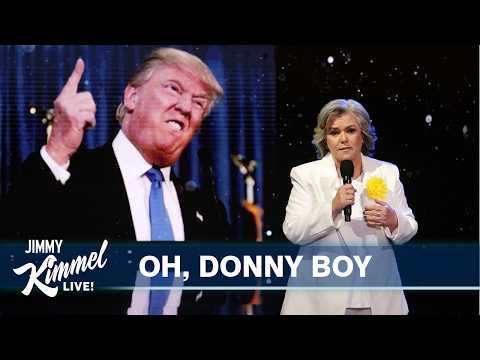
Trump's campaign appearances supply the segment's strongest material, particularly his repeated compliments about male Republican candidates' looks and physical characteristics. A montage captures him praising handsome faces, prominent jawlines, athletic builds, and eventually Husted's backside. Kosta responds by exaggerating the remarks into increasingly suggestive scenarios while pointing out the president's apparent lack of restraint. The jokes work because they build directly from Trump's own quoted language, making the contrast between the seriousness of presidential campaigning and the unusual subject of his attention immediately apparent. Kosta also explicitly rejects the idea that these remarks establish anything about Trump's sexual orientation, framing them instead as evidence of an increasingly unfiltered public speaking style.
The closing parody campaign advertisement is the most creatively developed sequence. Rather than simply replaying Trump's comments, it transforms his praise of Husted's physique into an entire fictional political platform built around body-related wordplay. Economic concerns, special interests, campaign endorsements, and comparisons with Democratic opponent Sherrod Brown are all repurposed into increasingly outrageous jokes about physical attractiveness. The advertisement's exaggerated political messaging effectively mimics the promotional language of real campaigns while exposing how easily superficial qualities can overwhelm substantive discussion. Although the barrage of similar jokes eventually becomes repetitive, the sustained commitment to the premise produces a memorable conclusion.
As political commentary, the segment succeeds more through comic timing, carefully chosen clips, and Kosta's expressive delivery than through investigative depth. Its strongest material is directly connected to remarks viewers can hear, while its weaker moments rely on assumptions about intoxication, motives, or broader political implications. The humor is consistently irreverent and frequently crude, which suits the show's established satirical approach but limits its appeal for audiences seeking measured election coverage. Beyond the comedy, the underlying criticism is reasonably clear: political campaigns can become so consumed by personal attacks, embarrassing performances, and spectacle that meaningful policy discussion disappears almost entirely.
Pros
- Michael Kosta's energetic delivery, quick reactions, and escalating punchlines maintain an entertaining pace across three distinct campaign stories.
- The advertisement featuring Amy Acton's estranged mother provides a striking example of how personal political attacks can overshadow substantive election issues.
- Jamie West's uncomfortable interview produces memorable comedy, with Kosta's acknowledgment of her apparent knowledge of local tax figures adding an unexpected moment of nuance.
- Trump's own recorded remarks about Republican candidates provide a concrete foundation for the segment's strongest satirical observations.
- The fictional Jon Husted campaign advertisement creatively extends a single political embarrassment into an elaborate parody of campaign messaging and superficial candidate appeal.
Cons
- Repeated suggestions that Jamie West is drunk go beyond what her disorganized interview conclusively establishes.
- The discussion of Amy Acton's family controversy provides little context for the allegations or the reported campaign strategy.
- Political substance remains secondary, with limited attention to candidate qualifications, policy differences, or the electoral significance of the controversies.
- The extended reliance on sexual innuendo and repeated jokes about Husted's appearance becomes somewhat predictable by the closing advertisement.
Michael Kosta delivers an energetic and frequently hilarious examination of political spectacle, turning uncomfortable interviews, personal campaign attacks, and Trump's unusual compliments into effective late-night satire. The strongest moments build directly on the politicians' own words, while speculative assumptions and repetitive innuendo occasionally weaken the commentary. It is a highly entertaining comedy segment that captures the absurdity of modern campaigning more successfully than it explains the political stakes behind it.