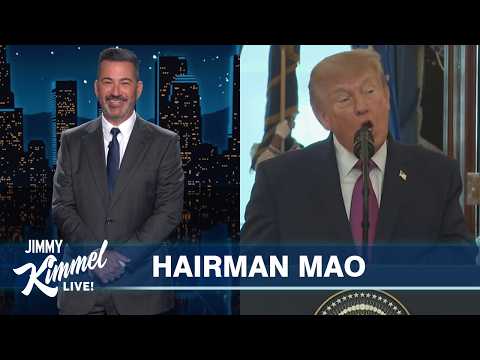
Trump’s reported dispute with the original architect of his White House ballroom gets only a quick joke in the opening news roundup, despite being the subject highlighted by the title. The segment says Trump clashed with the architect over design features alleged to violate building-safety codes, then immediately pivots to a punchline about stripper poles. That makes the headline feel somewhat misleading: viewers expecting a substantive treatment of the architectural dispute will instead find a much broader late-night monologue centered on Trump, China, Republicans, prices, polling, and press access.
Seth Meyers is on firmer comedic ground when the material connects Trump’s ceremonial priorities to the larger political argument. Trump’s enthusiasm for a new White House helipad becomes a recurring setup, with Meyers contrasting detailed praise of the renovation with the president’s comparatively vague description of discussions with Chinese President Xi Jinping. The jokes about granite, helicopters, red carpets, and Trump presenting ordinary improvements as unprecedented accomplishments build on one another effectively rather than functioning as isolated one-liners.
The Xi portion also makes extensive use of Trump’s own remarks, particularly his praise of the Chinese leader’s intelligence, stature, appearance, and toughness. Meyers turns those comments into an extended matchmaking routine, while arguing that Trump appears unusually invested in his personal rapport with Xi. The comedy is pointed, but the segment largely substitutes ridicule for deeper examination of the diplomatic issues it names, including Iran, tariffs, and artificial intelligence. Those subjects are mentioned as evidence of what Meyers believes Trump should be discussing more substantively, rather than explored themselves.
Domestic politics occupies much more of the segment. Meyers plays clips of Republican figures discussing inflation, gasoline prices, and the need to give the administration more time, then challenges attempts to emphasize peak economic conditions under Joe Biden rather than conditions at the end of his presidency. This section benefits from showing the remarks being mocked, allowing viewers to hear the political messaging directly before Meyers responds. At the same time, economic figures and claims about Trump’s net worth are presented rapidly and primarily as material for satire, without sourcing or enough context to independently evaluate the broader economic picture.
The discussion of Republican efforts to distance themselves from Trump follows the same effective clip-and-response structure. Byron Donalds’ earlier “Daddy’s back” praise is contrasted with a report that Trump references and imagery had been removed from Donalds’ gubernatorial campaign website, while Trump is shown asking voters to pretend that he is on the ballot in the midterms. Meyers uses that juxtaposition to argue that Republican candidates face a difficult balancing act between association with Trump and an electoral environment he describes as unfavorable. The segment’s conclusion that allies are “scrambling” away from Trump is stronger than the limited examples presented can establish on its own, especially without broader evidence about Republican candidates or polling.
The final section on White House press access is among the more focused pieces of political material. A news report explains that a federal judge ordered access restored to three outlets after finding that their press badges had been revoked without constitutionally adequate due process. Meyers then gets considerable mileage from footage of a reporter attempting to reenter the White House and from the practical consequences of pool cameras being absent. The humor works because the underlying sequence is easy to follow, though the segment remains commentary rather than a detailed explanation of the court’s reasoning or the administration’s position.
Overall, the writing is energetic and densely packed, with callbacks to furries, the helipad, “Daddy’s back,” and Trump’s wealth helping give a sprawling collection of subjects some comic cohesion. The biggest structural weakness is the disconnect between the title and the actual emphasis: the ballroom architect story is essentially a passing setup rather than the focus. As political satire, the piece offers plenty of direct clips and clearly identifiable targets, but its overwhelmingly adversarial perspective and limited engagement with counterarguments mean viewers should treat its political conclusions as Meyers’ commentary rather than a comprehensive account of the disputes being discussed.
Pros
- Direct clips from Trump and Republican officials give much of the satire a concrete basis and allow viewers to hear the remarks Meyers is criticizing.
- The helipad material develops into an effective recurring joke while supporting the segment’s broader contrast between ceremonial renovations and policy substance.
- The discussion of the press-access ruling provides a clear underlying event before moving into comedy about the immediate aftermath.
- Callbacks across otherwise disparate subjects give the lengthy political monologue more cohesion than a simple sequence of unrelated jokes.
Cons
- The ballroom architect dispute promised by the title receives only a brief mention and a single punchline rather than meaningful examination.
- Economic statistics, polling assertions, Trump’s reported net worth, and claims about Republican political behavior receive little sourcing or contextual development.
- Major issues surrounding the Xi visit are invoked but largely left unexplored because the segment concentrates on Trump’s rhetoric and ceremonial presentation.
- The political analysis is consistently presented through Meyers’ critical perspective, with little attention to administration responses or competing interpretations of several disputes.
Meyers delivers a fast, cohesive piece of political satire whose best moments use politicians’ own remarks as setups for sustained comic arguments. The broader monologue is substantially more developed than the ballroom story advertised in the title, however, and its political claims often move faster than the supporting context. As comedy it is sharp and well structured; as an examination of the headline subject, it is notably thin.