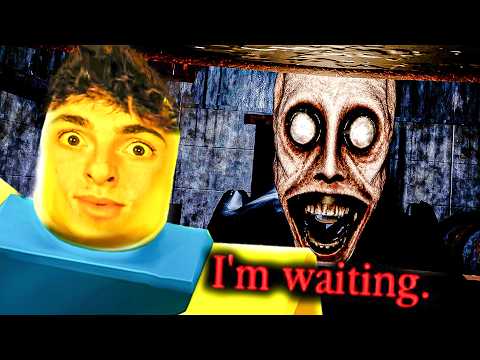
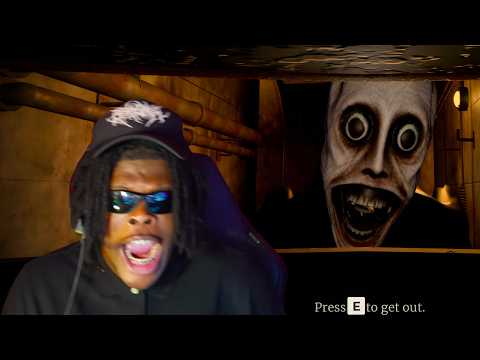
Getting separated almost immediately inside the yellow corridors of Unseen Liminality establishes what becomes the playthrough’s most reliable source of entertainment: three friends trying to coordinate while constantly distracting one another. Whistling to locate teammates is a genuinely useful mechanic, but it quickly becomes part of the comedy as the group struggles to reunite, attracts other players and becomes fascinated by a nearly pantsless stranger following them around. Rather than approaching the Backrooms-inspired environment as a serious horror experience, Hussein, Inferno Jae and their host turn it into a shared playground.
That attitude makes the first game considerably funnier than it is frightening. Flickering lights, strange figures, bodies and unsettling rooms provide plenty of horror imagery, yet almost every potentially tense discovery becomes an excuse for another joke, improvised character bit or group photo. A dead body becomes a photo opportunity, an eerie room becomes an impromptu therapy session, and encounters with bizarre characters inspire more ridicule than fear. The chemistry is energetic and spontaneous, although viewers looking for sustained immersion in the horror games themselves may find the constant joking works against the atmosphere.
The playthrough becomes more compelling once the group enters a larger survival scenario where monsters actively hunt players and sound appears to matter. The friends initially try to understand the rules through experimentation, including whether remaining quiet, standing still or taking advantage of rain can help them avoid detection. Those ideas are treated as player theories rather than firm explanations, and the inconsistent behavior of the creatures repeatedly undermines their confidence. Doors provide little protection, enemies sometimes attack apparently motionless players, and plans regularly collapse seconds after they are proposed.
Weapons give this section a welcome objective beyond simply surviving. Finding guns, grenades, mines and eventually an RPG turns the session into a running effort to kill at least one creature before the playthrough ends. That goal creates a loose narrative thread through otherwise chaotic deaths and respawns, particularly when the players attempt to regroup, recover equipment and guide one another toward the town. The repeated failures are often funny precisely because the group keeps treating each new weapon as the breakthrough that will finally change its fortunes.
Some of the best comedy comes from how badly cooperation deteriorates under pressure. Sacrifices accomplish nothing, valuable weapons are lost almost immediately, friendly players become targets, and attempts at stealth give way to screaming and frantic retreats. The decision to spend real money to obtain another gun is especially amusing because even better equipment does not suddenly make the group competent monster hunters. Their willingness to laugh at their own failures keeps repeated deaths from becoming entirely frustrating.
The loose structure does have limits. Extended stretches consist of running, dying, searching for friends and reacting loudly to another monster encounter, so the second half begins repeating variations of the same joke. The games themselves are also only partially explored because the group is far more interested in improvising, fighting and experimenting than systematically explaining objectives or mechanics. That suits the personality-driven format, but anyone hoping to learn much about these Roblox horror experiences beyond the immediate chaos will come away with an incomplete picture.
As a group comedy session, however, the lack of discipline is largely the point. The friends bounce naturally between mock seriousness, panic, teasing and absurd tactical planning without making the interactions feel overly staged. Roblox supplies the environments and unpredictable situations, but the entertainment comes primarily from three adults repeatedly discovering that every carefully announced plan can be destroyed by a sliding monster, an opened door or one friend doing something catastrophically unhelpful.
Pros
- The three-player chemistry produces consistently spontaneous banter and reactions.
- Unseen Liminality provides strange environments and encounters that give the group plenty to improvise around.
- The later survival game creates a stronger objective through the escalating search for weapons and attempts to kill a monster.
- Failed plans, lost equipment and repeated deaths become effective recurring comedy rather than simple setbacks.
- The players experiment with mechanics and adjust their tactics instead of merely wandering through the games.
Cons
- Constant jokes and tangents frequently prevent the horror atmosphere from developing sustained tension.
- Repeated cycles of regrouping, running from monsters and dying make portions of the later gameplay feel repetitive.
- Objectives and mechanics receive limited explanation, leaving some of the games difficult to follow beyond the immediate reactions.
- The chaotic group approach means the actual horror experiences are often secondary to the personalities playing them.
Strong group chemistry turns a pair of chaotic Roblox horror sessions into entertaining horror-comedy even when the scares themselves struggle to survive the commentary. Repetition and limited attention to the games' mechanics keep the playthrough from being especially informative or consistently tense, but the escalating attempts to cooperate, survive and finally fight back provide enough momentum to carry the disorder.