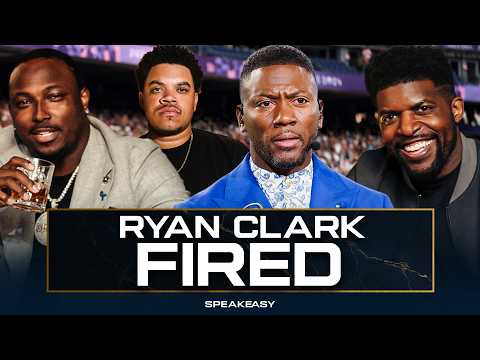
Ryan Clark's account of leaving ESPN is less focused on the mechanics of losing a television job than on his struggle to understand why excellence at that job was not enough to preserve it. He describes himself as blindsided but not entirely surprised, recalling signs that made him suspect his standing inside the company had deteriorated even as his football work continued receiving recognition. What makes the conversation compelling is that Clark does not pretend the experience left him with perfect certainty or uncomplicated defiance. He believes his willingness to speak publicly on issues affecting the Black community contributed substantially to his dismissal, yet he also admits he cannot prove that conclusion and wrestles openly with whether building different relationships or changing parts of his behavior might have produced another outcome.
Clark's case rests largely on a pattern he says became visible before his departure. He recalls an award-winning Monday Night Football piece involving Greg Brooks receiving little promotional attention, being excluded from a Family Feud appearance involving NFL Live colleagues, disappearing from Super Bowl-related promotion, and repeatedly failing to receive definitive answers about his future schedule. He also says Stephen A. Smith warned him that a particular executive did not like him and that another person inside ESPN told him his advocacy had created enemies at the executive level. These recollections explain why Clark interprets the firing as something planned rather than an ordinary reduction in staff, but they remain his account of internal events. No ESPN decision-maker appears to explain the company's reasoning, leaving the central question of why he was selected unresolved.
That evidentiary limitation becomes especially important when Clark argues that layoffs were used as camouflage for a decision to fire him. He points to the timing of his notification, says a story about his departure was going to appear before the broader layoffs, and believes its placement with OutKick was purposeful because he viewed the publication as hostile toward him. He connects this with an earlier article that he felt treated him more harshly than colleagues who had responded similarly to another controversy. The sequence clearly contributed to his belief that people inside ESPN were shaping a negative narrative around him, but the conversation cannot establish who leaked information, why it was leaked, whether the publication was deliberately chosen, or whether the layoff process was designed specifically to conceal his firing. The distinction between Clark's interpretation and independently demonstrated motive is essential.
The discussion of Peter Schrager provides the strongest example of Clark acknowledging where his own conduct may have contributed to tension. He recounts an on-air disagreement in which he tried to distinguish the perspective of someone who played professional football from someone who had not, while accepting that he may not have communicated that distinction properly. After Schrager objected, Clark says he walked away during the break and angrily told him not to disrespect him from a distance. Clark believes subsequent internal concern unfairly suggested he might become aggressive and says footage of the exchange was later leaked, which he interpreted through the stereotype of the “angry Black man.” At the same time, he emphasizes that he and Schrager spoke afterward, repaired the relationship, and worked together positively. That combination of accountability and disagreement is more persuasive than simply denying that anything happened.
Stephen A. Smith is treated with similar nuance. Clark rejects suggestions that Smith could have prevented the decision, arguing that influence and visibility do not make him an ESPN executive with final authority over employment decisions. More personally, Clark credits Smith with giving him additional television opportunities when he felt other parts of the network were reducing his role, and he describes their friendship and private disagreements as separate from public perceptions of their relationship. This section is useful because it pushes against an easy narrative in which prominent personalities must either control corporate decisions or be blamed for failing to stop them. Clark's version instead portrays Smith as an ally operating within limits.
The emotional center arrives when Clark considers whether he should have behaved differently. He says he already tried modifying himself, avoiding certain conflicts, meeting with executives, and asking what they needed from him beyond his performance as an analyst. Yet he also wonders whether he should have invested more heavily in internal relationships and acknowledges that, depending on when he is asked, he does have regrets. His earlier advice to Jeremy Lin becomes especially revealing: Clark says he warned that excellent work alone may not be sufficient, that relationships matter, and that people who publicly take unpopular social or political positions can create professional opposition. He nevertheless recognizes the alternative cost—being fired after suppressing what he believed would have been worse than losing the job while remaining recognizable to himself.
That tension gives weight to his statement that he loved both football broadcasting and his community. Clark does not portray the loss as financially catastrophic, explicitly contrasting his situation with employees who depended more immediately on ESPN to support their families. What hurts him is losing a career he expected to continue indefinitely, along with the routine of studying football, educating viewers, entertaining people, and working alongside colleagues he clearly values. His anticipation of watching the first games and pregame shows without participating is particularly effective because it moves the conversation away from corporate intrigue and toward the ordinary emotional consequence of suddenly being excluded from work that had become part of his identity.
The Pivot's personal setting makes that vulnerability possible, but it also limits the interview's ability to challenge Clark's interpretation. Channing Crowder and Fred Taylor repeatedly affirm his talent, character, and belief that racial dynamics influenced the decision, with Crowder introducing the historically charged analogy of “buck breaking” to suggest Clark was being made an example of for others. Clark says that could have been part of the situation while also acknowledging ESPN's right as a private company to make its own decisions. Because the hosts are close friends and collaborators rather than detached interviewers, allegations involving executive hostility, racial motivation, deliberate leaking, retaliation for advocacy, and coordinated narrative management receive little skeptical examination. That makes the episode powerful as Clark's personal testimony, but incomplete as an account of ESPN's motives.
Pros
- Clark provides specific incidents that explain why he came to believe his position at ESPN was deteriorating before his dismissal.
- His willingness to acknowledge possible mistakes in the Peter Schrager exchange adds credibility and complexity to an otherwise strongly critical account of ESPN.
- The discussion distinguishes Stephen A. Smith's personal support and influence from actual corporate authority over employment decisions.
- Clark openly admits that he cannot prove behaving differently would have saved his job, preventing his regrets from becoming a simplistic claim about what definitely caused the firing.
- His conflict between protecting a career he loved and continuing to advocate for issues important to him gives the conversation emotional depth beyond workplace grievance.
- Clark's concern for other laid-off employees and affection for former colleagues keep his criticism directed primarily toward the decision-making process rather than everyone associated with ESPN.
- The personal format captures the emotional consequences of unexpectedly losing work Clark expected to continue for the remainder of his broadcasting career.
Cons
- ESPN's decision-makers are not represented, so the conversation cannot establish the actual reasons Clark was selected for dismissal.
- Clark's belief that layoffs were used to camouflage a planned firing is central to his account but remains an interpretation rather than something demonstrated within the discussion.
- Claims that information was deliberately leaked to hostile media in order to damage Clark's reputation lack direct evidence identifying who leaked it or why.
- Assertions that Clark's racial advocacy and identity drove executive opposition are serious and receive little independent scrutiny from hosts who already strongly support his interpretation.
- Crowder's “buck breaking” analogy dramatically escalates the racial framing without evidence establishing that ESPN intended Clark's dismissal as a warning to other Black employees.
- The interview spends considerably more time developing Clark's explanation for the decision than considering plausible alternative reasons the company might give.
Clark's reflections are most compelling when he moves beyond trying to identify who wanted him gone and confronts what the loss means personally: he excelled at work he loved, tried to adapt when he sensed trouble, valued using his platform for his community, and still wonders whether different choices could have preserved his career at ESPN. His specific recollections make his suspicion of executive opposition understandable, but without the perspectives or evidence needed to establish corporate motive, the strongest allegations remain Clark's interpretation of events rather than settled explanation. As a candid account of professional rejection, identity, regret, loyalty, and the price of refusing to separate personal convictions from a public platform, the conversation is unusually revealing even when it cannot definitively answer why ESPN made its decision.