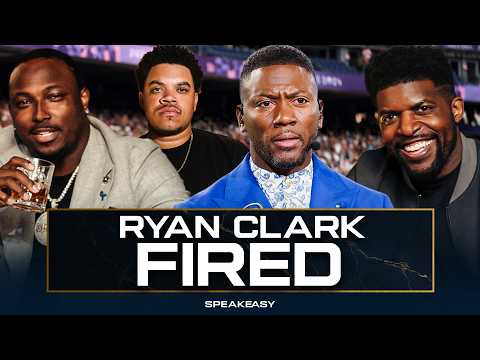
The opening argument has a potentially worthwhile media-industry question buried beneath its celebration of Ryan Clark’s reported departure: how much protection does association with a powerful television personality actually provide? The host uses Clark’s past defense of Stephen A. Smith to argue that Smith’s reputation for influence exceeds his real institutional leverage. That distinction between visibility and control is interesting, especially when contrasted with Pat McAfee’s independent production apparatus and ownership of his platform. The problem is that the video treats the circumstances of Clark’s firing, including the claim that he learned about it during a live broadcast, as settled fact without presenting evidence for that account.
The strongest section connects Clark’s situation to the broader lesson that media personalities should build audiences they control rather than assume a network relationship will last. Steve Kim makes this point clearly, noting that Clark and Cam Newton have independent platforms that give them somewhere to go after corporate television. Dre Baldwin similarly frames layoffs as partly an economic reality, while the panel discusses how expensive personalities can become obvious targets when companies reduce costs. Those observations give the conversation more substance than the host’s repeated insistence that Clark’s downfall represents poetic justice.
The critique of Stephen A. Smith is much less convincing because the video moves from observable outcomes to sweeping conclusions about his power and loyalty. Clark losing a job does not establish that Smith tried and failed to save him, that he possessed no meaningful influence, or that ESPN executives disregard him. The host also invokes Molly Qerim and Shannon Sharpe as evidence of a supposed pattern without establishing what role Smith played in their respective situations. The McAfee comparison illustrates a potentially important difference between an independently built business relationship and conventional on-air employment, but the claim that one man has genuine leverage while the other has merely “volume” is asserted far more confidently than the evidence shown supports.
Clark himself receives an intensely personal treatment. The panel is entitled to criticize his racial commentary, his disputes with Robert Griffin III, his political commentary, or any inconsistency they perceive in his analysis. Those are legitimate subjects for media criticism. But the monologue repeatedly crosses from evaluating his work into attacking his character, clothing, intelligence, emotional response to his son encountering alleged racism, and even the legitimacy of his Emmy recognition. Mocking a parent for becoming emotional while discussing a frightening experience involving his child is especially weak as an argument about professional credibility. It reveals the segment’s larger problem: resentment toward Clark frequently replaces analysis of what he actually said or why particular arguments were wrong.
The panel discussion is more balanced when the guests push beyond celebration. Baldwin notes that Clark will remain relevant through his own podcast rather than simply disappearing. Kim credits him for creating that independent safety net, and later discussions about Shannon Sharpe include genuine disagreement over whether returning to ESPN would make sense for either side. The participants also acknowledge uncertainty around possible staffing moves and debate the risks of rehiring a controversial personality. That willingness to disagree helps the show, although speculation about Sharpe, Skip Bayless, Super Bowl coverage, DEI considerations, and future ESPN personnel decisions accumulates without much supporting evidence.
The second half, concerning LeBron James and Tom Brady, drifts even further from grounded commentary. There is a reasonable topic underneath it: elite athletes can struggle with identity and purpose when decades of competition, structure, attention, and status end. Rashad Jennings offers the most measured contribution, drawing on his own NFL experience while explicitly acknowledging that he does not know James or Brady personally. The host instead makes definitive claims about their relationships with God, LeBron’s motives, Brady’s emotional state, their family dynamics, and why they pursue certain public opportunities. TJ Moe similarly speculates about “daddy issues,” divorce, relevance, and psychological needs. These interpretations may reflect the speakers’ worldview, but the video provides no basis for diagnosing the inner lives of people they do not know.
Presentation is energetic and confrontational, and the chemistry among the panelists keeps a very long episode moving better than its structure might suggest. There are useful stretches about post-career identity, independence from corporate media, and the difficulty athletes face when transitioning away from professional sports. Yet the episode repeatedly undercuts those insights with ridicule, broad ideological labeling, speculative motives, religious certainty about strangers, and jokes that dominate rather than sharpen the argument. Multiple advertisements, promotional transitions, extended tangents, and an abrupt pivot from ESPN personnel to athlete spirituality also make the program feel like two separate commentaries joined together rather than one disciplined examination.
Pros
- The distinction between public visibility and genuine institutional leverage creates a useful framework for discussing sports-media power.
- Steve Kim and Dre Baldwin offer practical observations about layoffs, expendability, and the value of building an independent platform.
- The panel contains meaningful disagreement over Shannon Sharpe, ESPN strategy, Pat McAfee, and post-network career options.
- Rashad Jennings brings welcome restraint to the athlete-transition discussion by separating personal experience from assumptions about people he does not know.
- The broader discussion of identity after professional sports raises a legitimate issue that deserves serious examination.
Cons
- The reported circumstances of Ryan Clark’s dismissal are treated as established without evidence being presented to substantiate the central narrative.
- Stephen A. Smith’s supposed lack of leverage and failures of loyalty are inferred from personnel outcomes without showing what influence he actually exercised.
- Criticism of Clark repeatedly becomes personal ridicule involving his intelligence, clothing, emotional response to his son’s experience, and awards rather than sustained analysis of his work.
- Speculation about future ESPN staffing, Shannon Sharpe, Skip Bayless, DEI strategy, and Super Bowl coverage often outruns the evidence available in the discussion.
- Claims about LeBron James and Tom Brady’s spirituality, psychology, family relationships, motives, and post-career fears are presented with far more certainty than the video can support.
- Advertising breaks, ideological tangents, repetition, and the lengthy shift into an unrelated athlete-purpose discussion weaken cohesion.
There is a worthwhile episode hidden inside this one about corporate media power, independent audiences, professional expendability, and the psychological challenge of life after elite sports, but its strongest ideas are repeatedly overwhelmed by celebration of another person’s misfortune, unsupported causal claims, personal attacks, and speculation about private motives. The panelists occasionally introduce nuance that improves the discussion, particularly around media economics and career transitions, yet the overall presentation favors certainty and provocation when a more disciplined separation of fact, interpretation, and personal judgment would have made the critique considerably stronger.