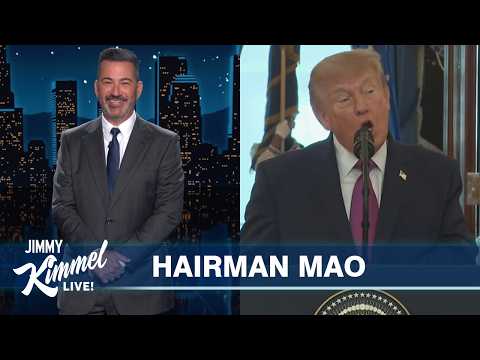
Donald Trump's potential meeting with North Korean leader Kim Jong Un provides Seth Meyers with an opening to ridicule the president's relationships with some of the world's most controversial leaders. With Trump also discussing meetings involving Chinese President Xi Jinping and Russian President Vladimir Putin, Meyers imagines a gathering that could include fictional villains such as Thanos and the Joker. The comparison is deliberately exaggerated, turning a diplomatic news item into a joke about the company Trump keeps. It is an entertaining opening that establishes the monologue's political tone, although the emphasis on punchlines leaves little room for examining the diplomatic implications of such meetings.
The political commentary becomes sharper when Meyers turns to Transportation Secretary Sean Duffy's refusal to apologize for a nationwide ground stop. Duffy's explanation that the problems were inherited from the previous administration receives a straightforward rebuttal from Meyers, who compares taking over government responsibilities to purchasing a fixer-upper and failing to make repairs. The analogy is accessible and delivers a recognizable criticism of political blame-shifting. Meyers also targets Trump's description of himself as someone who brings people together, an opinion piece calling for Commerce Secretary Howard Lutnick's dismissal, and reported restrictions imposed by White House Chief of Staff Stephen Miller. These jokes work through familiar political contradictions, but they remain comedic interpretations rather than detailed examinations of the underlying controversies.
Meyers broadens the monologue beyond Washington with jokes about an NFL quarterback appearing on The Bachelor, SpaceX's spacecraft recovery, an escaped emu in New Jersey, and a California ice cream theft. The variety helps prevent the political material from becoming monotonous, while the host's dry delivery gives even relatively minor stories a recognizable comic rhythm. A joke about Elon Musk's children and mechanical arms is particularly pointed, using the spacecraft recovery story to make a personal criticism of Musk's family relationships. Elsewhere, a survey suggesting that some people would unquestioningly accept reassuring health information from artificial intelligence introduces a potentially serious concern about misplaced technological trust, but the material moves quickly to an absurd punchline rather than exploring its consequences.
The extended "Getting to Know James Bond" segment shifts the presentation into a more structured comedy routine following the announcement about Robert Pattinson taking on the character. Meyers delivers a succession of deliberately ridiculous Bond facts, including a learner's permit to kill, anxiety about dressing too casually, and problems with spreadsheets removing the leading zeros from the agent's code name. The segment benefits from the contrast between the character's sophisticated reputation and the mundane situations invented for him. However, its rapid accumulation of jokes produces uneven results, with some observations offering clever reinterpretations of Bond conventions while others rely on familiar sexual humor or deliberately silly wordplay. The claimed casting announcement and franchise details serve as comedic premises rather than independently substantiated entertainment reporting.
The second major portion introduces "Jokes Seth Can't Tell," featuring writers Amber Ruffin and Jenny Hagel delivering punchlines that Meyers presents as unsuitable for him to perform. The segment has a stronger collaborative identity than the opening monologue because its comedy depends on the different perspectives of the performers and their interactions. Jokes involving racial assumptions, lesbian stereotypes, airline passengers, and cultural history are delivered through a format that openly acknowledges who is telling them. Ruffin's response to a joke about an artificial Black supporter in a political advertisement, including her explanation of the milk reference, demonstrates how the routine incorporates personal and cultural observations into its humor. The exchanges also allow Meyers to participate without monopolizing the material.
Jenny Hagel's repeated attempts to deliver jokes about Amelia Earhart becoming a lesbian icon create one of the presentation's most sustained comedic sequences. Rather than relying on a single punchline, the routine develops through multiple interpretations, increasingly provocative material, and Meyers' reactions. The progression gives the audience an opportunity to anticipate the next variation while the performers play with the discomfort generated by the jokes. Additional material about historic gay bars, racial discrimination, cannabis businesses, and LGBTQ landmarks blends cultural references with deliberately irreverent humor. Some jokes draw attention to historical prejudice, while others depend almost entirely on stereotypes or sexual innuendo, making the segment's effectiveness particularly dependent on the viewer's taste.
The overall presentation succeeds most clearly as a showcase for topical comedy and performer chemistry rather than sustained political analysis. Meyers moves confidently between national politics, entertainment, technology, and cultural observations, while the collaborative segment provides a welcome change from the conventional news-joke format. Nevertheless, the broad range of subjects creates a fragmented experience, and the headline involving Trump and Kim Jong Un represents only a small portion of the material. The political criticism is frequently amusing but generally one-sided, and several potentially consequential stories receive only enough context to support a punchline. Viewers seeking an entertaining late-night monologue will find plenty to enjoy, while those expecting a substantive examination of international diplomacy or government accountability may find the treatment superficial.
Pros
- Meyers uses Trump's potential diplomatic meetings to create an immediately recognizable and entertaining political opening.
- The fixer-upper analogy offers a concise and accessible criticism of Sean Duffy's explanation for the nationwide ground stop.
- The rapid movement between politics, entertainment, technology, and unusual news stories keeps the monologue varied.
- The James Bond segment finds humor in contrasting the character's sophisticated image with ordinary insecurities and absurd situations.
- Amber Ruffin and Jenny Hagel bring distinct comedic perspectives that make the collaborative segment feel different from a conventional monologue.
- The repeated Amelia Earhart jokes develop into an entertaining exchange through escalating punchlines and spontaneous reactions.
- The performers' comfortable chemistry allows awkward pauses, interruptions, and playful disagreements to become part of the comedy.
Cons
- The diplomatic opening offers little meaningful examination of what a possible Trump–Kim meeting could accomplish or imply.
- Several political criticisms rely on familiar characterizations rather than developing more substantial or surprising observations.
- The James Bond segment stretches its premise across numerous jokes of inconsistent originality and effectiveness.
- Some jokes depend heavily on sexual innuendo, personal attacks, or cultural stereotypes that may alienate viewers.
- The rapid transitions between unrelated stories occasionally make the presentation feel like a disconnected collection of punchlines.
- The headline emphasizes international diplomacy even though the majority of the material concerns unrelated comedy and entertainment.
Seth Meyers delivers an energetic collection of political satire, entertainment jokes, and boundary-pushing comedy that benefits from his confident timing and the lively contributions of Amber Ruffin and Jenny Hagel. The collaborative exchanges provide the most distinctive entertainment, while the opening political material offers accessible humor without much analytical depth. Although the uneven joke quality and reliance on provocative stereotypes occasionally undermine the writing, the presentation remains an enjoyable showcase of late-night comedy built around current events and performer chemistry.