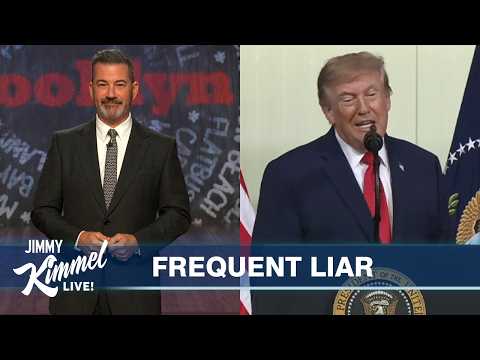
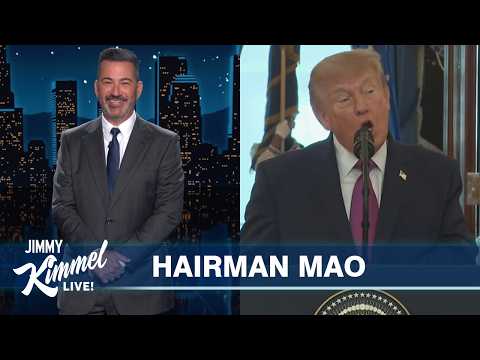
Donald Trump's repeated campaign promises to lower grocery prices, cut energy costs in half, and keep America out of new wars provide Seth Meyers with an extensive collection of political contradictions to examine. This installment of A Closer Look Back revisits those commitments alongside Trump's subsequent statements, economic reports, and developments involving the Middle East. Meyers argues that the administration has abandoned some of its most prominent election pledges while attempting to dismiss public frustration over affordability. The result is a sharply partisan but often entertaining examination of political accountability, built around the contrast between what voters were promised and what the administration has delivered.
The strongest material comes from the extensive collection of Trump's own campaign statements. Meyers repeatedly plays clips promising immediate reductions in grocery prices, gasoline below two dollars per gallon, and electricity costs falling by as much as 50%. These recordings establish that the promises were unusually specific and frequently accompanied by ambitious deadlines. Later clips show Trump acknowledging the difficulty of reversing price increases, questioning the emphasis on affordability, and defending his economic record. By placing these statements together, Meyers creates a persuasive illustration of the gap between campaign certainty and the complications of governing.
Affordability provides the foundation for some of the segment's most effective comedy. Trump's anecdote about an elderly woman returning an apple because she cannot afford three becomes an opportunity to question both the story's details and the administration's priorities. Meyers also ridicules Trump's repeated explanations of groceries, his excitement about taking Cheerios back to his cottage, and his suggestion that children do not need dozens of pencils. These jokes reinforce the broader portrayal of a wealthy president disconnected from ordinary household concerns. Some stretches, particularly the extended Cheerios and imaginary grocery-product routines, become so elaborate that they temporarily distract from the underlying economic argument.
The examination of energy prices adds greater substance through specific numerical claims and reported market conditions. Meyers challenges Trump's references to gasoline selling below two dollars per gallon by presenting a report indicating that only approximately 100 of 150,000 stations offered prices below that threshold, with the lowest state average closer to $2.40 at the time cited. He also highlights Trump's assertion that cheaper domestic energy would automatically reduce prices throughout the economy. The segment reasonably questions such a simplified relationship, particularly for internationally traded products, although it does not fully explore how energy costs influence transportation, production, and consumer prices. Its treatment of inflation also occasionally blurs the distinction between slowing price increases and actual price reductions.
The foreign-policy discussion broadens the criticism by contrasting Trump's repeated declarations that he would prevent new wars with the military escalation involving Iran described in the segment. Meyers uses campaign recordings presenting Trump as a candidate of peace, followed by remarks in which Trump disputes whether he ever guaranteed the absence of new wars. The reported disruption of oil markets gives this section an additional economic dimension, allowing Meyers to argue that foreign-policy decisions have compounded the affordability problems Trump promised to address. However, the presentation largely treats campaign promises as absolute guarantees without seriously examining the circumstances surrounding military decisions or the alternative arguments the administration might offer.
The supporting news clips and polling figures provide a useful counterweight to the comedy. Reports of annual inflation reaching 3.8%, economic disapproval ratings, and a CNN poll in which 77% of respondents said Trump's policies had increased their cost of living help establish that the criticism extends beyond Meyers' personal political perspective. The discussion of immigration enforcement, including the assertion that fewer than 14% of ICE arrests involved violent criminals, also challenges the administration's stated enforcement priorities. Nevertheless, the segment provides limited methodological context for its statistics, and polling about perceived economic conditions is not equivalent to independently demonstrating the causes of those conditions. The repeated sequences also create a somewhat fragmented structure, with several arguments and jokes revisited after their central points have already been established.
Pros
- Uses numerous recordings of Trump's campaign speeches to document specific promises concerning inflation, grocery prices, energy costs, and foreign wars.
- Effectively contrasts confident campaign declarations with later presidential statements acknowledging difficulties or questioning earlier priorities.
- Incorporates reported gasoline-price figures, inflation data, and public-opinion polling to support its political criticism.
- Connects rising energy costs and the reported Middle East conflict to the administration's broader economic commitments, creating a coherent argument about overlapping policy consequences.
- Delivers memorable observational comedy through the apple anecdote, grocery displays, Cheerios, pencils, and Trump's repeated references to affordability.
- Maintains a clear accountability-focused perspective by emphasizing what voters were explicitly told rather than relying entirely on general dissatisfaction with the administration.
Cons
- Repeated campaign montages and recurring grocery jokes become excessive, making portions of the presentation feel repetitive.
- Provides limited context for economic statistics and sometimes treats inflation rates, consumer prices, and individual product costs as interchangeable measures.
- Gives insufficient attention to alternative explanations for price movements, the complexities of international energy markets, or the administration's potential policy defenses.
- Presents the foreign-policy argument primarily through broken campaign promises without examining the strategic circumstances or competing interpretations surrounding the military conflict.
- Relies on strongly partisan language, personal ridicule, and occasional unsupported assertions that can weaken its credibility as a balanced political examination.
- Extended comedic tangents, including celebrity impressions and unrelated personal anecdotes, sometimes interrupt otherwise substantive criticism.
Seth Meyers delivers an energetic and frequently funny critique of the distance between Trump's campaign promises and his administration's reported performance, with the strongest evidence coming from the president's own repeated commitments. The combination of archival statements, economic reporting, and pointed humor makes the argument accessible, although repetitive editing, selective context, and an openly adversarial tone limit its analytical depth. As political satire focused on accountability, it succeeds more convincingly than it does as a comprehensive assessment of economic and foreign policy.