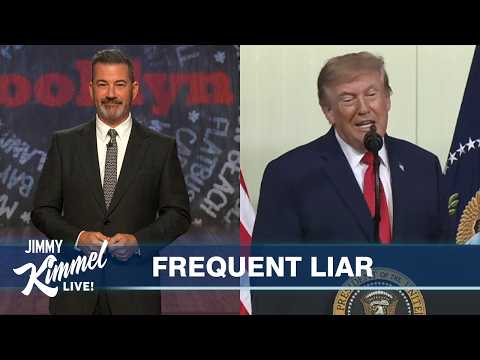
Donald Trump’s insistence that the country has the “best poverty numbers” becomes an efficient opening target for Seth Meyers, who contrasts the boast with Trump’s billionaire status and trip to a private golf event. The rapid-fire news monologue works best when Meyers notices small absurdities in Trump’s phrasing rather than trying to turn every headline into a larger argument. His joke that poverty figures should be described as “lowest” rather than “best” is particularly economical, while the reported mixed reception at the Tennessee-Texas football game supplies another setup for questioning the image of unwavering enthusiasm around the president. Contemporary reporting does confirm that boos were audible when Trump appeared on the stadium screen, although accounts differ over the balance between boos and cheers, making the segment’s simplified description less complete than the underlying event. People.com +1
Once “A Closer Look” begins, Meyers builds the segment around a more substantial contradiction: Trump repeatedly describes events as going extremely well while the clips Meyers selects suggest political and policy problems accumulating around him. The extended treatment of Xi Jinping’s visit is deliberately less concerned with diplomatic substance than with Trump’s wandering comments about how many days the meetings lasted, his ballroom tour and his fascination with granite. That provides some of the funniest material, especially the recurring “beautiful curtain” and granite jokes, but the repetition eventually becomes indulgent. The comedy establishes Trump’s unusual presentation effectively without demonstrating much about what was actually accomplished during the meetings.
The Iran discussion gives the segment considerably more weight. Meyers moves from Republican complaints about energy prices to House Republicans supporting a resolution seeking an end to the war and Republican candidates publicly calling for a quick conclusion. He then focuses on Trump’s rejection of an Iranian proposal involving reopening the Strait of Hormuz, asking why an apparent opportunity to achieve a stated U.S. objective would be rejected. Reporting supports the central factual premise that Trump rejected an Iranian ceasefire proposal that included reopening the Strait, while also noting that the administration was seeking a broader agreement involving Iran’s nuclear program—a significant piece of context Meyers’ comedic argument does not explore. Financial Times
That omission illustrates both the effectiveness and limitation of the format. Meyers is making political satire, not presenting a comprehensive foreign-policy analysis, and his argument is constructed from clips selected to maximize contradictions. His bedtime analogy turns the ceasefire issue into an immediately understandable joke, but it also makes a complicated negotiation sound considerably simpler than it is. The segment is strongest when viewers treat those jokes as criticism and commentary rather than as a complete explanation of U.S.-Iran diplomacy.
The political portion develops a clearer through-line by contrasting Republican rhetoric about becoming a working-class, anti-war party with dissent over the current conflict and its economic consequences. Meyers gets good mileage from mocking staged grocery-store campaign advertising, but the underlying point is more important than the joke: politicians who previously supported the conflict are now publicly distancing themselves from it while emphasizing fuel prices and living costs. Current polling does show substantial dissatisfaction with Trump over economic conditions, including especially weak ratings on the cost of living, so the segment’s broader focus on economic political pressure has supporting evidence beyond the clips it presents. AP News +1
The closing polling discussion is persuasive as evidence of declining enthusiasm but would benefit from more methodological context. Meyers highlights figures showing erosion in Trump’s Republican approval and especially strong approval, then frames that decline as evidence of “cracks” in his hold over the MAGA movement. Other recent polling likewise finds weakening Republican support, but different surveys produce different absolute numbers; Reuters/Ipsos, for example, recently measured Republican approval at 73%. Reuters Meyers wisely stops short of declaring the shift permanent, explicitly acknowledging that nobody knows whether it will last. That qualification makes the conclusion stronger than the more sweeping rhetoric surrounding it, and the final return to the granite joke neatly closes a segment that otherwise sprawls across diplomacy, war, energy prices, party identity and polling.
Pros
- Meyers builds a coherent theme around the contrast between Trump’s optimistic rhetoric and the political problems highlighted throughout the segment.
- The Iran section connects foreign policy, energy prices and Republican dissent rather than treating them as unrelated headlines.
- Recurring granite and ballroom jokes give the lengthy Xi discussion a recognizable comic structure.
- The segment acknowledges that declining Republican enthusiasm may not persist, adding an important qualification to its polling argument.
- Trump’s own remarks and Republican criticism provide concrete material for much of the satire rather than leaving the monologue dependent entirely on Meyers’ assertions.
Cons
- The Xi Jinping section spends so long on ballroom, granite and translation jokes that substantive questions about the meetings receive little attention.
- The treatment of Iran simplifies a complicated ceasefire proposal by focusing primarily on the Strait of Hormuz provision without discussing the administration’s stated desire for broader terms.
- Polling figures are presented with limited information about individual surveys, samples or differences between polls.
- The football-game joke reduces what reporting describes as a mixed crowd reaction to a cleaner booing narrative.
- Several recurring jokes continue beyond the point needed to establish their underlying criticism.
Meyers turns a collection of presidential remarks, Republican dissent and polling numbers into a focused piece of political satire about the widening gap between declarations of success and signs of public frustration. The sharpest jokes reinforce that theme, while the weaker passages simplify complicated diplomatic questions or stretch comic riffs longer than their substance warrants. As satire it is energetic and well constructed, but viewers looking for a complete account of the underlying policy disputes will need considerably more context.