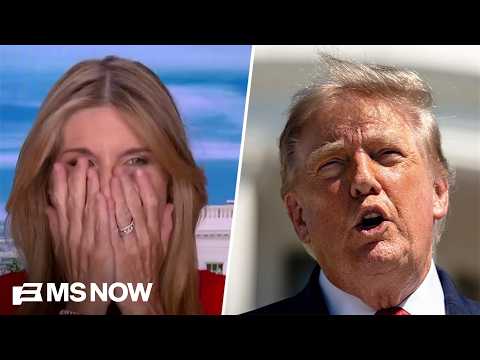
Donald Trump’s answers about the approaching midterm elections give the commentary an immediate focal point: his confidence that personal campaigning will help Republican candidates. The host contrasts that confidence with an unnamed Republican campaign source who reportedly rejected repeated offers for a Trump appearance, then highlights Trump’s reliance on Republican primary victories as evidence of his broader electoral value. That creates a coherent argument about the tension between Trump’s desire to participate and the concerns the program says some Republican campaigns have about his involvement.
The Time interview provides plenty of material for close examination, particularly Trump’s winding response about convention viewership and his examples involving Lindsey Graham’s sister, Ralph Norman and Thomas Massie. The host effectively points out that defeating Republicans in primary contests does not by itself demonstrate an ability to improve Republican performance in a general election. However, descriptions such as “Kuku Bananas,” “rambling incoherence” and “sleaze bag” commentary quoted from Trump establish a heavily adversarial tone, with the host frequently moving from analyzing Trump’s statements to ridiculing them.
The most consequential section concerns the claim that Trump consulted Elon Musk’s Grok chatbot about how Venezuelans might respond to the capture of Nicolás Maduro. The program attributes this account to Time and says officials described Trump as impressed by the chatbot’s response. Given the seriousness of using an AI system in discussions touching foreign policy or military action, this is an important subject, but the segment moves quickly from the reported anecdote to a sweeping characterization that Trump is allowing chatbots to “help and make decisions about which countries to attack.” The material presented supports scrutiny of how the tool was reportedly used, but not every implication the host attaches to it is independently demonstrated here.
Trump’s comments about AI data centers offer a clearer opportunity for policy criticism. His statement that he wants data centers in the country but not necessarily next to his own home is juxtaposed with the host’s observation that communities may have similar objections. That contradiction is easy to understand, although the discussion would be stronger with more detail about the specific reasons communities are protesting, rather than treating opposition primarily as an electoral liability.
The Iran-war exchange is the strongest piece of evidence-based rebuttal in the segment. Trump is shown disputing the suggestion that Americans heard a roughly four-to-six-week timeline and blaming the press for creating that impression. The program then plays several statements explicitly describing four-to-six-week estimates, directly challenging his characterization with relevant clips. Those excerpts do not resolve every question about how the military operation evolved or why its duration changed, but they give viewers concrete evidence with which to assess this particular dispute.
The closing material shifts toward personality and hypocrisy, contrasting Trump’s concern about preserving the Oval Office with the host’s description of changes elsewhere at the White House and mocking his decorative choices. His complaint that the interviewer had not asked a positive question also supports the broader theme that he remains willing to engage extensively with media outlets he criticizes. The final argument—that his appetite for attention creates political problems for his party—is presented forcefully, but it remains the host’s political interpretation rather than a conclusion established solely by the interview excerpts. A closing membership promotion is brief but still interrupts what otherwise functions as a tightly focused commentary segment.
Pros
- The Iran-war section directly compares Trump’s claim about the press with multiple earlier statements describing a four-to-six-week timeline.
- Trump’s extended interview answers are presented in enough detail for viewers to understand what the host is criticizing.
- The distinction between success in Republican primaries and effectiveness in a general election is clearly explained.
- The reported Grok consultation raises a substantive question about the role of AI tools in high-level government decision-making.
- The segment maintains a clear thematic focus on how Trump’s public statements could create difficulties for Republican candidates.
Cons
- Sarcasm and openly hostile characterizations frequently blur the line between analysis and partisan advocacy.
- The Grok discussion expands a reported consultation into a broader claim about AI helping determine which countries to attack without establishing that full characterization.
- The data-center discussion emphasizes political contradiction while providing little substantive context about the underlying community objections.
- Several predictions about how Trump’s remarks will affect Republican campaigns are asserted more confidently than the evidence presented supports.
- Mockery of Oval Office décor contributes little to the more consequential arguments about elections, war and technology.
The commentary is most persuasive when it puts Trump’s statements beside specific contradictory material, particularly in the dispute over the Iran-war timeline. Its energetic presentation and well-chosen interview excerpts make the argument easy to follow, but partisan framing, speculative electoral implications and occasional overstatement weaken the distinction between documented contradiction and political interpretation.