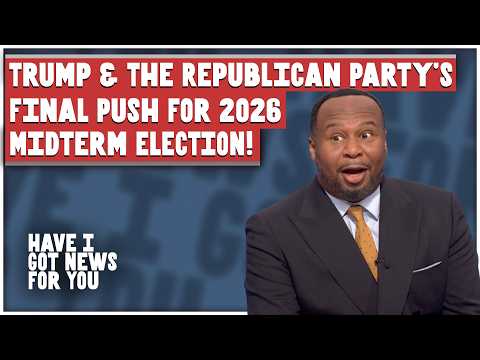
Canada’s proposed use of retaliatory tariffs is presented as something more calculated than a generic response to American trade policy: the central argument is that specific products can be chosen because their economic footprint overlaps politically competitive states and districts. Harvesting machinery becomes the clearest example, with the discussion connecting John Deere production to Iowa and then connecting Iowa to competitive 2026 races. That geographic framing gives the argument a concrete structure instead of treating tariffs as an abstract national economic fight.
The most substantive section examines whether trade retaliation can actually translate into electoral consequences. The host cites research that he says examined areas exposed to retaliation during Trump’s first-term trade disputes and found declining support for Republican House candidates, including an estimate that Republicans would have lost 10 fewer seats without the trade war. That historical comparison is important to the video’s thesis, but viewers are given only a summary of the research rather than its methodology, assumptions, or competing explanations for those election results. The evidence therefore supports a plausible mechanism within the presentation without establishing that Canadian retaliation will produce comparable results in 2026.
The discussion also acknowledges a major complication that could easily have been ignored: tariffs aimed at politically sensitive regions might produce the opposite reaction. The host notes that voters who already view Canada negatively could interpret retaliation as further reason to support Trump and Republicans. He also concedes that tariffs may have little electoral effect amid the many other issues influencing a midterm election. Those qualifications make the analysis more credible than the emphatic framing sometimes suggests, because economic exposure and voting behavior are not treated as perfectly interchangeable.
Presentation is where the piece becomes much more uneven. Elliott Morgan uses jokes, exaggerated analogies, quick clips, self-deprecation and deliberately over-the-top language to keep an economic and electoral-policy discussion moving at an energetic pace. Some humor effectively translates dry subjects such as geographically targeted tariffs into something accessible, but the frequency of punchlines also competes with the analysis. Several passages move from explaining possible economic pressure to mocking Trump or Republican voters rather than developing the underlying trade argument.
That tonal problem becomes especially pronounced when the commentary turns to Trump personally. Morgan reacts to Trump’s speaking appearance with speculation about his physical condition and makes repeated jokes about death and a “forever nap.” Whatever the intended comedic effect, those remarks do not contribute evidence about tariffs, Canadian strategy or the midterms. They also shift attention away from the stronger question the video had established: whether economic retaliation concentrated in electorally competitive areas can measurably alter political incentives.
The political conclusions are similarly more confident in places than the evidence presented can sustain. Clips from Canadian commentators provide sharply critical assessments of the Trump administration, while claims about worsening material conditions, voter motivation and Republican enthusiasm receive comparatively little supporting detail. The video is more persuasive when it maps an explicit chain—Canadian product selection, American production locations, competitive elections and historical tariff research—than when it broadens into sweeping judgments about Trump, Republicans or American voters.
Pros
- Connecting specific tariff targets to manufacturing locations and competitive races makes the central political strategy easy to understand.
- The first-term tariff comparison gives the electoral argument some historical grounding rather than relying entirely on speculation.
- The host explicitly considers both backlash against Republicans and the possibility that Canadian retaliation could strengthen pro-Trump sentiment.
- Fast pacing, humor and concrete examples make a potentially dry trade-policy subject accessible.
Cons
- The cited research is summarized without enough methodological detail to judge how strongly it supports predictions about the 2026 midterms.
- Personal mockery of Trump, including speculation about his condition and jokes about his death, distracts from the trade-policy analysis.
- Several broad claims about voters, economic conditions and political motivation receive less evidence than the more carefully developed tariff argument.
- The partisan comedic framing sometimes makes tentative electoral possibilities sound more settled than the analysis actually demonstrates.
The targeted-retaliation argument provides a useful framework for understanding how trade policy can be designed with domestic American politics in mind, particularly when paired with the historical comparison to earlier tariff disputes. Its analytical value is diminished by personal attacks, limited examination of the cited research and a tone that sometimes substitutes partisan certainty for evidence, but the acknowledgment of possible backlash keeps the central argument from becoming entirely one-sided.