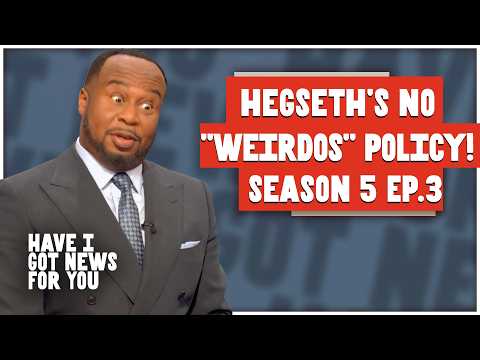
With the midterm elections approaching, President Donald Trump's campaign appearances, Republican concerns about voter turnout, and an unusual controversy involving the Cheesecake Factory provide plenty of material for Have I Got News for You. Roy Wood Jr. leads a lively panel discussion that mixes political criticism with absurd humor, frequently shifting between serious electoral questions and ridiculous public statements. Guests David Alan Grier and Sam Jay contribute to an energetic exchange that rarely allows the conversation to become overly formal. The result is an entertaining examination of American politics that prioritizes comedic reactions while occasionally revealing legitimate concerns about campaign strategies and election integrity.
The opening discussion focuses on Trump's campaign rallies and the growing importance of affordability among voters. The panel contrasts concerns about grocery prices and gasoline costs with Trump's comments about political supporters and his boasts about economic prosperity. Jokes about his remarks concerning Nikki Minaj's appearance establish the irreverent tone, while the broader discussion suggests that the president's messaging may be disconnected from voters' financial frustrations. The humor works particularly well when the participants highlight the contrast between everyday economic pressures and political spectacle. However, assertions about declining rally attendance, Republican anxiety, and changing voter preferences receive relatively little supporting evidence beyond the clips and commentary presented.
The Cheesecake Factory controversy becomes the episode's most entertaining recurring storyline. Barack Obama's comparison of Trump's White House renovations to a Cheesecake Factory supposedly opened by Saddam Hussein sparks an unexpectedly passionate debate about the restaurant's reputation, interior design, and whether the joke carries an elitist undertone. Sam Jay's defense of the restaurant creates an amusing disagreement with the other participants, demonstrating how an apparently trivial subject can generate spontaneous comedy. The discussion becomes even more ridiculous when the panel examines Republican reactions, including White House praise for the restaurant's architecture and Treasury Secretary Scott Bessent's reported visit. The absurdity of political figures treating a restaurant comparison as a major controversy provides some of the episode's sharpest satire.
The conversation also explores Trump's sensitivity to criticism from Obama, particularly regarding the White House's appearance and maintenance. The panel mocks Trump's comments about cleanliness, with comparisons to an irritated Airbnb owner and jokes about his background as a landlord. These exchanges are funny because they transform political grievances into recognizable personality traits and everyday situations. The discussion of canceled and subsequently reinstated campaign rallies adds another opportunity to question Republican confidence heading into the election. Nevertheless, the panel's overwhelmingly critical perspective on Trump occasionally substitutes speculation about his motivations and political standing for more substantive examination of the available information.
The Alaska Senate race introduces a more consequential controversy involving incumbent Republican Dan Sullivan and another candidate named Daniel Sullivan. According to the discussion, reports suggested that Democrats helped recruit the similarly named candidate, potentially confusing voters or drawing support away from the incumbent. The panel explains that Alaska's Supreme Court allowed the candidacy while acknowledging the questionable political implications. Particularly effective is the disagreement over whether Democrats should embrace aggressive tactics when Republicans have employed controversial strategies themselves. Some participants defend fighting political hardball with similar methods, while others argue that deliberately exploiting voter confusion undermines electoral integrity. This exchange provides a welcome moment of genuine disagreement, although the reported recruitment allegations remain disputed within the discussion and should not be treated as conclusively established.
Concerns about accepting election results and shifting voter coalitions give the final political segments a more serious foundation. The panel considers Democratic warnings that Trump might challenge unfavorable midterm outcomes, with participants anticipating legal disputes rather than confidently predicting another January 6-style confrontation. The discussion also emphasizes voter participation and suggests that a decisive result would be harder to contest than a narrow victory. Attention then turns to Latino voters and predictions of a possible Democratic surge, including an awkwardly phrased television comment about a "brown tsunami." The panel's reactions generate laughs, but the segment offers limited polling context to substantiate claims about changing political loyalties. A closing clip featuring a Trump supporter referencing the Jonestown massacre delivers a bizarre final punchline, though the comparison to cult behavior is played primarily for shock and comedy rather than deeper analysis.
Roy Wood Jr.'s hosting is central to keeping the program moving, particularly through his rapid-fire questions, pointed setups, and willingness to let the guests challenge one another. Grier's animated reactions and Jay's unapologetic opinions complement the host's delivery, creating an atmosphere that feels more conversational than rehearsed. The recurring Cheesecake Factory references provide welcome continuity between otherwise disconnected political stories, while the combination of news clips and panel responses gives the satire a clear structure. At times, however, the reliance on profanity, exaggerated insults, and predictable anti-Trump punchlines weakens the sharper observations. The episode succeeds as topical entertainment, but its political commentary is most convincing when it examines competing arguments rather than simply inviting the audience to laugh at familiar targets.
Pros
- Roy Wood Jr.'s confident hosting, quick questions, and sharp comedic timing keep the political discussion energetic and engaging.
- David Alan Grier and Sam Jay contribute distinct personalities, spontaneous reactions, and entertaining disagreements that strengthen the panel dynamic.
- The Cheesecake Factory controversy provides an especially funny recurring storyline, turning a minor political dispute into effective satire about image, class, and presidential priorities.
- The Alaska Senate race discussion raises meaningful questions about electoral ethics, strategic manipulation, and the difference between legally permissible conduct and responsible campaigning.
- Clever use of political news clips gives the comedians concrete material to react to rather than relying exclusively on prepared political jokes.
- The discussion successfully connects economic concerns, election disputes, and voter participation to the broader atmosphere surrounding the midterms.
Cons
- The predominantly anti-Trump perspective sometimes produces predictable jokes and leaves limited room for alternative interpretations of political events.
- Claims about declining rally attendance, Republican electoral difficulties, and shifting Latino voter preferences receive insufficient supporting data or detailed context.
- Some speculation about Trump's motivations and potential election challenges is presented through comedic interpretation rather than substantiated analysis.
- Frequent profanity, crude humor, and exaggerated personal insults occasionally overshadow more insightful political observations.
- Rapid transitions between serious election-integrity concerns and absurd punchlines sometimes prevent important issues from receiving meaningful examination.
Roy Wood Jr. and his guests deliver an entertaining installment of political satire that finds genuine comedy in campaign controversies, questionable election tactics, and an unexpectedly passionate argument about restaurant decor. Although the show's partisan perspective, occasional reliance on crude humor, and limited factual examination reduce its value as comprehensive political analysis, the lively panel chemistry and willingness to debate electoral ethics give the comedy substance beyond its punchlines. It works best as an amusing, opinionated reflection of America's increasingly theatrical political environment rather than a balanced guide to the approaching elections.