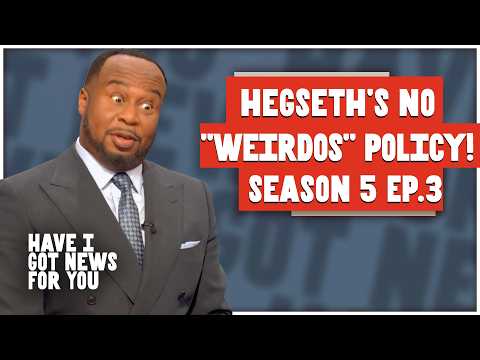
Mike Rogers defending his position on Canadian tariffs, Susan Collins confronting a decades-old campaign promise, and Mike Collins facing questions about white nationalism provide plenty of material for Roy Wood Jr. and his comedy panel. This installment of Have I Got News for You examines Republican vulnerabilities ahead of the midterm elections through debate clips, campaign advertisements, and increasingly uncomfortable political exchanges. With comedians Amber Ruffin, Rosebud Baker, and Michael Colyar contributing jokes and observations, the discussion combines legitimate questions about political accountability with the show's familiar mixture of improvisation, sarcasm, and partisan ridicule.
The Michigan Senate contest between Democrat Abdul El-Sayed and Republican Mike Rogers supplies some of the liveliest material. Rogers' campaign advertisement criticizing Canadian tariffs becomes particularly interesting when the program contrasts it with his earlier promotion of Trump's tariff policies. That comparison gives the comedy a substantive foundation, highlighting an apparent change in political messaging rather than relying entirely on personal insults. El-Sayed's accusations about Rogers' polling difficulties and the candidates' exchange of increasingly pointed terms of address provide additional opportunities for humor. The panel's fascination with phrases such as "my guy" and "brother" occasionally stretches the joke beyond its natural lifespan, but the underlying political contradiction remains worth examining.
Georgia's Senate debate introduces considerably more serious subject matter as Democrat Jon Ossoff challenges Republican Mike Collins over alleged associations with white nationalist figures and the circulation of extremist content. The program presents Ossoff's accusations alongside Collins' response condemning racism, antisemitism, and hatred. Including both exchanges allows viewers to hear the confrontation rather than relying exclusively on the panel's characterization. However, the discussion quickly moves toward jokes about Collins' accent and speculative interpretations of his remarks. Those reactions may entertain an audience already familiar with the controversy, but the segment provides limited independent context for assessing the allegations or determining the significance of Collins' response.
The Maine Senate race produces one of the clearest examples of political inconsistency. Susan Collins' current opposition to congressional term limits is contrasted with footage from her original 1996 campaign, when she explicitly promised to serve only two terms. The archival statement gives the criticism unusual clarity because viewers can compare her positions directly without depending on the comedians' interpretations. Her evasive response to questions about appearing alongside Trump also fits the program's broader theme of Republican candidates attempting to manage their relationships with the president. The jokes about Collins' speaking style and longevity are less substantial, but the historical comparison makes this section particularly effective.
Elsewhere, the program moves rapidly through Republican dissatisfaction in Florida, a Ken Paxton campaign advertisement in Texas, and Trump's encouragement for voters to behave as though he personally appears on the ballot. Paxton's slogan about removing missing-person posters provides an especially awkward piece of campaign language for the panel to dissect, while Trump's lengthy diversion into the structural safety of a rally screen illustrates the unpredictable speaking style that frequently fuels political comedy. These segments maintain variety and momentum, although some are too brief to establish much beyond the immediate punchline. Claims about Republican electoral weakness, enormous advertising expenditures, and an impending Democratic wave receive little supporting analysis, leaving the broader election forecast more suggestive than demonstrated.
Roy Wood Jr. handles the shifting material with an energetic quiz-show approach, inviting the guests to guess the subjects of political clips before revealing the answers. The format encourages spontaneous exchanges, and the panel's exaggerated guesses often create entertaining contrasts with the actual political developments. Ruffin's sharp reactions, Baker's provocative observations, and Colyar's playful contributions give the discussion several distinct comedic voices. Nevertheless, the constant movement between serious accusations and broad jokes sometimes produces tonal discomfort. The closing exchange about Trump's remarks concerning Los Angeles and San Diego is especially confrontational, ending with an angry response rather than a deeper examination of the statement's meaning or context.
Ultimately, the program works better as a satirical roundup of campaign contradictions than as a comprehensive assessment of the midterm elections. Its most persuasive moments involve directly comparable political statements, particularly Rogers' changing tariff rhetoric and Collins' abandoned term-limit pledge. Its weaker moments depend on unverified electoral predictions, exaggerated characterizations, and jokes that presume agreement with the panel's political perspective. The entertainment remains lively and frequently pointed, but viewers looking for detailed electoral analysis or a broader range of political interpretations will find the coverage limited.
Pros
- The comparison between Mike Rogers' earlier support for Trump's tariffs and his current campaign messaging provides a concrete example of political inconsistency.
- Susan Collins' original term-limit promise, contrasted with her present opposition, offers particularly effective archival evidence for the program's criticism.
- The Georgia debate clips present both Jon Ossoff's accusations and Mike Collins' response, giving viewers direct examples of the confrontation.
- Roy Wood Jr.'s quiz-show presentation and the panel's spontaneous exchanges maintain an energetic, accessible comedic atmosphere.
- Campaign advertisements, debate confrontations, and presidential remarks provide varied material that keeps the political roundup engaging.
- The discussion effectively illustrates how Republican candidates are navigating the political complications of their relationships with Trump.
Cons
- Predictions of a Republican electoral collapse receive insufficient polling evidence or contextual analysis to establish their credibility.
- Serious allegations involving white nationalism are followed by broad jokes that sometimes undermine the gravity of the subject.
- Several jokes about politicians' accents, appearances, and verbal habits add little beyond familiar personal ridicule.
- The rapid movement between states limits meaningful examination of individual races, candidate positions, and voter concerns.
- The predominantly anti-Republican perspective leaves little room for competing interpretations of the political developments presented.
Roy Wood Jr. and his panel deliver an entertaining political comedy roundup that finds its best material in candidates' conflicting statements, awkward campaign advertisements, and contentious debate exchanges. The combination of archival footage, spontaneous humor, and recognizable political personalities makes the discussion accessible, although its electoral predictions and more serious accusations deserve greater scrutiny. Despite uneven depth and occasional reliance on easy ridicule, the program succeeds as lively midterm satire with several genuinely revealing moments.