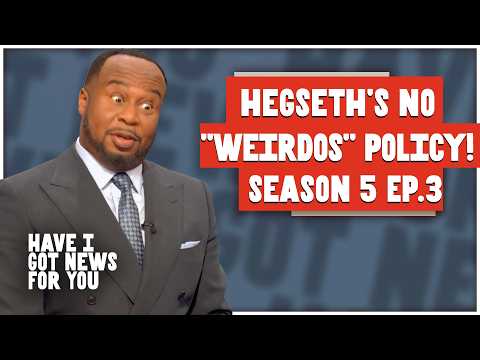
JD Vance's attempt to soften his rhetoric toward immigrants becomes an immediate target for Jon Stewart, who contrasts the vice president's conciliatory remarks at a Michigan town hall with his subsequent comments about riots in France. Stewart uses the contradiction to launch a broader examination of political scapegoating, rising energy prices, and the Trump administration's foreign policy decisions. What follows is an extended collection of political comedy segments featuring Stewart, Michael Kosta, and Ronny Chieng, each approaching the increasingly chaotic midterm election season with a different comedic style. The result is energetic, frequently hilarious, and occasionally more interested in delivering a devastating punchline than establishing a fully supported argument.
Stewart's examination of the French unrest provides one of the strongest sequences. He challenges Vance's suggestion that immigration explains the demonstrations by pointing to France's long history of revolution and protest, including a reference to the storming of the Bastille. The historical comparisons are exaggerated for comedic effect, but they effectively expose the weakness of attributing complex domestic unrest to immigrants without adequate evidence. Stewart also connects the demonstrations to concerns about fuel prices and living costs, using Emmanuel Macron's attendance at a Celine Dion concert as an absurd contrast to the seriousness of the situation. The jokes are memorable, although the treatment of the unrest leaves limited room for examining the protesters' specific grievances or the French government's response.
The discussion of Russia, Ukraine, and energy policy gives Stewart considerably more substantive material. He questions the administration's explanation of rising diesel prices, contrasts recently announced sanctions against Russian oil sales with a subsequent diesel arrangement, and challenges the argument that encouraging Russian exports would simultaneously pressure Moscow to reduce its military operations. The strongest criticism concerns the apparent inconsistency between restricting Russian energy revenues and pursuing an agreement that Stewart says could financially benefit Russia. His use of an energy-price chart and clips of administration officials helps give the segment an identifiable argumentative foundation. However, the presentation does not independently establish the precise economic effects of the proposed arrangement, and assertions about its potential financial benefits to Russia remain dependent on the reporting and interpretations presented. A brief reference to restrictions affecting Ukrainian satellite communications introduces another serious issue without developing it sufficiently.
Michael Kosta shifts the focus toward the approaching midterms, where bizarre campaign tactics and uncomfortable political interviews provide abundant comedic opportunities. His reaction to an advertisement featuring Amy Acton's estranged mother criticizing her daughter turns a deeply personal political attack into a sequence of increasingly ridiculous family jokes. The interview with Indiana candidate Jamie West is another standout, particularly Kosta's reactions to her disorganized answers and surprisingly specific discussion of neighboring county tax rates. His delivery works because he alternates between disbelief and unexpected admiration, preventing the segment from becoming a repetitive exercise in ridicule. Still, his assumption that West is intoxicated is presented with more confidence than the material establishes, illustrating how quickly observational comedy can turn speculation into an apparent conclusion.
Kosta's examination of Donald Trump's repeated compliments about male politicians introduces a lighter, more personality-driven form of satire. Trump's descriptions of candidates' appearances, including his unusually detailed appreciation of an Ohio senator's physique, provide the foundation for jokes about aging, attraction, and the president's tendency to wander away from conventional campaign messaging. Kosta makes the repetition work through escalating absurdity, but the material eventually becomes somewhat predictable. Ronny Chieng subsequently delivers a sharper sequence built around Vance's awkward interview responses, allegations involving a presidential pardon, and Pete Hegseth's abandoned proposal to livestream a military execution. The execution discussion is particularly effective because Chieng moves beyond mocking personalities to question the judgment behind turning capital punishment into public entertainment. His treatment of the pardon controversy is more problematic, however, because the timing of a reported financial arrangement is used to suggest corruption without establishing a proven exchange of favors.
The final stretch returns to the midterm elections, with Chieng examining increasingly competitive Senate contests and the peculiar strategies candidates are using to gain an advantage. His discussion of Michigan's Abdul El-Sayed and Mike Rogers highlights the inflammatory nature of allegations involving extremism, while the Mississippi segment finds humor in a Republican stronghold becoming potentially competitive. Importantly, the presentation acknowledges that moving a race from solid Republican to likely Republican is not the same as predicting a Democratic victory. Trump's campaign remarks about renaming bodies of water provide another opportunity to contrast political spectacle with voters' economic concerns. The Maine discussion involving Susan Collins and Troy Jackson closes on an especially crude note, using an unusual family relationship and a deliberately outrageous fictional campaign advertisement to illustrate how personal political attacks can overwhelm substantive debate.
Across the compilation, the differences between the three comedians help sustain interest despite the considerable volume of material. Stewart is strongest when identifying contradictions in government policy, Kosta excels at reacting to awkward human behavior, and Chieng delivers his most effective jokes through blunt disbelief and rapid escalation. News footage, interview excerpts, running callbacks, and physical comedy give the segments a varied rhythm, while the occasional acknowledgment of uncertainty prevents the presentation from becoming entirely one-dimensional. Nevertheless, the collection has noticeable weaknesses. Several jokes revisit similar themes about Trump's personality, some allegations receive insufficient evidentiary context, and the frequent reliance on profanity, sexual humor, and extreme comparisons can distract from otherwise worthwhile political criticism. The compilation also lacks a unified narrative beyond the broader theme of political dysfunction, making it feel more like an extended showcase of individual routines than a cohesive examination of the election season.
Pros
- Stewart's comparison of Vance's remarks about immigrants with his subsequent commentary on France creates a clear and effective example of political inconsistency.
- The examination of Russian diesel sales, sanctions, and the Ukraine conflict raises substantive questions about competing administration priorities.
- Kosta's reactions to the Ohio campaign advertisement and Indiana candidate interview turn unusually revealing political moments into entertaining comedy.
- Chieng's treatment of the proposed public execution combines sharp satire with meaningful questions about government judgment and public spectacle.
- The three comedians offer complementary performance styles, helping maintain momentum throughout the lengthy compilation.
- Extensive use of political speeches, interviews, and news excerpts gives many jokes recognizable foundations rather than relying entirely on invented scenarios.
- The midterm coverage provides a broad look at political tactics, including personal attacks, inflammatory accusations, and increasingly competitive races.
Cons
- Several serious political and financial allegations receive insufficient supporting context to distinguish suspicion from established wrongdoing.
- Kosta's characterization of the Indiana candidate as intoxicated goes beyond what her unusual interview responses independently prove.
- Repeated jokes about Trump's attraction to male politicians become predictable and consume time that could have supported more substantive election analysis.
- Crude sexual references, profanity, and deliberately offensive comparisons occasionally overwhelm the underlying political arguments.
- Complex topics involving French unrest, international energy markets, and Ukrainian military communications receive abbreviated treatment.
- The compilation's sprawling structure and limited transitions weaken its overall cohesion.
Stewart, Kosta, and Chieng deliver a lively and often exceptionally funny collection of political satire, with their strongest moments exposing contradictions, questionable decisions, and the increasingly personal nature of election campaigning. The performances are consistently engaging, but uneven evidentiary depth, repetitive humor, and occasional overreliance on ridicule prevent the political analysis from matching the comedy's effectiveness. As an entertaining examination of contemporary political absurdity, the compilation succeeds comfortably, even when its sharper observations deserve more careful development.