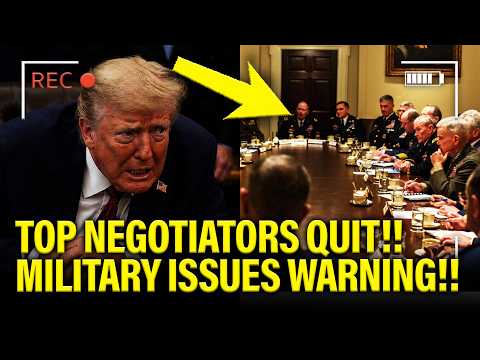
Reports of depleted Patriot interceptors and formal objections from senior military commanders give the discussion a concrete strategic concern: whether sustained operations against Iran are consuming resources the United States may need elsewhere. The hosts build their case around reporting attributed to the Wall Street Journal, Washington Post and Reuters, arguing that military leaders warned about ammunition shortages before hostilities and are now increasingly concerned about readiness for potential crises involving China or Russia. That is a substantially more consequential argument than a generic dispute over whether the administration's foreign policy is succeeding.
The most useful material concerns the reported military assessments themselves. The discussion says Army, Navy and Air Force leaders, along with four-star commanders responsible for Europe, the Indo-Pacific and Latin America, participated in an assessment, with several registering formal non-concurrences over extending Middle East force commitments. Particularly striking is the reported description of inventories of PAC-3 Patriot interceptors and surface-to-surface missiles in Europe as "beyond critical." The hosts also note the Pentagon's counterpoint that the United States remains capable of meeting its defense obligations, an important qualification that prevents the segment from presenting the bleakest assessment as uncontested institutional fact.
Where the presentation becomes less disciplined is in moving from reported concerns to confident conclusions about American vulnerability. Claims that more than 100 Patriot interceptors were probably expended in a recent engagement, that Iran may deliberately have used older missiles to exhaust American stocks, and that the war has left the country "deeply vulnerable" carry major implications, yet the segment does not provide enough supporting detail to let viewers independently assess them. Some are explicitly presented as estimates or speculation, but the surrounding commentary often gives uncertain assessments the rhetorical force of established conclusions.
The Taiwan dimension considerably raises the stakes. According to the account presented here, some officials believe the United States could not fully execute contingency plans for defending Taiwan if China acted in the near term, while Indo-Pacific allies are becoming concerned about dwindling missile and air-defense inventories. The reference to retired Marine Colonel Mark Cancian and his Taiwan war-gaming experience adds a relevant expert perspective about overlap between requirements in Iran and the Western Pacific. Still, because viewers are receiving summaries of classified or anonymously sourced assessments rather than the underlying readiness data, the precise extent of any capability gap remains impossible to determine from the material presented.
There is also an interesting institutional story underneath the ammunition numbers. The hosts emphasize that disagreement within the military is not inherently unusual; what they find remarkable is the apparent extent of the objections and the fact that information about them reached the press. That distinction makes the segment more thoughtful than its sensational "final notice" packaging suggests. At the same time, assertions about Hegseth having purged dissenting voices and speculation that somebody in his office deliberately wanted the assessment public receive little development, leaving motives behind the leaks considerably less established than the discussion sometimes implies.
Politically, the commentary is unmistakably adversarial toward Trump and Hegseth. The strongest criticism does not require that tone: if weapons earmarked for other theaters really are being redirected to an extended Middle East campaign, and replenishment could take years, the readiness tradeoffs deserve scrutiny regardless of political affiliation. Repeated descriptions of chaos, dysfunction, a badly failed war and self-inflicted vulnerability make the hosts' position abundantly clear, but they also blur the boundary between reporting what military officials allegedly concluded and the panel's broader judgment of the administration. More sustained engagement with the Pentagon's assurance of continued defense capability would have produced a better test of the central argument.
The closing observation that "peace through strength" becomes harder to sustain politically while scarce weapons are being consumed is an effective way to connect military logistics with the administration's stated foreign-policy posture. Unfortunately, the abrupt pivot into promotion for the hosts' book reinforces the partisan-media atmosphere immediately after a discussion of potentially grave national-security concerns. The underlying readiness questions are important enough that they would benefit from fewer sweeping declarations, clearer sourcing for numerical claims and more separation between documented military objections, anonymous assessments, informed speculation and political interpretation.
Pros
- Specific discussion of Patriot interceptors, missile inventories, formal non-concurrences and competing theater requirements gives the readiness argument meaningful substance.
- The segment draws an important distinction between ordinary internal military disagreement and the unusual significance it assigns to these objections becoming public.
- Including the Pentagon's position that the United States remains capable of meeting its defense obligations provides at least one significant counterweight to the hosts' argument.
- Connecting Middle East expenditures with possible European and Indo-Pacific requirements clearly explains why ammunition depletion could have consequences beyond Iran.
Cons
- Several consequential claims about expenditure levels, Iranian strategy and the degree of American vulnerability are not supported with enough detail to establish their reliability.
- Strongly anti-administration commentary repeatedly mixes reported military assessments with the hosts' own political conclusions.
- The Pentagon's contrary readiness assurance is acknowledged but not seriously examined against the more alarming assessments.
- The sensational framing overstates what is presented as warnings, objections and leaked assessments rather than a literal final ultimatum from military leaders.
- Speculation about the motivations and origins of the leaks receives more confidence than the available information appears to justify.
Serious reported concerns about ammunition depletion and competing global commitments make this a worthwhile examination of an important military-readiness question. Its strongest moments explain the strategic tradeoffs and unusual institutional pushback, while its weakest turn uncertain assessments and political interpretation into conclusions more readily than the evidence presented warrants. A more rigorous separation of reporting, speculation and commentary would have made an already consequential subject considerably stronger.