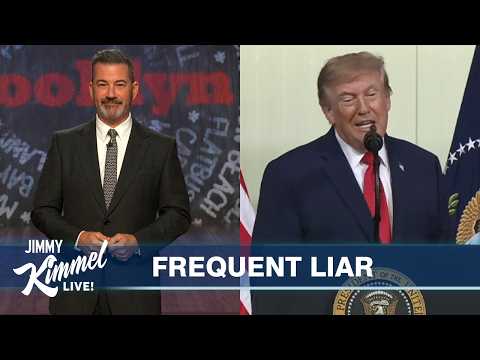
Jimmy Kimmel opens with a pointed examination of Donald Trump's political troubles, using Fox News polling, Republican concerns about the midterm elections, and declining Truth Social activity to build a rapid-fire sequence of jokes. The suggestion that Democrats could regain control of the House gives the opening a clear political focus, while Trump's enthusiastic promotion of Right Side Broadcasting Network provides an opportunity for Kimmel to mock his relationship with conservative media. Comparing Trump's apparent preference for a competing network to someone liking an ex-partner's rival's Instagram photos is a particularly effective joke, transforming a political media dispute into an instantly recognizable personal rivalry.
The discussion of Trump's reported 36% approval rating and declining Truth Social traffic continues the theme of political vulnerability. Kimmel's observation that he and Trump seem to be the only people reading the president's posts is an amusing exaggeration, especially when paired with jokes about Trump's sons supposedly abandoning the platform. However, the polling figures, social media statistics, and election predictions are presented without much supporting context. These details provide useful material for political satire, but viewers looking for a careful assessment of Trump's electoral position will find considerably more punchlines than analysis.
The monologue becomes more confrontational when Kimmel addresses Trump's comments about television cameras, a proposed execution by firing squad, and questions surrounding newly appointed press secretary Katie Zachariah. The press secretary controversy offers particularly accessible comedic material, with Kimmel highlighting her admission that she failed the California bar examination after previously creating confusion about her legal qualifications. His comparison to George Santos and subsequent joke about Zachariah and Pete Hegseth demonstrate his ability to connect separate political personalities through simple wordplay. Nevertheless, some of the more sexually suggestive insults and personal attacks contribute little beyond provoking a reaction, occasionally weakening the sharper criticism of official conduct.
The White House's response to Kimmel's earlier monologue becomes another entertaining centerpiece. Rather than simply expressing outrage over being called a talentless loser, Kimmel reads the administration's insulting statement and turns its language against the spokesperson who delivered it. His mockery of the word "beclowned" and his willingness to perform another deliberately corny joke create an effective contrast between official hostility and late-night comedy. The segment also illustrates Kimmel's preferred approach to political conflict: respond to attacks with ridicule rather than a lengthy defense. That strategy produces several memorable moments, although viewers who do not already share his political perspective may find the relentlessly adversarial tone limiting.
A more serious passage briefly interrupts the comedy as Kimmel references potential military escalation involving Iran, immigration enforcement, Ukraine, and other troubling developments. He urges viewers not to become emotionally numb and directs them to vote.org to check their voter registration. This transition gives the monologue a purpose beyond entertainment and makes his political position unmistakable. At the same time, the rapid succession of alarming claims receives little explanation or supporting evidence, leaving important distinctions between reported developments, interpretations, and possible future actions unexplored. The appeal to civic participation is clear, but the preceding discussion would benefit from greater precision.
The second half changes direction considerably, beginning with Guillermo's elimination from Dancing with the Stars and a playful investigation into whether he maintained his commitment to avoiding alcohol during rehearsals. Secretly recorded attempts by staff members to tempt him with tequila provide an entertaining recurring setup, and Guillermo's repeated refusals make the eventual celebratory drink feel earned. The subsequent mosquito sketch builds on a discussion of sterile male mosquitoes being used for population control, introducing an anthropomorphic mosquito whose romantic confidence collapses when his reproductive status becomes apparent. Its escalating anatomical jokes are deliberately ridiculous, and the absurd character interaction offers a welcome departure from political confrontation. The closing Unnecessary Censorship montage continues that lighter approach by transforming otherwise ordinary television moments into suggestive comedy through strategically placed bleeps.
Taken together, the show demonstrates Kimmel's versatility as both a politically outspoken host and a performer comfortable with broad, occasionally juvenile humor. His delivery moves confidently between sarcastic commentary, direct audience engagement, exchanges with Guillermo, and elaborate comedy sketches. The variety prevents the presentation from becoming a single extended political rant, even though the transitions between serious international concerns and absurd sexual humor can feel abrupt. The strongest material comes when a recognizable situation naturally produces a clever comparison or character interaction; the weaker moments depend on familiar insults, exaggerated accusations, or shock value rather than especially inventive writing.
Pros
- Kimmel's opening commentary connects Fox News election predictions, Trump's approval rating, and Truth Social activity through accessible political satire and memorable comparisons.
- The White House's hostile response provides an entertaining opportunity for Kimmel to turn official criticism into self-deprecating comedy.
- The controversy surrounding Katie Zachariah's legal qualifications supplies a concrete subject for several effective jokes about political credibility.
- Guillermo's alcohol-free dance training and the staff's unsuccessful attempts to tempt him create a genuinely amusing, personality-driven segment.
- The sterile mosquito sketch offers imaginative absurdity and a refreshing change from the politically focused opening.
- Kimmel maintains energetic delivery and variety across political commentary, audience interaction, character comedy, and the closing censorship montage.
Cons
- Polling numbers, social media statistics, and politically consequential claims receive limited context or supporting explanation.
- Repeated personal insults and sexually suggestive attacks sometimes overshadow more substantive criticism of political figures.
- The strongly partisan framing leaves little room for alternative interpretations or meaningful examination of opposing arguments.
- The transition from serious concerns about war and immigration enforcement to lighthearted entertainment feels somewhat abrupt.
- Portions of the mosquito sketch and closing censorship montage rely heavily on sexual innuendo, making the humor less consistently inventive than the stronger political wordplay.
Jimmy Kimmel delivers an energetic combination of political satire, personal comedy, and deliberately outrageous sketches, with particularly entertaining moments involving the White House's criticism and Guillermo's dancing experience. Although the political commentary sometimes substitutes ridicule for explanation and the broader humor occasionally becomes repetitive, the show's confident delivery and varied segments provide plenty of entertainment. It succeeds more convincingly as an outspoken late-night comedy performance than as a balanced examination of the political controversies it discusses.