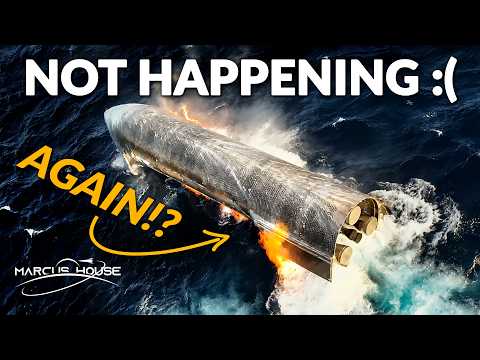
Booster 21’s 33-engine static fire provides a strong opening because it gives the discussion an immediate technical question: why did a burn SpaceX described as full duration appear roughly ten seconds shorter than comparable recent tests? Felix offers pad preservation as a possible explanation, connecting the shorter firing to observed flame-trench wear and the greater sustained stress of holding a booster stationary during a static fire. Importantly, he labels this as his own theory rather than presenting it as SpaceX’s explanation, although the discussion would be stronger with firmer evidence about the actual reason for the changed duration.
Flight 14 itself is presented as a potentially consequential step rather than a guaranteed orbital breakthrough. The distinction matters because the mission profile remains uncertain here: Felix lays out both a multi-orbit scenario involving deployment of Starlink V3 satellites and another suborbital rehearsal, while acknowledging that SpaceX has not definitively confirmed which will occur. His September 15 expectation is similarly framed as an inference from recent turnaround patterns rather than an announced launch date. That restraint helps balance the considerable enthusiasm surrounding Ship 41 potentially reaching orbit and deploying satellites that remain there.
Some of the best material comes from following hardware that is less spectacular than a launch. Testing of the S43.1 nose section becomes an accessible explanation of the relationship between structural strength, vehicle mass and payload capacity, while Ship 40’s unusual voyage back toward Brownsville leads to a thoughtful comparison of possible shipping routes. Distance, canal delays, Red Sea risk and seasonal Pacific weather are all used to explain why sailing around the Cape of Good Hope could make practical sense. The reasoning is engaging, though several conclusions remain the presenter’s interpretation of tracking information and geography rather than confirmed explanations from SpaceX.
The early activity at SpaceX’s announced Louisiana site broadens the episode into infrastructure development. Core drilling, possible launch-site patterns and nearby dredging are used to explain what may happen before major foundations are built on marshland, with comparisons to construction previously observed in Texas. Felix appropriately leaves some ambiguity around what the dredging signifies, but other predictions about future soil preparation and foundation methods are delivered with greater confidence than the available observations alone can establish. Governor Jeff Landry’s description of a $100 billion investment and the projected employment figures are clearly presented as claims associated with the project rather than independently demonstrated economic outcomes.
Starshield adds another useful dimension by showing how SpaceX’s launch business connects with communications services and government customers. The discussion identifies a Space Force aviation-connectivity contract and argues that civilian and military demand increasingly makes SpaceX communications infrastructure important. The larger conclusion that the company effectively cannot launch enough is more rhetorical than demonstrated, however, and would benefit from actual launch-demand, capacity or backlog figures. This section also illustrates the episode’s recurring tendency to move quickly from a specific development to an expansive interpretation of what it means for SpaceX.
The latter portion makes a substantial shift from Starship to Japan’s lunar ambitions, but it develops into a worthwhile account of ispace’s attempts to land on the Moon. The failures of its first two missions are explained through their reported altitude-measurement problems, followed by a clear description of how the planned Ultra lander combines elements from separate Japanese and American development programs. Its proposed 2028 launch on Mitsubishi Heavy Industries’ H3 is given broader significance as an attempt to pair a Japanese lander with a Japanese launch vehicle, while the H3’s own failure and subsequent return to flight keep the account from becoming uncomplicated boosterism. The repeated reminders that future dates and design fixes are not guarantees are especially appropriate for programs still under development.
Presentation is energetic and generally effective at translating aerospace developments into understandable stakes, but the episode is crowded. A lengthy AI promotion, a personal appeal related to the team’s green-card effort, membership requests and merchandise promotion repeatedly interrupt an already wide-ranging program. The transition from Flight 14 to Louisiana construction, Starshield and then ispace also makes the title subject feel less dominant as the episode progresses. Even so, the combination of hardware observations, logistical reasoning and explicit uncertainty gives spaceflight followers considerably more substance than a simple countdown to the next launch.
Pros
- Clearly distinguishes the presenter’s theory about Booster 21’s shorter static fire from an official SpaceX explanation.
- Explains both possible Flight 14 profiles while acknowledging that the orbital mission and proposed timing remain uncertain.
- Uses Ship 40’s return voyage effectively to connect geography, shipping distance, canal logistics, weather and regional risk.
- Makes less glamorous development work, including nose-cone testing and Louisiana core drilling, understandable and relevant to the larger Starship program.
- The ispace section gives useful context on two previous lunar failures, the Ultra redesign and the significance of using Japan’s H3 launcher.
- Maintains substantial enthusiasm without treating every prediction, target date or proposed mission outcome as established fact.
Cons
- Several interpretations of SpaceX testing, Louisiana construction and Ship 40’s routing are plausible deductions rather than confirmed explanations and sometimes receive more confidence than the available evidence warrants.
- Broad claims about launch demand and SpaceX’s growing infrastructure importance would be stronger with supporting quantitative evidence.
- The extended AI sponsorship and separate immigration-related appeal significantly interrupt the aerospace coverage.
- Covering Starshield and a lengthy ispace/H3 story makes the episode informative but increasingly diffuse relative to its Flight 14 focus.
A strong aerospace update combines careful observation with accessible explanations of why seemingly minor tests, shipping decisions and hardware changes matter. Speculation is usually identified appropriately, although some broader conclusions could use firmer evidence and the numerous interruptions weaken an otherwise focused presentation. The substantial lunar segment adds genuine value even as it stretches the episode well beyond Starship.