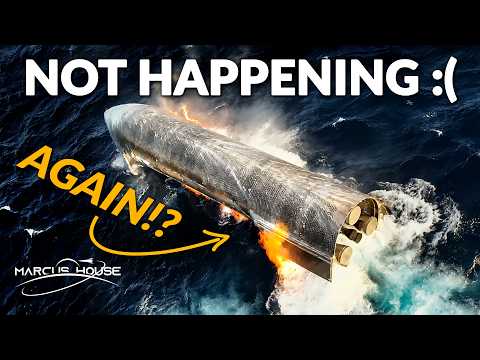
Starship Flight 14 is presented as a potentially decisive transition from increasingly ambitious test flights to an actual orbital mission, with the FAA’s newly approved Pacific contingency areas serving as the central evidence. Felix does a good job explaining what those zones mean and why they matter, particularly the distinction between an Indian Ocean splashdown profile and a vehicle returning across the Pacific after orbital flight. However, the argument occasionally moves faster than the underlying evidence: regulatory preparation for orbital trajectories strongly indicates what SpaceX is planning, but it does not by itself establish that Flight 14 will successfully reach orbit or follow the exact mission profile predicted here.
The most interesting analysis concerns what could happen after launch. Felix calculates that Starship’s initial trajectory could bring it near Hawaii roughly 79 minutes after liftoff, while four complete orbits would produce another favorable alignment about six hours later. Connecting that geometry to the original 2021 orbital test concept gives the prediction useful context, and he clearly labels the four-orbit scenario as his own calculation rather than confirmed mission planning. The discussion becomes less certain when it assumes deployment of Starlink V3 satellites and speculates about the precise deorbit sequence, but the distinction between known regulatory information and personal forecasting is generally visible.
Coverage of the hardware pipeline adds valuable perspective beyond Flight 14 itself. Possible lunar Starship components spotted at McGregor are treated cautiously, while Ship 42 and Booster 22 undergoing testing in parallel illustrate how SpaceX may be increasing operational tempo. Felix is even more explicit about the uncertainty surrounding his theory that these vehicles could be test articles destined for Pad 39A rather than the Flight 15 stack. The patched-looking engine skirt, equipment arriving at Kennedy Space Center, and need to commission a new launch pad form an intriguing circumstantial case, but the presentation correctly stops short of treating that case as confirmation.
The broader infrastructure reporting is similarly effective because seemingly mundane construction is connected to the practical requirements of operating Starship at scale. A proposed heavy-haul road between production facilities and Massey’s could reduce dependence on Highway 4 closures, while work at the Port of Brownsville is interpreted as preparation for moving large vehicles by water. Some conclusions about future destinations and transportation patterns remain projections, yet the operational logic is clearly explained. This section makes the program feel less like a succession of spectacular launches and more like an emerging transportation system requiring roads, ports, pads, regulatory corridors, and parallel hardware processing.
Stoke Space provides the strongest counterpoint to the Starship-heavy opening. The $1 billion funding round and Nova Block 2 reveal lead into an accessible explanation of the company’s alternative approach to full reusability, including a larger first stage, 14 methalox engines, hot staging, and a hydrogen-powered upper stage with an actively cooled metallic heat shield. The comparison with Starship’s ceramic tiles is particularly useful because it frames two substantially different engineering responses to reusable atmospheric entry. At times the enthusiasm outruns the maturity of the hardware—claims such as 100-flight engines, 15 metric tons to low Earth orbit, and a 2029 debut remain targets rather than demonstrated capabilities—but Felix largely presents them in that developmental context.
Blue Origin’s contrasting fortunes give the episode a strong final act. The damage at Launch Complex 36, the decision to move toward vertical integration during reconstruction, and the aggressive return-to-flight target are balanced against the commercial consequences of downtime. Amazon Leo purchasing additional Ariane 6 launches is used effectively to illustrate how delays can redistribute launch business, although the causal interpretation is more suggestive than proven here. The roughly $700 million NASA Mars telecommunications orbiter contract then shifts attention to Blue Origin’s Blue Ring platform and explains why aging Mars relay infrastructure makes dedicated communications capacity strategically important. Across all three companies, the episode succeeds at turning a crowded stretch of aerospace news into a coherent picture of an industry simultaneously scaling vehicles, infrastructure, and competition.
Pros
- Uses the FAA’s Pacific contingency planning to clearly explain why orbital re-entry preparations represent an important change for Starship operations.
- Separates much of the Flight 14 trajectory analysis and Ship 42/Booster 22 discussion from confirmed information by explicitly identifying predictions and speculation.
- Connects Starship’s roads, ports, testing sites, launch pads, and transportation equipment into a convincing explanation of the infrastructure required for higher flight cadence.
- Makes Stoke Space’s actively cooled heat-shield concept understandable and meaningfully contrasts its reusable architecture with Starship’s ceramic-tile approach.
- Balances Blue Origin’s launch-pad setback and commercial pressure with its Mars communications contract rather than reducing the company’s situation to either failure or success.
Cons
- The certainty surrounding Flight 14 going orbital sometimes exceeds what regulatory preparation alone can establish, especially before the flight actually occurs.
- Several detailed mission expectations, including satellite deployment, orbit count, deorbit timing, and Hawaii trajectory, remain predictions rather than confirmed elements of the flight plan.
- Stoke’s performance, reuse, and schedule targets receive enthusiastic treatment despite being prospective capabilities from a vehicle architecture that has not yet demonstrated them in flight.
- The lengthy sponsorship, subscription, membership, merchandise, and engagement interruptions noticeably break the momentum of an otherwise information-dense update.
The episode is at its best when it turns regulatory filings, construction activity, test hardware, and funding announcements into understandable evidence of how reusable launch systems are evolving beyond individual rockets. Its enthusiasm occasionally gives predictions and developmental targets more momentum than the available evidence warrants, but careful qualification in the most speculative sections keeps the reporting broadly grounded and useful.