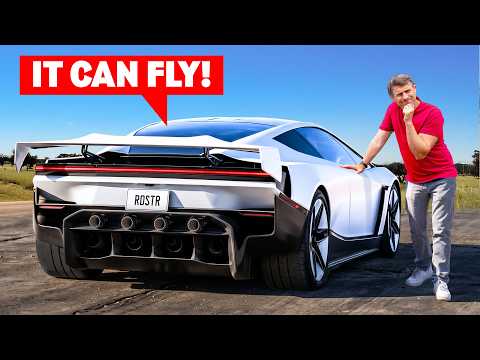
Tesla's redesigned Roadster performs an extraordinary series of demonstrations, from driving upside down on a ramp to launching itself into the air and landing on its wheels. The spectacle initially impresses the presenter, but that excitement quickly gives way to skepticism about whether any of these capabilities could realistically appear in a production vehicle. Rather than dismissing the engineering outright, the commentary examines the practical limitations of Tesla's suction fans, compressed-air propulsion system, and ambitious performance promises. The result is an entertaining and frequently persuasive argument that an impressive demonstration does not necessarily translate into a viable road car.
The discussion of fan-generated downforce provides some of the strongest technical context. By referencing the Chaparral 2J, Brabham BT46B, and McMurtry Spéirling, the presenter establishes that using fans to create extraordinary grip is hardly a new invention. These historical comparisons help explain how a vehicle can generate enough suction to remain attached to an inverted surface while also highlighting the complications involved in adapting such technology for everyday driving. Concerns about excessive noise, road irregularities, and debris are relevant, although the suggestion that Tesla's system would necessarily be louder than existing examples remains speculative without direct measurements.
The compressed-air propulsion system receives similarly critical treatment, particularly regarding its claimed ability to accelerate the Roadster from zero to 60 mph in approximately 0.8 seconds. The presenter raises understandable concerns about directing powerful bursts of compressed air toward surrounding vehicles and pedestrians, especially in ordinary traffic conditions. However, the presentation becomes less convincing when it assigns dramatic consequences to these hypothetical situations without demonstrating the calculations behind them. The comparison between a ruptured 5,500 psi pressure vessel and 20 pounds of TNT is especially problematic because it relies on an unspecified calculation generated by an automated tool rather than independently established engineering evidence. High pressure alone does not determine the energy released in a rupture, making this one of the commentary's weakest technical claims.
Questions about the Roadster's flying capabilities introduce another worthwhile distinction between spectacular engineering and practical transportation. The presenter challenges the usefulness of jumping over traffic accidents, pointing out that safe landing areas cannot be guaranteed and that downward-directed propulsion could create additional hazards. These observations are particularly effective because they consider the surrounding environment rather than treating the car's performance in isolation. The comparison with conventional vehicle safety systems also reinforces the importance of predictable crash behavior. Nevertheless, assertions about regulatory impossibility and potential damage beneath the vehicle are presented more confidently than the supporting evidence warrants.
Beyond safety, the commentary examines whether Tesla's proposed technology would provide meaningful benefits even in controlled environments. The discussion of limited thrust duration and lengthy refilling times raises legitimate questions about repeated acceleration runs and competitive drag racing. The presenter also notices that different demonstration vehicles appear to perform different stunts, an observation used to question how much of the showcased technology could realistically coexist in one production configuration. This is an interesting line of criticism, although it does not conclusively establish that a combined system would be impossible. The speculation about how Tesla might eventually divide the Roadster into flying, thrust-assisted, fan-equipped, and conventional variants is plausible as an interpretation of the presentation, but not a confirmed production strategy.
The final stretch broadens the criticism from engineering feasibility to Tesla's credibility and delivery commitments. Particular attention goes to customers who reportedly placed Roadster orders years earlier and a reservation disclaimer stating that delivery cannot be guaranteed. This contractual uncertainty is more concrete than many of the earlier predictions and gives the discussion a meaningful consumer perspective. The presenter also questions whether the publicity surrounding the demonstrations is intended primarily to generate excitement and strengthen Tesla's image. That interpretation fits the skeptical argument, but the suggestion that the event was designed to influence the company's stock performance is not supported by direct evidence of corporate intent.
Presentation-wise, the commentary succeeds through energetic delivery, accessible mechanical explanations, and an entertaining mixture of disbelief and sarcasm. The historical racing examples, descriptions of potential road hazards, and breakdown of different Roadster configurations give the argument more substance than a simple attack on Elon Musk's promises. At the same time, exaggerated collision scenarios, aggressive jokes, and repeated declarations that the technology will never become road legal occasionally undermine the credibility of otherwise sensible criticism. The presenter is at his best when identifying unanswered engineering questions and weakest when treating predictions, rough estimates, and assumptions as settled conclusions.
Pros
- Historical comparisons with the Chaparral 2J, Brabham BT46B, and McMurtry Spéirling provide useful context for understanding fan-generated downforce and inverted driving demonstrations.
- Practical examination of noise, uneven road surfaces, debris, and propulsion hazards raises important questions about adapting specialized performance technology for public roads.
- Discussion of compressed-air thrust duration and refilling requirements highlights operational limitations that spectacular acceleration demonstrations can obscure.
- Questioning the usefulness and safety of flying maneuvers effectively distinguishes impressive engineering achievements from realistic transportation applications.
- Attention to different demonstration vehicles, proposed Roadster configurations, and uncertain delivery commitments adds valuable consumer and production context.
- Energetic commentary, memorable analogies, and sarcastic humor make complicated technical concerns accessible and entertaining.
Cons
- Dramatic claims about propulsion-related collisions and the explosive potential of compressed-air storage lack sufficiently transparent calculations or independent technical verification.
- Predictions that various Roadster technologies will never receive road approval are expressed with excessive certainty despite limited evidence about final designs or regulatory assessments.
- Assumptions about fan noise, vehicle configurations, and damage caused by propulsion systems sometimes extend beyond what the demonstrations establish.
- The argument that Tesla staged the event to boost its image and stock performance is speculative and receives little supporting evidence.
- Frequent profanity, exaggerated comparisons, and dismissive remarks occasionally distract from the stronger engineering and consumer-focused analysis.
This entertaining critique raises worthwhile questions about whether Tesla's spectacular Roadster demonstrations can become safe, practical, and commercially available technology. Its historical comparisons, attention to real-world operating conditions, and examination of delivery uncertainty provide a substantial foundation for skepticism, but several dramatic technical claims and definitive predictions require stronger evidence. The result is an engaging and useful challenge to automotive marketing hype that would be considerably more persuasive with greater technical precision and a clearer separation between demonstrated limitations and speculation.