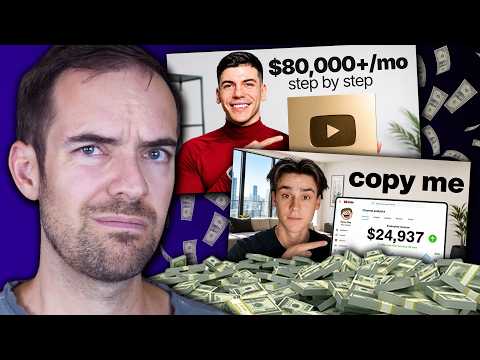
Three invented personalities—a 101-year-old wellness adviser, a wealthy grandmother, and a young relationship commentator—form the basis of a seven-day attempt to turn synthetic social-media characters into actual revenue. The experiment immediately benefits from clear constraints: a $99 startup budget, no use of the creator’s face or voice, and a $1,000 revenue target. That framework gives what could easily become another vague side-hustle tutorial a measurable objective and, importantly, leaves room for failure.
The setup process is demonstrated in unusually practical detail. Character profiles are developed for health, wealth, and relationships before images, environments, voices, scripts, and short-form videos are created. Showing imperfect generations, such as Amos initially appearing far too young for his supposed age, helps prevent the process from looking completely effortless. The walkthrough also illustrates how consistency across character images, locations, voices, captions, and account branding matters when constructing a believable persona.
Where the presentation becomes less convincing is in its early discussion of successful competitors. Large earnings figures and assumptions about how much particular synthetic influencers are making are presented without meaningful verification, and engagement is sometimes treated as evidence of profitability. The claim that health, wealth, and relationships are especially profitable niches is similarly asserted rather than demonstrated. Those examples are useful for brainstorming business models, but they should not be mistaken for evidence establishing typical earnings or the likelihood that a newcomer can reproduce them.
The actual social-media experiment is more valuable because it produces observable results rather than relying entirely on success stories. Thirty initial posts are divided across three Instagram accounts, and the creator openly identifies the characters as synthetic in their profiles. The audience responses are particularly interesting: some commenters debate Sienna's opinions or ask about her clothing without apparently recognizing that she is fictional. That illustrates how convincing the generated characters can appear, although a handful of comments cannot establish how broadly viewers were actually fooled.
Choosing Amos based on his early performance also produces the experiment's most instructive mistake. Vivian initially finishes last, only for her account to accelerate later, including one post reported at more than 250,000 views. The creator acknowledges that the seven-day deadline encouraged a premature decision rather than pretending the original strategy was correct. That reversal is a useful reminder that short-term social-media performance can be volatile and that an early winner is not necessarily the account with the greatest eventual reach.
Monetization through a 30-day wellness workbook gives the challenge a concrete financial test, but it also introduces its biggest substantive concern. The creator says he reviewed the generated material to ensure it was logical and safe, yet viewers are not shown enough of the workbook to independently evaluate its health guidance. That matters when a fictional 101-year-old persona is being used to establish authority around energy, longevity, food, and healthy habits. Disclosure that Amos is synthetic is a positive ethical choice, but it does not replace evidence or appropriate scrutiny for health-related claims.
The final accounting is refreshingly less spectacular than the opening success stories: 23 sales at $12 produce $276 in revenue, with the stated $99 generation cost and $19.52 in payment fees leaving $157.48 in profit. The creator consequently misses his $1,000 target rather than redefining success to preserve the premise. Still, the result should be interpreted narrowly. Seven days, three newly created accounts, one digital product, a particular content strategy, and a creator documenting the experiment do not establish what a typical person would earn, while the suggestion that expansion to more platforms would produce additional money is plausible speculation rather than something tested here.
Pros
- Establishes clear budget, time, anonymity, and revenue constraints that make the experiment easy to evaluate.
- Shows the character, image, voice, content, account, product, and monetization workflow in practical detail.
- Reports the failed $1,000 target and $157.48 stated profit rather than presenting the experiment as an outsized financial success.
- Vivian's delayed surge provides a useful example of how quickly early social-media conclusions can become outdated.
- Explicitly labeling the characters as synthetic addresses some of the deception concerns raised by the concept.
Cons
- Several competitor income figures and assumptions about profitability are presented without supporting evidence.
- Broad claims about profitable niches and the ease of making money go beyond what a seven-day experiment can establish.
- The wellness product receives too little substantive scrutiny given that it contains health and longevity guidance.
- The extensive Higgsfield walkthrough and promotional discount create a commercial element that overlaps heavily with the experiment itself.
- The final discussion extrapolates potential earnings from additional platforms and monetization methods that were not actually tested.
The modest $157.48 stated profit is more informative than the enormous earnings claims used to introduce the concept, because it demonstrates both genuine monetization and the limitations of a short experiment. The practical workflow, transparent failure to reach the target, and unexpected reversal between Amos and Vivian make for an engaging test, but unsupported profitability claims and the lightly examined wellness content keep the conclusions from being as rigorous as the experiment could have been.