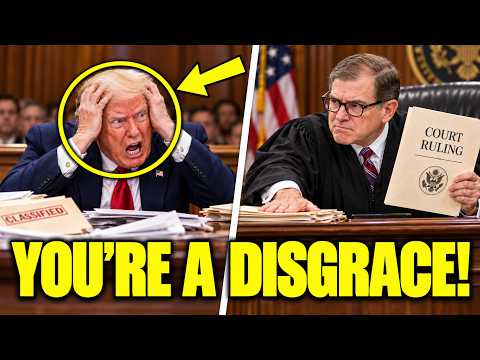
Donald Trump's reputation as a successful real estate developer faces a serious challenge in a New York civil fraud ruling that questions the financial representations underlying his business empire. Judge Arthur Engoron's decision to cancel business certificates associated with Trump-controlled entities provides the foundation for an aggressive examination of the former president's wealth, credibility, and potential financial exposure. Combining television news coverage with forceful political commentary, the presentation argues that the ruling threatens more than individual properties. It challenges the business reputation Trump spent decades cultivating and promoting as evidence of his leadership abilities.
The strongest evidence concerns the valuation of Trump's triplex apartment in Trump Tower. According to the ruling discussed in the coverage, Trump represented the apartment as approximately three times its actual square footage, producing an estimated valuation discrepancy of $114 million to $207 million. This concrete example makes the allegations understandable without requiring extensive financial expertise. Additional references to 40 Wall Street, Seven Springs, and Mar-a-Lago broaden the discussion to other disputed valuations, although those properties receive less detailed examination. The distinction between demonstrably inaccurate measurements and more subjective real estate appraisals deserves greater attention than the commentary provides.
The potential consequences for Trump's New York properties supply much of the presentation's dramatic momentum. Trump Park Avenue, 40 Wall Street, Seven Springs, and his Trump Tower residence are identified as assets potentially affected by the ruling. The accompanying news discussion appropriately acknowledges that the precise implications remain uncertain, particularly because Trump's attorneys intend to appeal. Unfortunately, the surrounding narration repeatedly turns possibilities into seemingly inevitable outcomes, describing lost control, receivership, interrupted cash flow, and liquidation with considerably more certainty than the quoted reporting supports. The original coverage's careful qualifications are often overshadowed by declarations of impending financial catastrophe.
Judge Engoron's criticism of Trump's legal defense provides another substantial element. The presentation highlights his rejection of arguments concerning disclaimers attached to financial statements, along with sanctions reportedly imposed on attorneys for advancing arguments the court considered frivolous. These details help explain why the ruling represented a significant legal setback rather than merely another unfavorable headline. The discussion also identifies the unusual position facing Trump's defense: the same judge responsible for the ruling would preside over the remaining civil proceedings. However, the commentary sometimes treats judicial frustration as evidence that subsequent outcomes are effectively predetermined, overlooking the distinction between an unfavorable preliminary ruling and unresolved legal questions.
The explanation of civil fraud standards is particularly useful. Through the television panel's discussion, viewers learn why Trump's argument that lenders suffered no financial losses did not necessarily defeat the state's claims. The speakers distinguish between the accuracy of representations submitted during business transactions and whether the resulting loans were successfully repaid. They also explain that different legal claims can involve different requirements, making the remaining trial relevant despite the earlier findings. This provides valuable context that the more sensational portions frequently lack. The financial discussion is less disciplined, particularly when the $250 million sought by Attorney General Letitia James is treated almost like an established obligation rather than a requested remedy subject to further proceedings and potential appeals.
Beyond the immediate legal dispute, the presentation explores how the ruling might affect Trump's relationships with lenders, insurers, business partners, and political supporters. Its central argument is that a public identity built around exceptional business judgment becomes vulnerable when a court identifies serious inaccuracies in financial documents. That is a legitimate subject for analysis, and the discussion of liquidity versus estimated net worth adds a useful financial distinction. Nevertheless, predictions of permanently damaged financing relationships, diminished brand value, family-wide consequences, and political collapse are largely speculative. The presentation offers little independent evidence establishing how financial institutions, customers, or voters actually responded to the ruling.
The overall execution is energetic but increasingly repetitive. Television clips provide recognizable legal details and moments of genuine analysis, while the narrator supplies a consistent argument connecting those developments to Trump's broader public image. Yet the language repeatedly escalates toward absolute conclusions, describing a collapsing empire, an irreparably damaged reputation, and consequences that supposedly cannot be reversed. Extended passages revisit the same themes of inflated valuations, weakened credibility, and threatened properties without adding much supporting information. The opening insistence that the presentation is not a political attack also sits awkwardly beside its openly adversarial rhetoric. Most importantly, the coverage concerns a ruling issued before a forthcoming trial, but the narration often presents the situation with the certainty of a fully resolved legal and financial outcome.
Pros
- Grounds its central argument in specific judicial findings, particularly the substantial discrepancy involving Trump's Trump Tower apartment.
- Identifies several major New York properties potentially affected by the ruling, making the business implications easier to understand.
- Includes informative television coverage explaining the judge's criticism of Trump's attorneys and the sanctions imposed on members of the defense.
- Clarifies why successful loan repayment and the absence of direct lender losses do not necessarily eliminate liability under the civil fraud provisions discussed.
- Raises meaningful questions about the relationship between reported net worth, available liquidity, business credibility, and potential financial remedies.
Cons
- Frequently presents uncertain legal and financial consequences as though receivership, loss of property control, and forced liquidation are inevitable.
- Treats the $250 million requested by the attorney general with insufficient distinction between a proposed financial remedy and an established payment obligation.
- Relies on highly charged political rhetoric that undermines the presentation's claim to offer analysis rather than partisan commentary.
- Repeatedly revisits the destruction of Trump's business reputation without introducing enough additional evidence to justify the extended discussion.
- Offers limited substantiation for predictions about future lending relationships, permanent brand damage, family consequences, and political repercussions.
- Fails to maintain the careful distinctions between established findings, pending proceedings, possible appeals, and speculative outcomes that the included news coverage sometimes acknowledges.
This examination of Trump's New York civil fraud ruling contains substantial legal details and useful explanations of why inaccurate financial representations can carry consequences even when lenders are repaid. Its strongest material comes from the judicial findings and measured television analysis, but repetitive commentary, exaggerated certainty, and speculative predictions weaken its credibility as an independent assessment. The result is an engaging and occasionally informative political presentation that would be considerably stronger with more restrained language and clearer separation between what the court decided and what might happen next.