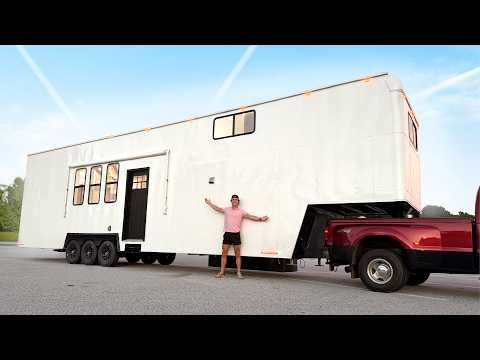
Britain and his dad have to close a gap in a bent trailer door before they can worry about mood lighting. Across the garage, Brock and Josh have a roomier six-by-ten trailer and enough wall space to dream about a big-screen TV. Both trailers cost $800, and each team gets a $1,000 conversion budget and three days. The mismatched starting points make the rivalry interesting because size dictates what each team can realistically build.
The workshop scenes are best when a decision has an immediate consequence. Britain struggles to fasten a wall panel through steel while his dad is at work, and their plan for a hinged bunk eventually gives way to a bed and a spot on the floor. Brock and Josh revise their layout several times before committing to an entertainment center. The deadline feels real in those moments, though the frequent reminders that both teams are behind grow tiresome between them.
A $20 secondhand rug and a $15 thrift-store television give the budget challenge some personality. The shopping sequences make it easy to see how quickly insulation and wood eat into the money available for comforts. The running balances are harder to use as a cost comparison because the reveal gives neither build a complete tally and the teams are supplied with different power stations. The extended pitch for the smaller unit also breaks up the demolition sequence just as the work is getting underway.
Keeping the builds hidden from the opposing teams pays off at the campsite. Britain and his dad have a kitchen with a spice rack, storage tucked behind the bed and into the door, and a window that earns immediate praise. Brock and Josh use their extra space for a broad sleeping area and a large TV, with dark trim pulling the room together. The tours are candid about the compromises, including the smaller camper’s unreliable TV connection and the larger camper’s awkward exit.
The dirt road and dinner give the builders two concrete ways to see how their work holds up. The smaller trailer’s troublesome door stays shut on the drive, and both teams get to use their kitchens. The overnight segment offers thinner evidence for the promised cold-weather test. One camper feels warmer to a participant in the morning, but the video gives no temperature readings to put that impression in context, and snoring accounts for one of the roughest nights.
The sell-or-keep stakes make sense once the builders start talking about using the campers again. The judging gets less satisfying when the scores settle the contest before anyone has slept in either trailer, especially after one judge says he wants to sleep in the camper before giving a final rating. The tours make it easy to understand why the larger build wins them over, while the order of events gives overnight comfort little weight in the result.
Pros
- The trailers’ unequal dimensions give the teams different design problems from the outset.
- The build sequences show how stubborn materials, limited time, and changing plans shape the finished campers.
- The secondhand finds make the trade-offs between basic materials and creature comforts tangible.
- The campsite tours let the builders react to each other’s work and point out practical details they might otherwise miss.
- The drive and dinner put the repaired door and compact kitchens to use.
Cons
- The running budget updates never come together in a full cost comparison that accounts for the supplied power stations.
- The lengthy power station promotion interrupts the demolition sequence.
- Repeated warnings about falling behind add little once both teams are visibly scrambling.
- The overnight segment relies on impressions of warmth without giving temperatures for context.
- The teams settle the score before the overnight test can inform their ratings.
There’s real satisfaction in watching the builders climb into spaces they were still patching together that morning. The competition earns its payoff through their pride in the finished interiors, even if the final scores tell us more about which camper impressed the family on arrival than which one made the better overnight shelter.