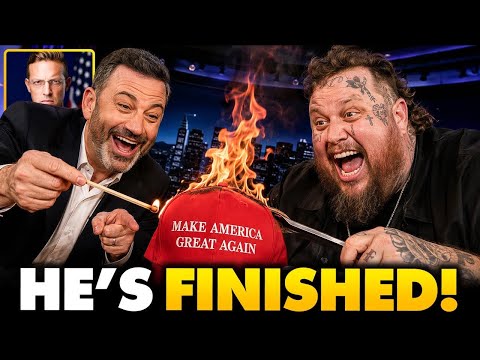
Jelly Roll’s guest-hosting appearance on Jimmy Kimmel Live becomes the basis for a sweeping argument that his public image and career are rapidly collapsing. The commentary says his jokes about Donald Trump alienated fans who viewed him as politically neutral, then portrays his response as even more damaging than the original appearance. That is a potentially interesting story about celebrity branding, audience expectations and the risks of entering political comedy, but the presentation quickly moves from discussing visible controversy to declaring an escalating career crisis without establishing the evidence needed to support it.
The centerpiece is an alleged event where Jelly Roll supposedly praised Jimmy Kimmel, defended his Trump jokes and told offended listeners not to play his music. The account then describes audience members calling him a fraud, hypocrite and “fake Christian,” followed by Jelly Roll responding from the microphone before leaving the stage amid boos. These are extraordinarily specific claims, extending to purported dialogue, the approximate distance of one heckler and Jelly Roll’s movements afterward. Yet no source, recording, event identification or other corroboration is provided within the presentation, making it impossible here to determine whether this confrontation happened as described.
That evidentiary problem becomes more significant as the claims expand. The presenter says Jelly Roll has canceled press events, is losing brand deals, has been fired from Hollywood appearances, is being affected in connection with Tulsa King, and is having songs removed from radio rotation. These assertions would offer measurable evidence of genuine professional consequences if substantiated, but no companies, stations, executives, contracts, cancellation notices or other supporting material are presented. Telling viewers to turn on their radios and see whether they hear fewer Jelly Roll songs is particularly weak as evidence for a coordinated or widespread reduction in airplay.
There is a more defensible critical point buried beneath those unsupported claims. The presenter objects to Jelly Roll participating in jokes about Trump’s weight or appearance because Jelly Roll has publicly discussed his own weight-loss journey, according to the commentary. Whether that makes the jokes hypocritical is an opinion rather than an established fact, but it at least creates a coherent subject for discussion: whether someone who has experienced significant weight issues should be more reluctant to use another person’s appearance as comedy. Unfortunately, the commentary repeatedly converts that criticism into much broader declarations that Jelly Roll’s personality, faith and public identity are “fake” or “phony.”
The treatment of religion is especially speculative. Audience criticism allegedly questioning Jelly Roll’s Christianity is followed by the presenter suggesting that many people have concluded he does not actually believe in Christianity and referring vaguely to leaked videos that supposedly prove his persona false. None of that establishes a person’s private religious beliefs. The distinction between criticizing how someone invokes faith publicly and claiming to know whether that faith is genuine matters, and the commentary does not maintain it.
Presentation-wise, the delivery is forceful and easy to follow, with a clear thesis established immediately and several recurring reasons given for why the presenter believes the backlash is intensifying. There is also some acknowledgment of uncertainty when discussing who may have written the Kimmel jokes. However, phrases such as “100% fake,” repeated references to backlash growing stronger and frequent assertions that Jelly Roll’s career is declining make the argument increasingly repetitive. The strongest version of this piece would have concentrated on documented remarks and observable audience reaction, then separated those facts from speculation about motives, Christianity, radio play and career consequences.
Pros
- Establishes a clear argument about the tension between Jelly Roll’s public persona, political comedy and audience expectations.
- Raises a legitimate question about the optics of appearance-based humor given the weight-loss story attributed to Jelly Roll.
- The alleged stage confrontation, if independently substantiated, would provide a concrete example of negative audience reaction.
- Occasionally acknowledges uncertainty, particularly regarding who wrote the jokes delivered on Jimmy Kimmel Live.
Cons
- The central booing incident is described in extraordinary detail without providing corroboration or identifying evidence.
- Claims about canceled events, lost brand deals, Hollywood work and declining radio airplay are presented without supporting documentation.
- Broad declarations that Jelly Roll’s personality and Christian faith are fraudulent go substantially beyond what the material presented can establish.
- Repetition of the same “backlash” and “fake persona” conclusions substitutes for deeper examination of the underlying evidence.
- Suggesting listeners informally monitor their local radio stations does not meaningfully demonstrate a widespread change in airplay.
There is a worthwhile discussion here about celebrity authenticity, political comedy and what happens when an entertainer challenges expectations held by part of an audience. The commentary weakens that discussion by building its most dramatic conclusions on highly specific but unsupported claims and repeatedly treating interpretation as established fact.