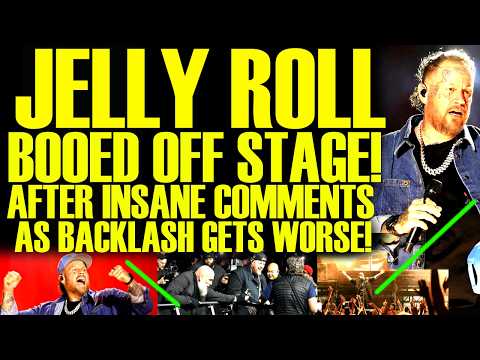
Jelly Roll’s guest-host monologue for Jimmy Kimmel becomes the centerpiece of a much larger argument about celebrity authenticity, political loyalty and whether entertainers owe ideological consistency to their audiences. The commentary contrasts his jokes about Donald Trump with earlier moments in which he interacted warmly with Trump and declined to offer an informed opinion about ICE. That contrast gives the criticism a recognizable foundation, but the leap from changing tone to “betraying” an audience is asserted much more confidently than it is demonstrated.
Playing a substantial portion of the monologue is one of the presentation’s better decisions because viewers can hear what actually prompted the backlash. Jelly Roll jokes about Trump’s flag waving, weight, approval ratings and history of insulting other people’s appearances before ending with a crude joke about physical fitness. The host distinguishes between the weight material and the more explicitly political approval-rating line, arguing that the latter makes the performance feel less like self-deprecating comedy and more like partisan opposition. Whether that constitutes a meaningful political transformation is another question, but at least the central evidence is presented rather than merely described.
The analysis becomes less persuasive when it starts treating earlier friendliness toward Trump as evidence that Jelly Roll previously occupied a defined pro-Trump position. Being cordial with a president, praising him on some occasions or appearing enthusiastic during an encounter does not by itself establish a political allegiance that subsequent jokes necessarily betray. Likewise, Jelly Roll’s quoted explanation that he felt poorly informed about politics actually complicates the attempt to place him firmly within a political camp. The commentary recognizes some of that uncertainty early on but increasingly abandons it as the argument intensifies.
Claims about Hollywood influence are even more speculative. The host repeatedly attributes the tone to Jimmy Kimmel’s writers and suggests that Jelly Roll or his representatives should have removed particular lines, yet no evidence is supplied about who wrote which jokes or how much control Jelly Roll exercised over the material. Phrases such as “sold out,” comparisons to Bud Light and accusations that he is courting a “woke Hollywood machine” transform an observable career appearance into a broader narrative about ideological capture without establishing the intermediate steps.
The strongest underlying question concerns audience expectations. Jelly Roll is presented as having built an image around redemption, country music, faith, outsider status and an unconventional personal history, and the host argues that aggressively mocking Trump conflicts with what some fans believed that image represented. The included negative reactions demonstrate that at least some people interpreted the appearance that way. They do not, however, establish the broader claim that Jelly Roll has “completely betrayed” his fans, destroyed his career or triggered a commercially significant revolt. No sales, streaming, ticketing, polling or other audience data is offered to measure the scale of the reaction.
The presentation also undermines its stated reluctance to embrace cancel-culture behavior. The host says people should not become overly emotional about jokes or cancel entertainers over every disagreement, but much of the segment amplifies insults, celebrates declarations about deleting Jelly Roll’s music and ultimately labels his conduct an unforgivable betrayal. References to his divorce and accusations that he used Christianity to make money add further heat without supplying evidence that those matters explain the Kimmel appearance. The result is energetic political commentary, but its most dramatic conclusions depend heavily on assumptions about Jelly Roll’s motives, identity and audience rather than demonstrated consequences.
Pros
- Extended playback of Jelly Roll’s monologue gives viewers direct context for the controversy rather than relying entirely on the host’s characterization.
- The comparison with Jelly Roll’s earlier comments about avoiding uninformed political pronouncements creates a legitimate question about how his public persona has evolved.
- The host identifies a meaningful distinction between self-referential weight jokes and the explicitly political approval-rating material.
- Discussion of the tension between an outsider image and participation in mainstream celebrity culture raises a worthwhile question about authenticity and audience expectations.
Cons
- Claims that Jelly Roll betrayed his fans or destroyed his career are unsupported by meaningful evidence about his broader audience or actual career consequences.
- Friendly interactions with Trump are treated too readily as proof of a political commitment that the Kimmel jokes supposedly violated.
- The commentary speculates about Jimmy Kimmel’s writers, Jelly Roll’s publicists and Hollywood influence without establishing who wrote the material or why Jelly Roll performed it.
- Selected hostile social-media reactions demonstrate backlash from some viewers but cannot establish its prevalence or representativeness.
- Personal references to Jelly Roll’s divorce, faith and supposed motives intensify the attack without demonstrating their relevance to his decision to perform the monologue.
- The stated resistance to cancel culture sits awkwardly beside repeated amplification of calls to abandon Jelly Roll over a political comedy appearance.
There is a worthwhile discussion here about celebrity branding, political comedy and the expectations performers create with their audiences, and the inclusion of Jelly Roll’s actual monologue gives that discussion a concrete basis. The argument becomes substantially weaker when a controversial guest-host appearance is elevated into proof of ideological betrayal and career destruction without evidence of either Jelly Roll’s motives or measurable consequences.