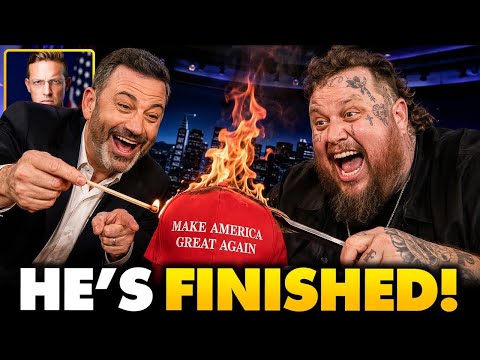
Jelly Roll’s stint hosting Jimmy Kimmel becomes the centerpiece of an angry argument that he has betrayed the conservative and Christian audience credited here with supporting his career. The criticism focuses on jokes directed at Donald Trump, particularly remarks about his weight, intelligence and fitness for office, alongside Jelly Roll’s appeal to Christian teachings about welcoming strangers and loving one’s neighbor. Those clips provide something concrete to discuss, but the commentary quickly escalates from disagreement with his choices to declarations that his career has been destroyed and his faith exposed as fraudulent.
The most substantial criticism concerns the tension between Jelly Roll’s public Christian identity and the personal nature of his political insults. One commentator argues that invoking Christianity while calling Trump a “fat pig” is difficult to reconcile with a message centered on love and redemption. Another makes the more practical point that even if Jimmy Kimmel’s writers supplied the jokes, Jelly Roll ultimately chose to deliver them. That distinction between authorship and responsibility is one of the clearer arguments in an otherwise highly emotional discussion.
The treatment of Jelly Roll’s religious comments is much less convincing. His quotation about feeding the hungry, giving drink to the thirsty and welcoming strangers is countered with claims about Deuteronomy, Romans and Jesus supposedly establishing a clear biblical position on modern border enforcement. Those theological interpretations are asserted rather than carefully demonstrated, and Jelly Roll’s statement about loving and welcoming neighbors is repeatedly reframed as an endorsement of “open borders” without evidence here that he actually called for eliminating border controls. The result is political interpretation presented with considerably more certainty than the material supports.
Claims about Jelly Roll’s audience and career suffer from the same problem. Speakers repeatedly insist that most of his listeners voted for Trump, that liberals largely do not listen to him, and that his Kimmel appearance has caused irreversible professional damage. One segment also speculates that canceled concerts involving Jelly Roll and Post Malone might reflect weak ticket sales, while another suggests Jelly Roll may have been financially rewarded for advancing a political agenda. None of those claims is supported with ticket data, audience demographics, sales figures, polling or evidence of payment, making the dramatic predictions about his career impossible to assess from what is presented.
The compilation does gain some balance when contrasting Jelly Roll’s earlier reluctance to comment on politics with his later willingness to deliver explicitly anti-Trump comedy. That shift is legitimately interesting, particularly because his earlier explanation emphasized being disconnected from current events and questioning why anyone should value his political opinion. A later commentator also avoids automatically condemning him, instead arguing that he was free to perform the jokes but should accept responsibility for that decision rather than blaming writers if backlash affects him. That is a more coherent critique than the surrounding claims about demonic entertainment forces or ideological betrayal.
Presentation is the biggest obstacle. Several commentators repeat essentially the same accusation—that Jelly Roll abandoned his audience for approval from the political left—while relying on insults, sweeping stereotypes and speculation about liberals, conservatives, country listeners and the entertainment industry. Assertions about “TDS,” blue-haired voters, secret incentives and people “bending the knee” may energize an already sympathetic audience, but they do little to establish what actually happened to Jelly Roll’s popularity or commercial prospects. The opening material is especially overheated, announcing an allegedly permanent career collapse before supplying evidence capable of supporting such a conclusion.
Pros
- Direct clips of Jelly Roll give viewers some primary material from which to judge his political jokes and religious comments.
- The comparison with his earlier reluctance to discuss politics raises a legitimate question about how his public positioning has changed.
- The distinction between jokes being written for a host and the host choosing to deliver them is a reasonable point about personal responsibility.
Cons
- Claims that Jelly Roll has permanently destroyed his career are unsupported by sales, streaming, ticketing or audience data.
- Speculation about canceled concerts, political payments and entertainment-industry pressure is presented without evidence.
- Jelly Roll’s comments about Christian treatment of strangers are repeatedly equated with supporting open borders without establishing that he advocated such a policy.
- Sweeping stereotypes about country fans, liberals and conservatives substitute assumptions about audiences for demonstrated demographic evidence.
- Repetition, insults and partisan rhetoric overwhelm the more defensible criticism of Jelly Roll’s decision to deliver personal political attacks.
There is a worthwhile discussion buried here about celebrity politics, audience expectations and whether Jelly Roll’s Kimmel performance fits comfortably with the redemptive Christian identity emphasized by his critics. Too much of the presentation, however, turns that legitimate tension into unsupported predictions, ideological stereotypes and speculation, leaving the case for a genuine career collapse far weaker than its rhetoric suggests.