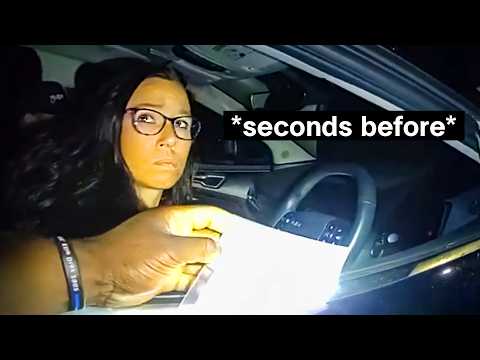
A missing rear bumper, fresh damage along the vehicle and conflicting explanations about when the damage occurred give the responding deputies a legitimate puzzle to work through. The investigation develops methodically as officers compare the driver's account with a license-plate-reader image, attempt to contact the reporting party and inspect marks on the car. That progression is one of the presentation's better features because viewers can see why the deputies continue asking questions rather than simply being told that the driver appears suspicious.
The host's 29 years in Florida law enforcement provide a useful perspective when he concentrates on procedure. He explains what an LPR is, discusses Florida's move-over requirements and points out why the deputies are trying to establish whether a crash actually occurred. He also notices a sensible interpersonal adjustment when the female deputy takes a larger role after the initial interaction becomes confrontational, interpreting it as an effort to keep the encounter from escalating unnecessarily.
Once the investigation shifts toward possible impairment, the footage becomes particularly effective at showing the mechanics of field sobriety exercises. The deputy carefully explains the eye test, walk-and-turn and one-leg stand, repeatedly gives instructions and attempts to account for the driver's stated brain injury, balance difficulties, disc replacement and sensitivity to lights. The host correctly frames the exercises as part of the officers' effort to develop probable cause rather than treating any single awkward movement as automatic proof of intoxication.
Some of the commentary is less disciplined. Labels such as "entitled," jokes about whether the woman prefers a witchcraft store or church, speculation about why she invokes being Mormon and remarks about whether the female deputy is a mother add personality but little analytical value. The assertion that criminals generally do not get along with police is similarly broad and unnecessary. These digressions encourage viewers to judge the driver's character when the far more relevant material is already available in her behavior, statements and the deputies' investigation.
The encounter eventually turns physical while officers are handling the woman, culminating in the reported bite of an officer. The host appropriately notes the health concern human bites can create for first responders, but the title's "demon mode" framing is much more sensational than the footage requires. More importantly, the presentation does not pretend that the apparent conduct seen on body camera guarantees a successful prosecution.
That distinction becomes crucial in the closing update. The host reports that she was charged with battery on a law enforcement officer, resisting an officer without violence, DUI and DUI with a BAC of 0.15 or higher, then states that prosecutors dismissed the battery count and filed no information on the other three charges. Whatever viewers conclude from the encounter itself, the presentation clearly separates initial charges from the ultimate court outcome: according to the host's account, there was no plea, trial or conviction. That final legal context substantially improves a piece that otherwise sometimes leans too heavily into mockery and personality-driven commentary.
Pros
- Clearly follows how deputies investigate the damaged vehicle and conflicting explanations rather than reducing the encounter to its eventual confrontation.
- Offers useful law-enforcement context about license-plate readers, roadside safety and the purpose of field sobriety exercises.
- Highlights the deputies' attempts to adjust their approach and give detailed instructions during the impairment investigation.
- Reports the eventual disposition of the charges and distinguishes an arrest from a conviction.
Cons
- Repeated jokes and derogatory labels encourage character judgments that add little to the procedural analysis.
- Speculation about the woman's religion and motivations is unnecessary and unsupported.
- Broad remarks about criminals and police oversimplify behavior that cannot reliably establish criminality.
- The sensational "demon mode" framing exaggerates an encounter that is already dramatic without embellishment.
The strongest material comes from watching a confusing roadside investigation develop step by step and hearing the procedural decisions explained along the way. Useful law-enforcement observations and an important closing account of the case's disposition are weakened by mocking asides and speculative character judgments that the footage does not need.