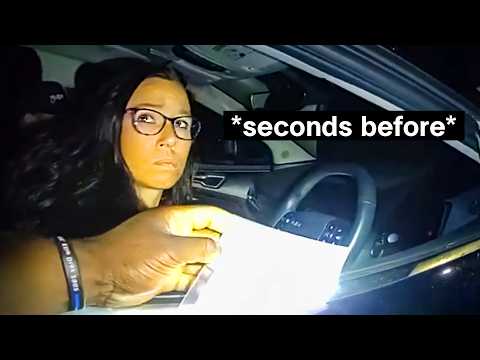
What begins as a disagreement over a vehicle being towed escalates almost immediately because the woman repeatedly blocks an officer from viewing or recording the vehicle’s identifying information. She demands explanations, insists the officer has no reason to obtain the plate or VIN, and continually positions herself between the officer and the vehicle. Whatever dispute existed over whether the car was properly parked, the footage presented here makes the more consequential conflict easy to understand: the officer is attempting to investigate, while the woman refuses to let that process proceed normally.
The confrontation becomes physical when the officer attempts to move past her and eventually detain her. The woman repeatedly says she is not touching or resisting anyone while simultaneously arguing, pulling away, refusing instructions and continuing to struggle during the handcuffing process. Other people ultimately assist the officer, and later accounts describe claw marks on the officer’s arm. Those details provide a reasonably coherent explanation for why the incident progressed from a parking complaint to a resisting-or-obstructing charge, although the video appropriately notes near the end that the suspect remains legally innocent unless proven guilty.
The strongest portion comes after additional officers arrive and begin separating the original dispute from the physical confrontation. A witness describes the officer trying to get around the vehicle while the woman blocked her, and another officer later explains to the woman’s father that she was allegedly impeding the investigation before resisting the attempt to handcuff her. The father’s calm response creates an effective contrast with his daughter’s conduct, while the sergeant’s explanation is measured enough to make the stated basis for the arrest considerably clearer than the chaotic opening footage does.
The host’s live reaction is much less disciplined. There are legitimate observations underneath it—particularly the point that arguing with an officer during an active detention is unlikely to resolve a disagreement about whether the officer is legally correct—but those observations are buried beneath relentless insults about the woman’s intelligence, comparisons to animals, George Floyd and BLM jokes, and repeated use of derogatory slurs. The commentary frequently becomes more interested in humiliating the subject than examining what happened, which weakens what could otherwise have been a straightforward discussion about escalation, compliance and challenging police conduct through later legal channels.
That tendency becomes even more pronounced when the host turns one confrontation into a sweeping diagnosis of modern culture. He argues that people increasingly cannot tolerate being told no, lack the ability to think beyond the immediate moment and treat ordinary adult behavior as oppressive. Those are broad social claims rather than conclusions established by this single incident, and the assertion that this mindset causes more problems than domestic disputes and traffic crashes combined is offered without evidence. The segment is strongest when discussing behavior visible in the encounter and weakest when treating one person as proof of a much larger cultural theory.
There is at least some genuine debate when the conversation turns to whether the first officer could have de-escalated the encounter more effectively. Another participant raises the possibility that the officer handled that responsibility poorly, while the host argues that responsibility should primarily remain with the person who escalated the dispute. That disagreement could have produced a worthwhile examination of the competing responsibilities of civilians and police officers, but the host largely dismisses the question by arguing that officers are paid primarily to enforce the law rather than to find the right verbal formula for an unreasonable person. The result is a forceful position rather than a particularly nuanced consideration of whether both personal responsibility and professional de-escalation can matter simultaneously.
Despite the excessive rhetoric, the underlying incident has a clear progression and enough competing accounts to sustain interest without embellishment. The later witness statements, police explanation and comparatively calm conversation with the father provide useful context for interpreting an initially confusing physical encounter. A more restrained presentation could have focused on those elements, distinguished the parking dispute from the alleged obstruction and resistance, and examined the arrest without turning the woman into a vehicle for insults and unsupported claims about society at large.
Pros
- The encounter has a clear progression from a parking dispute to interference with the officer’s investigation and an attempted detention.
- Witness accounts and the later police explanation give useful context for understanding why the situation escalated.
- The conversation with the suspect’s father is calm and informative, providing a strong contrast with the earlier confrontation.
- The video eventually acknowledges that the resisting-or-obstructing charge is an allegation and that the suspect is presumed innocent unless proven guilty.
- The later discussion raises a legitimate question about individual responsibility versus police de-escalation, even if it does not explore that issue deeply.
Cons
- Relentless insults, slurs and comparisons to animals overwhelm much of the potentially useful analysis.
- George Floyd and BLM jokes add little to the incident and turn serious subjects into punchlines unrelated to establishing what occurred.
- Broad claims about intelligence, generational behavior and modern culture are extrapolated from one confrontation without supporting evidence.
- The assertion that this supposed mindset causes more problems than domestic disputes and traffic crashes combined is presented without substantiation.
- The discussion of police de-escalation becomes unnecessarily binary, largely treating professional de-escalation and civilian responsibility as competing rather than potentially simultaneous obligations.
- Repetitive mocking during the struggle frequently restates the obvious instead of helping viewers distinguish the original parking dispute, alleged obstruction and later resisting charge.
There is a revealing and surprisingly straightforward escalation beneath the inflammatory commentary: a minor parking dispute becomes substantially more serious once the officer’s investigation is obstructed and an attempted detention turns physical. The later witness accounts and police explanation make that sequence worth examining, but the host repeatedly sacrifices useful analysis for ridicule and unsupported cultural generalizations. A more disciplined treatment could have made the same case about personal responsibility far more convincingly.