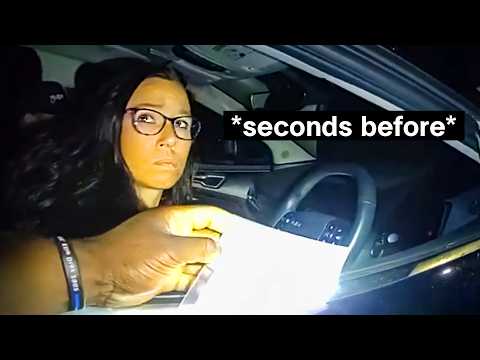
A routine traffic stop escalates into a serious narcotics investigation as officers question two increasingly agitated occupants of a vehicle. What begins with alleged traffic violations involving turn signals, window tint, and vehicle inspection quickly develops into a confrontation over police authority, consent to search, and the occupants' conflicting explanations. The encounter ultimately leads to a reported seizure of approximately 16,000 pills, giving the footage considerable significance beyond the initial roadside argument. Rather than simply celebrating the arrest, the host uses the incident to examine the legal decisions and tactical choices that could determine whether a major criminal case survives judicial scrutiny.
The host's law enforcement perspective provides valuable context throughout the encounter, particularly when evaluating officer positioning and personal safety. He notices that multiple patrol units are present from the beginning and that a plainclothes officer subsequently joins the investigation, suggesting that the stop may involve more than ordinary traffic enforcement. His discussion of officers standing opposite each other across the vehicle highlights a potential crossfire hazard, while his observations about controlling a person during a search demonstrate how seemingly minor positioning decisions can create unnecessary risks. These practical explanations give the commentary an instructional purpose that distinguishes it from a conventional police bodycam reaction.
The legal analysis is arguably the presentation's greatest strength. The host references Pennsylvania v. Mimms and Maryland v. Wilson to explain officers' authority to order drivers and passengers out of vehicles during lawful traffic stops. He also examines the distinction between a limited weapons pat-down and a consensual search, explaining why an officer's request for permission matters when reaching into someone's pockets. These discussions are accessible without becoming overly simplistic, although the precise legality of any individual search still depends on the circumstances and scope of consent.
Particularly useful is the explanation of Whren v. United States and Rodriguez v. United States, two Supreme Court decisions that establish important boundaries for traffic enforcement. The host explains that an officer's underlying investigative motivation does not automatically invalidate a stop supported by an actual traffic violation, but that officers generally cannot prolong a traffic detention for unrelated investigation without additional legal justification. His observation that approximately fifteen minutes appear to pass during the encounter raises a legitimate question about whether the detention remained connected to its original purpose. Importantly, he acknowledges that edited footage can omit critical developments, preventing him from reaching a definitive conclusion about the stop's legality.
The confrontation itself becomes increasingly revealing as the driver repeatedly demands an explanation for the stop and challenges officers' attempts to search the vehicle. Officers cite several traffic violations, while the driver disputes their explanations and insists that they issue a citation rather than continue questioning him. The host identifies communication problems among the officers, including overlapping conversations and unclear investigative responsibilities. His criticism of phrases such as "skim through" when requesting a vehicle search, and of an officer's suggestion that he can simply obtain a warrant, illustrates how imprecise language can create legal complications. The discussion also recognizes that repeatedly addressing someone with familiar street terminology may undermine communication rather than establish rapport.
The later interrogation introduces a more troubling dimension when a narcotics detective tells one occupant that cooperation could influence how the situation unfolds. The detective claims to know that the occupants have been dishonest about their movements and repeatedly presses for information about the contents of the vehicle. His references to potentially serious prison time and his willingness to help someone who cooperates create an unmistakably high-pressure exchange. However, the presentation does not fully examine the legal implications of these statements or establish exactly what evidence officers possessed before moving toward a search. The reported recovery of approximately 16,000 pills and the host's account of a federal prison sentence for the driver provide a dramatic conclusion, but those details are attributed to the original video's reporting rather than independently documented within this presentation.
The host closes by connecting the seizure to the broader consequences of synthetic opioid trafficking, citing CDC overdose figures and expressing appreciation for officers removing dangerous substances from circulation. His concern about the suspects' families introduces a human dimension, although the discussion assumes culpability more readily than his earlier legal analysis would suggest. The precise substance, its confirmed composition, and its connection to the cited overdose statistics are not sufficiently established in the presentation. A lengthy closing segment devoted to an electricians' challenge coin and channel promotion also weakens the ending, shifting attention away from the unresolved legal questions surrounding the stop. Nevertheless, the host's willingness to criticize police tactics while supporting effective enforcement gives the commentary a more balanced foundation than its dramatic premise initially suggests.
Pros
- The host provides detailed, accessible explanations of important Supreme Court decisions governing traffic stops, vehicle occupants, investigative detention, and consent searches.
- Specific observations about crossfire positioning, officer coordination, and physical control during searches offer practical lessons about police safety.
- The examination of Whren and Rodriguez clearly distinguishes lawful reasons for initiating a traffic stop from restrictions on prolonging the detention.
- The host acknowledges that edited footage can omit crucial evidence, appropriately limiting conclusions about the encounter's legality.
- Criticism of ambiguous search requests, warrant language, and conversational tactics demonstrates a willingness to scrutinize police conduct rather than automatically endorse it.
- The occupants' increasingly confrontational exchanges create a compelling real-world example of how communication problems can complicate an investigation.
Cons
- The reported seizure of approximately 16,000 pills and subsequent federal sentencing information receive limited supporting documentation within the presentation.
- The discussion of synthetic opioid deaths does not sufficiently establish the identity or composition of the seized pills before connecting the case to broader overdose statistics.
- The host identifies questionable investigative language and possible detention concerns without fully exploring their potential consequences for admissibility or prosecution.
- Observations about extreme nervousness and suspicious behavior occasionally receive more investigative significance than the available footage alone can establish.
- The extended challenge coin presentation and promotional closing interrupt the momentum after the central investigation has concluded.
An engaging roadside investigation becomes an informative examination of police procedure, constitutional limitations, and the importance of careful communication during criminal investigations. The host's practical experience and detailed legal explanations elevate the material, although some conclusions about the suspects and the recovered substances would benefit from stronger supporting evidence. Despite an unnecessarily prolonged closing segment, the presentation succeeds as both compelling police footage commentary and a useful lesson in the legal complexities surrounding major narcotics arrests.