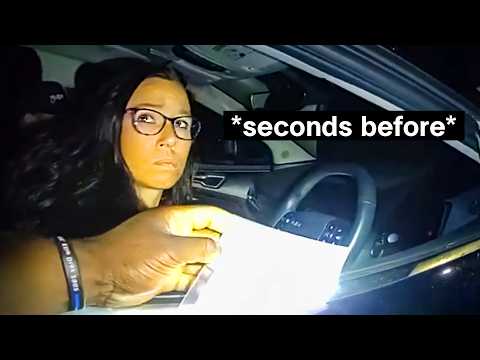
An obscured license plate quickly becomes secondary once the driver insists that he is operating through a “private trust,” claims he falls outside the officers’ jurisdiction and repeatedly invokes the Fifth Amendment instead of identifying himself. The commentary recognizes those arguments as sovereign-citizen-style reasoning and uses the stop to examine both the driver’s escalating resistance and the officers’ tactical decisions. That combination gives the segment more substance than a simple compilation of body-camera confrontation.
Sergeant Curtis is particularly effective when separating the driver’s rhetoric from what the officers are actually confronting. He identifies the private-plate language, “American national” claims, distinction between “driving” and “traveling,” and assertions about constitutional jurisdiction as unsupported arguments rather than treating them as legitimate legal loopholes. At the same time, some legal conclusions are framed broadly through phrases such as “most jurisdictions” or references to resisting laws without identifying the applicable statute, so the commentary is more convincing as practical policing analysis than as a rigorous legal breakdown of every charge.
The tactical observations are among the strongest material. Curtis notices the dog beside the driver, the shattered windshield, the passenger without a seat belt and the cramped location where officers continue conducting business near the vehicle. His suggestion that an officer move the driver toward the patrol car to create distance from the dog and unknown passenger demonstrates the kind of situational thinking that viewers would otherwise miss. The recurring emphasis on checking a dog’s temperament also makes sense within the specific circumstances rather than feeling like generic officer-safety commentary.
The sergeant’s arrival produces a more nuanced discussion than the title might suggest. Curtis initially approves of her statement that the driver can be identified at jail, but then criticizes the way she enters an already contentious conversation without first separately hearing the driver’s account. He explains why supervisors benefit from creating the appearance and reality of an independent review before backing the original officer. That willingness to critique officers who are otherwise portrayed as procedurally justified strengthens the credibility of the commentary.
Professionalism receives similar scrutiny. When an officer jokes about the possibility that the man’s dog could end up at the pound, Curtis argues that officers do not need to verbalize everything they think and should maintain professional bearing even when a detainee has created his own predicament. Later, he gives the original officer credit for repeatedly searching the vehicle for documents the arrested man desperately wants to preserve. That contrast—criticizing needless sarcasm while praising unnecessary but compassionate assistance—keeps the analysis from becoming reflexively pro-police.
The driver himself provides an extraordinary amount of material, moving through claims about corporate government, executive orders, the Federal Reserve, judges violating their oaths, private jurisdiction and a supposed constitutional right to operate the vehicle without ordinary requirements. Curtis eventually dismisses the collection as “gibberish,” which accurately conveys his assessment but is less useful than the earlier moments where he isolates individual claims and explains why officers are not persuaded by them. A more systematic distinction between each argument and the specific legal obligation at issue would have made the educational value considerably stronger.
The presentation also becomes noticeably less focused after the arrest sequence concludes. A lengthy challenge-coin segment, New Zealand police discussion, anniversary contest, scholarship promotion and subscription material extend well beyond the central incident. These portions may serve the channel’s regular audience, but they weaken the pacing of an otherwise tightly defined examination of a traffic stop that escalates because the driver refuses to abandon a legally dubious worldview.
Pros
- Tactical observations about the dog, officer positioning, passenger and vehicle create useful policing context beyond the visible argument.
- Curtis criticizes questionable officer conduct as well as the driver, particularly the supervisor’s initial approach and an unnecessary joke about the dog.
- The driver’s sovereign-citizen-style claims are clearly identified as assertions rather than accepted as legitimate exemptions from ordinary traffic enforcement.
- Praising the officer for helping recover the detainee’s important documents adds a fair example of professionalism after earlier criticism.
Cons
- Several legal explanations rely on broad references to what happens in “most jurisdictions” rather than tying conclusions to the specific law governing this stop.
- The commentary becomes less analytical when the driver’s numerous constitutional and jurisdictional claims are collectively dismissed instead of being individually unpacked.
- The extended challenge-coin, contest and scholarship material significantly outlasts the central body-camera analysis and dilutes the ending.
The strongest material comes from treating the encounter as both a study of sovereign-citizen reasoning and an opportunity to critique police tactics, supervision and professionalism. Curtis generally avoids reducing the incident to mockery, although more precise legal grounding and a tighter conclusion would make the analysis more authoritative and focused.