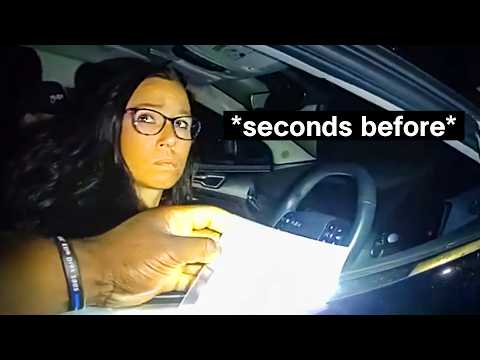
A routine traffic stop on an Arkansas highway takes an unexpected turn when a state trooper encounters a North Carolina couple returning from a cross-country trip. Initially pulled over for lingering in the left lane without passing other vehicles, the driver engages in a friendly conversation about Las Vegas, trucking, and his work. However, what begins as an ordinary roadside interaction gradually develops into a suspected drug trafficking investigation involving suspicious shipping boxes, conflicting travel explanations, and a substantial quantity of products containing controlled substances. The footage provides an interesting examination of how experienced officers investigate suspicious circumstances while maintaining a surprisingly conversational approach.
One of the presentation's greatest strengths is the trooper's ability to establish rapport without immediately revealing the direction of his investigation. Conversations about casino loyalty programs, commercial trucking, and remote employment create an informal atmosphere that encourages the driver to discuss his activities in considerable detail. The officer remains personable while asking questions about the couple's travel itinerary, employment, and reasons for visiting Las Vegas. As the encounter progresses, seemingly insignificant details become increasingly relevant, particularly the driver's explanation for transporting packages across multiple states rather than shipping them directly to their intended destinations.
The commentator adds an educational dimension by examining the officer's investigative decisions and explaining their potential legal implications. References to Rodriguez v. United States introduce the constitutional limitations surrounding the duration of traffic stops, while the discussion of United States v. Sharpe addresses how courts evaluate investigative delays. These explanations are especially relevant once the trooper requests a canine unit and the couple remains detained while officers investigate the packages. However, the legal commentary occasionally presents broad interpretations without sufficiently examining whether the specific facts establish reasonable suspicion or justify the length of this particular detention. The distinction between explaining applicable legal principles and demonstrating that an officer complied with them deserves greater attention.
Another recurring theme involves recognizing behavioral indicators that might suggest nervousness or deception. The commentator highlights the driver's apparent attempt to communicate privately with his passenger, his changing demeanor when questioned about the boxes, and physical behaviors such as stretching, drinking water, and breathing heavily. These observations provide useful examples of what officers might document during an investigation, particularly when considered alongside inconsistencies in someone's explanation. Nevertheless, the commentary sometimes gives ordinary behaviors more suspicious significance than the evidence independently supports. Nervousness during police questioning is hardly unusual, and gestures such as stretching or requesting water cannot reliably establish criminal intent without additional context.
The investigation becomes considerably more engaging when the trooper discovers packages whose shipping information appears inconsistent with the couple's stated travel plans. Officers question why boxes originating in California and apparently destined for Lubbock, Texas, would be transported toward North Carolina instead of delivered or shipped directly. Their observations concerning the placement of luggage, the driver's repeated travel through the area, and the couple's differing explanations help establish the investigative narrative. The commentator effectively emphasizes how discrepancies can become more significant when examined collectively, although some of the earlier roadside conversation runs longer than necessary before the central discovery takes shape.
The interaction between the driver and his girlfriend gives the encounter an unexpectedly personal dimension. As the officers become increasingly suspicious, the driver attempts to accept responsibility and distance his girlfriend from whatever might be discovered. Their subsequent exchanges, including his repeated requests to sit beside her and his expressions of affection, create a more complicated emotional picture than the video's sensational title initially suggests. The troopers also display moments of dry humor, discussing everything from whiskey preferences to myths about police hats and swimming pool dye. These exchanges provide occasional comic relief, but the overall experience is more focused on investigative procedure and the consequences of the couple's decisions than on consistently funny police encounters.
The discovery of products described as containing THC and psychedelic mushrooms provides the investigation's decisive turning point. Officers explain that the suspected mushroom-related controlled substance could result in more serious charges under Arkansas law, and the commentator highlights the potential consequences of transporting different categories of prohibited substances. However, the presentation does not establish a verified total quantity, laboratory confirmation of the substances, or the final charges filed against the couple. The officer's comparison between a Class Y felony and murder also requires important clarification: sharing a felony classification does not mean the offenses have identical elements or necessarily carry identical penalties. Without confirmed charging documents or a subsequent case outcome, the video cannot definitively establish the ultimate legal consequences.
Pros
- The gradual progression from an ordinary left-lane traffic violation to a suspected drug trafficking investigation creates a compelling narrative.
- The trooper's relaxed conversational approach demonstrates how rapport-building can reveal potentially important investigative details.
- Discussions of Rodriguez v. United States and United States v. Sharpe introduce valuable legal considerations regarding reasonable suspicion and prolonged traffic stops.
- The commentator's observations about officer positioning, roadside traffic, pat-down decisions, and potential escape risks add a practical safety perspective.
- Contradictions involving shipping labels, travel destinations, and the couple's explanations provide concrete reasons for examining the officers' suspicions.
- The driver's attempts to protect his girlfriend introduce an emotional dimension that makes the consequences feel more personal.
- The officers' occasional humor and casual conversations provide entertaining contrasts to the increasingly serious investigation.
Cons
- Behavioral indicators such as nervousness, stretching, drinking water, and unusual breathing receive considerable attention despite their limited reliability as independent evidence of criminal activity.
- The legal discussion explains relevant court decisions but does not conclusively establish whether the detention and canine-related delay were justified by the circumstances.
- Repeated commentary about the absence of a pat-down and the driver's positioning becomes somewhat redundant.
- The extended roadside conversations occasionally slow the pacing before the investigation reaches its central discovery.
- The sensational emphasis on humor and a gigantic drug bust exceeds what the presentation substantiates, particularly without a verified quantity of seized substances.
- The discussion of controlled-substance classifications and potential penalties lacks sufficient precision, while the couple's final charges and case outcome remain unconfirmed.
The combination of an observant Arkansas trooper, an increasingly questionable travel explanation, and an unexpected discovery makes this an engaging police encounter with meaningful investigative lessons. Although the commentator provides useful insights into officer safety and constitutional procedure, his reliance on subjective behavioral interpretations and occasionally imprecise legal explanations weakens the educational value. The result is an entertaining and sometimes surprisingly human look at a serious roadside investigation that would benefit from tighter pacing, greater evidentiary caution, and a clearer account of the legal outcome.