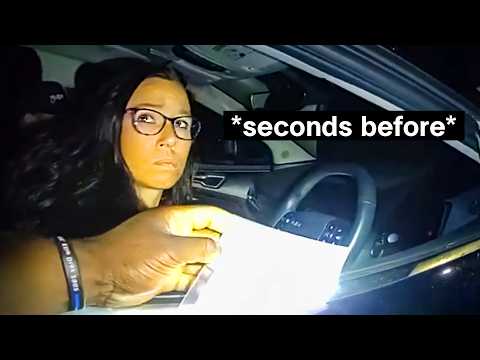
A 40-mph drive through a 25-mph residential zone begins as an ordinary traffic stop, but the encounter rapidly becomes more serious once Carlene refuses to accept the citation and drives away. The footage gives the escalation an unusually clear starting point: the deputy explains the alleged speed, returns her documents and appears ready to conclude the stop. Her decision to accelerate away instead becomes the turning point around which everything else unfolds.
The strongest portion is the sequence immediately following that departure. Rather than relying entirely on narration to characterize the driving, the presentation includes the deputy searching the neighborhood and speaking with people who say Carlene was traveling very fast and that they had to move out of her way. The deputy later describes seeing her vehicle again, attempting another stop and deciding not to pursue after she continued through the residential area. Those perspectives provide useful context, although claims about precisely what happened during portions not directly shown should still be understood as witness and officer accounts rather than independently established facts.
Carlene's eventual detention outside Walmart produces a second extended confrontation. She repeatedly complains about her shoulder, asks officers to stop, resists being placed into the vehicle and later says she is claustrophobic. The footage captures the disorder effectively, but it also becomes repetitive. Long stretches of commands, pleading and arguments communicate how difficult the arrest became without always adding much new information.
The medical episode adds more ambiguity than the commentary sometimes acknowledges. After Carlene slumps over and later ends up on the pavement, an acquaintance mentions what he describes as possible "hysterical seizures," while officers openly question whether her behavior is genuine. EMS is called to evaluate her, which is an important part of the sequence, but nothing presented establishes a medical diagnosis or proves that she was pretending. The narration and some officer comments lean toward interpreting her actions as deliberate, where a more restrained presentation would better reflect what can actually be determined from the material shown.
One useful feature is the amount of procedural discussion captured after the arrest. Deputies talk through the original speeding allegation, the subsequent driving, the decision not to chase through the neighborhood, the resisting allegation and the later interaction with EMS. That gives viewers more than a dramatic arrest clip and helps explain how an apparently minor traffic encounter accumulated additional allegations. At the same time, repeated officer summaries cover much of the same ground and could have been edited more tightly.
The closing account states that Carlene was charged with felony fleeing or eluding, resisting an officer without violence and reckless driving, while also receiving citations for speeding and running a stop sign. It further states that she posted a $4,000 bond and that the case remains ongoing. That final qualification matters: charges and citations describe allegations and legal actions taken against her, not convictions. With stronger restraint around the uncertain medical behavior and somewhat tighter editing, this would be an even more effective example of how quickly resistance to a routine traffic stop can produce far greater consequences.
Pros
- The initial stop and subsequent escalation are presented in a clear chronological sequence.
- Witness comments and the deputy's later explanation add context to the alleged reckless driving beyond the narrator's characterization alone.
- The footage shows the deputy deciding against pursuing through the residential neighborhood, providing useful context about how the incident was handled.
- The ending clearly identifies the reported charges, citations, bond and ongoing status of the case.
Cons
- Extended sections of repeated commands, pleading and officer summaries make the second half more drawn out than necessary.
- Commentary sometimes treats Carlene's unusual physical and medical behavior as deliberate without evidence sufficient to establish that conclusion.
- Some important details of the alleged driving are conveyed through officer and witness accounts rather than directly visible footage.
A remarkably avoidable escalation gives this police footage a strong narrative arc, and the extensive body-camera material makes the progression from traffic citation to arrest easy to follow. Repetition and overly confident interpretations of Carlene's medical behavior weaken an otherwise detailed presentation, especially while the underlying criminal case remains unresolved.