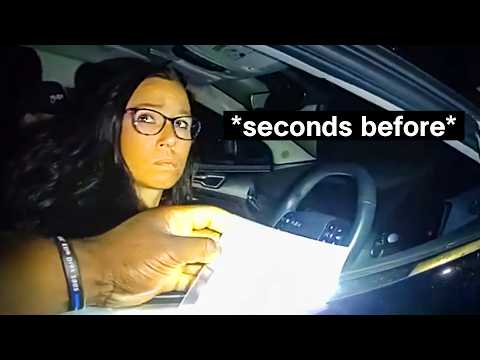
A traffic stop involving questionable vehicle registration and missing insurance quickly develops into a confrontation that raises serious questions about police procedure, personal responsibility, and tactical decision-making. What initially appears to be a relatively straightforward insurance violation escalates when the driver refuses to exit her vehicle, locks herself inside, and eventually flees to a nearby residence. The situation becomes even more complicated when officers pursue her into a home occupied by family members, including young children. Rather than simply presenting the encounter as another example of an uncooperative motorist, the commentary examines how decisions made by both the driver and responding officers contributed to an increasingly dangerous situation.
The initial roadside interaction provides important context for understanding the confrontation. Officers explain that the vehicle's registered owner has a suspended license, while records also indicate possible insurance problems and registration restrictions involving unpaid tolls. The woman maintains that she has a financial interest in the vehicle and suggests that insurance arrangements may have changed without her knowledge. Her explanations become increasingly frustrated as officers investigate the conflicting information. The presentation effectively demonstrates how an ordinary traffic stop can become complicated by incomplete documentation, disputed ownership details, and uncertainty about insurance coverage. However, the available information never conclusively establishes whether valid insurance existed at the time of the stop.
One of the commentary's most useful elements is its explanation of the legal principles surrounding vehicle stops and insurance violations. The presenter references the Supreme Court's 2020 decision in Kansas v. Glover, explaining how information about a registered owner's suspended license can support an investigative stop when officers lack evidence that someone else is driving. He also distinguishes between operating an uninsured vehicle and failing to produce proof of insurance, noting that the consequences can differ depending on jurisdiction and circumstances. These explanations give the incident educational value beyond its confrontational moments, although the legal interpretations are presented primarily through the commentator's professional perspective rather than a comprehensive examination of the applicable statutes and case law.
The encounter becomes particularly troubling when the driver requests a supervisor but refuses repeated instructions to leave the vehicle. Officers warn her that continued noncompliance could result in arrest, while she remains inside and apparently contacts emergency dispatch. The situation escalates further when officers prepare to break into the vehicle, only for the woman to drive away before they can complete the extraction. The footage creates genuine tension, but the commentary's willingness to question the officers' urgency makes this section more substantial than a conventional police confrontation compilation. The presenter asks why officers could not have waited for the approaching supervisor and whether better preparation, including measures to prevent the vehicle from fleeing, might have reduced the danger.
The subsequent pursuit and forced entry into a residence introduce another layer of legal and tactical complexity. The presenter references United States v. Santana, a 1976 Supreme Court decision concerning warrantless entry during hot pursuit, while questioning the dangers of an officer entering a residence without knowing who or what might be waiting inside. His concerns become especially relevant when the confrontation spills into a household containing frightened children and other family members. Rather than dismissing the woman's responsibility for fleeing, he emphasizes that officers must also consider whether their chosen tactics are proportionate, controlled, and likely to produce the safest outcome. The discussion is thoughtful, although its treatment of warrantless entry would benefit from greater acknowledgment that the legality of such actions depends on the specific facts and applicable legal standards.
Another revealing moment comes when an officer describes the residential entry to a supervisor. The officer's explanation suggests that his foot caught the door and forced it open, while the footage appears to show a more deliberate kick. The commentator carefully avoids declaring that the officer intentionally misrepresented his actions, instead using the apparent discrepancy to discuss professional credibility and the importance of accurate reporting. He also examines how officers might better manage distressed family members, particularly children witnessing their mother's arrest. These observations demonstrate a willingness to scrutinize police conduct without excusing the driver's behavior. Nevertheless, the edited nature of the footage limits how confidently viewers can assess the complete sequence of decisions, conversations, and actions.
The overall presentation benefits from the commentator's practical law enforcement perspective and his repeated distinction between what can be observed and what remains uncertain. His questions about waiting for supervision, planning an extraction, handling family members, and maintaining accurate accounts give the material a constructive training-oriented purpose. He also reports that the incident apparently received public scrutiny and that the involved officer was cleared following a departmental investigation, although supporting documentation is not presented. Unfortunately, the pacing occasionally suffers from repetitive rhetorical questions and lengthy interruptions. Subscription appeals, a motivational discussion about officer readiness, and an extended Marine Corps challenge coin showcase distract from an otherwise focused examination of a serious encounter. Despite these diversions, the willingness to consider mistakes and responsibilities on both sides gives the analysis considerable value.
Pros
- The progression from an insurance investigation to a vehicle barricade, pursuit, and residential arrest creates a compelling case study in escalating police encounters.
- The explanation of Kansas v. Glover provides useful legal context for understanding why officers initially stopped the vehicle.
- The distinction between lacking insurance and failing to produce proof of coverage adds practical educational value.
- The commentator challenges the urgency of extracting the driver before an approaching supervisor could intervene.
- The examination of the attempted vehicle extraction identifies important concerns about tactical planning and passing traffic.
- The discussion of residential entry and frightened family members broadens the analysis beyond the immediate arrest.
- The comparison between an officer's account and the apparent actions captured on camera raises worthwhile questions about professional credibility.
Cons
- The driver's actual insurance status remains unresolved, leaving an important factual question unanswered.
- The legal discussion sometimes simplifies complicated issues involving warrantless entry and police authority.
- Repeated questions about waiting for the supervisor create unnecessary repetition without producing a definitive explanation.
- The edited footage limits the ability to evaluate the complete circumstances surrounding the officers' decisions.
- The reported departmental investigation and clearance receive little supporting detail beyond the commentator's description.
- Subscription requests, motivational commentary, and the extended challenge coin segment interrupt the otherwise serious analysis.
This engaging police encounter analysis succeeds by looking beyond the driver's confrontational behavior to examine how law enforcement decisions can influence the outcome of an escalating situation. Its practical discussion of traffic-stop authority, tactical preparation, residential entry, and professional accountability provides meaningful educational value. Although some legal questions deserve deeper examination and several unrelated interruptions weaken the pacing, the balanced emphasis on personal responsibility and professional judgment makes this a worthwhile and thought-provoking watch.