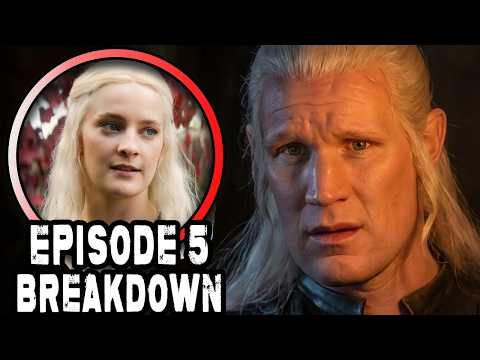
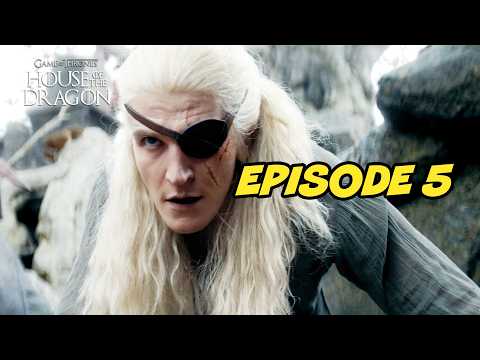
The breakdown approaches the episode as a major turning point, tracing how military losses, political paranoia, strained family bonds, and increasingly unreliable dragonriders are weakening Rhaenyra’s position. Its strongest organizing idea is that nearly every faction is beginning to fracture from within. Criston Cole meets an undignified end, Daemon loses control over his remaining authority, Rhaenyra struggles with unrest in King’s Landing, and the dragonseeds grow more resentful of the rulers they are supposed to serve. That thematic throughline gives coherence to an episode containing an unusually large number of characters and locations.
Criston’s death receives an appropriately detailed comparison with the source material. The explanation of the staged campsite, the surrounding Riverlords and Winter Wolves, his request for an honorable fight, and the refusal to grant him one clearly communicates why the sequence is meant to deny him a heroic legacy. The host’s obvious contempt for the character adds energy, although repeatedly calling him the show’s biggest “dirt bag” pushes the commentary toward celebration rather than analysis. The discussion remains useful, but a little more restraint would have allowed the scene’s deliberate rejection of chivalric mythology to carry more weight.
The video is especially effective when connecting immediate events to broader political consequences. The disappearance of the Gold Cloaks is tied to hunger, unpaid soldiers, weakened public order, attacks on religious figures, and Rhaenyra’s declining ability to address everyday grievances. Similar attention is given to Ulf and Hugh, whose frustrations are framed not as isolated misconduct but as warnings about giving extraordinary power to people whose loyalty is deteriorating. The comparison of dragons to nuclear weapons is blunt, yet it efficiently expresses why their disillusionment poses a danger far beyond ordinary insubordination.
Several book references and historical details add worthwhile context, including the Vulture Kings, the Field of Fire, coiled dragon pairs, Daenys the Dreamer, Dreamfyre’s eggs, and the old-god significance surrounding Harrenhal. The host generally identifies when the adaptation differs from the books or when the books leave room for invention. However, some interpretations are delivered with more confidence than the available evidence supports. Claims that Helaena is weaving the opening tapestry, that her embroidery depicts Alicent attempting to kill Aemond, or that references to winter and ice hint at Aemond becoming a White Walker are presented as theories, but the rapid delivery can make speculation blur into explanation.
Alys Rivers and Aemond provide the richest material in the breakdown. The video carefully examines her imagery, her interest in controlling Harrenhal, the dragon eggs she uses to tempt him, and her proposal that they establish a new dynasty. It also acknowledges uncertainty about her true motives and about how far the series may depart from the written version of events. The same measured approach would have helped the ending, where the darkly photographed attack on Corlys is treated as a probable death despite the host admitting that the scene is difficult to see and required repeated enhancement.
The presentation is energetic and impressively comprehensive, with humorous transitions and accessible reminders helping viewers follow a dense web of names and alliances. Gwayne Hightower’s competence, Ormund’s hypocrisy, Alicent’s regret over Helaena’s marriage, and Rhaenyra’s reaction to being cut by the Iron Throne all receive focused attention. Still, the constant jokes, repeated invitations for viewers to comment, and frequent use of phrases such as “crashing out” create some redundancy. The result is informative and enthusiastic, but less disciplined than it could be, particularly when moving between confirmed events, book lore, trailer-based predictions, and personal theories.
Pros
- Connects the episode’s many storylines through the shared theme of collapsing loyalty and authority.
- Provides substantial book context while identifying several adaptation changes and unresolved possibilities.
- Clearly explains the strategic consequences of Criston Cole’s death, the loss of the Gold Cloaks, and the dragonseeds’ growing resentment.
- Gives strong attention to character motivations, particularly Alys, Aemond, Alicent, Helaena, Gwayne, Hugh, and Ulf.
- Maintains an energetic, accessible tone despite the episode’s large cast and complicated political landscape.
Cons
- Some speculative interpretations are discussed with nearly the same confidence as events directly shown.
- Repeated jokes and phrases occasionally overwhelm the more thoughtful political and character analysis.
- The possible death of Corlys is treated too definitively given the acknowledged visual ambiguity.
- The dense, rapid delivery sometimes blurs distinctions between episode evidence, book history, trailer clues, and fan theories.
This is a lively and highly detailed companion to an eventful episode, strongest when explaining how personal resentment and political instability are undermining every major faction. Its extensive lore knowledge adds real value, though tighter organization and firmer boundaries between observation and speculation would make the analysis more authoritative.