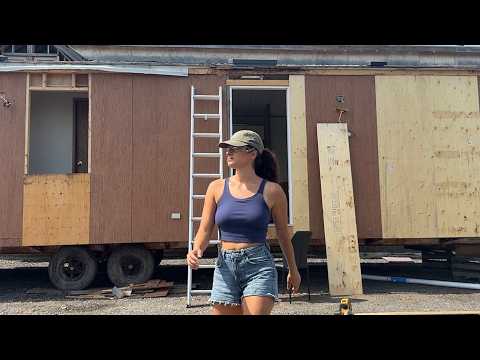
A salvaged spiral staircase becomes the centerpiece of a major renovation milestone as a determined DIY builder finally brings her long-planned installation closer to completion. After acquiring the staircase before even obtaining the shipping containers for her home, she now faces the complicated task of reassembling its handrails, balusters, and upper safety railing. What initially seems like a relatively straightforward finishing job quickly turns into a frustrating exercise in problem-solving, patience, and improvisation. The result is an engaging renovation update that captures both the satisfaction and unpredictability of working with reclaimed materials.
Much of the challenge comes from reconstructing a staircase without completely understanding how its original components fit together. Using photographs as references, the creator sorts different baluster sizes, removes old nails, identifies attachment points, and works out the correct positioning of the curved handrail. Uneven quantities of shorter and taller pieces introduce additional uncertainty, while one broken component requires gluing before installation can continue. These details make the project feel genuinely hands-on rather than presenting renovation as a sequence of effortless transformations. The creator's willingness to acknowledge confusion and reconsider her approach gives the process an appealing authenticity.
The installation becomes particularly demanding when the existing fastening holes prove too worn to securely hold replacement hardware. Longer, thicker screws and nails become necessary, forcing an inconvenient supply trip from the remote property. Hammering the numerous balusters into position also proves physically exhausting, while the upper railing presents further complications because the staircase's previous installation sat differently relative to the surrounding floor. These setbacks provide natural tension, although the repeated struggles with nails and uncertain positioning occasionally slow the presentation. The practical explanations are useful, but some sequences could benefit from clearer demonstrations of the final attachment methods.
Restoring the salvaged timber adds another worthwhile dimension to the project. White paint marks, grimy surfaces, and damaged sections require cleaning, sanding, and fresh varnish before the pieces can be incorporated into the finished structure. Rather than replacing every imperfect component, the creator works to preserve the staircase's existing character while improving its appearance. This restoration work reinforces the appeal of reusing substantial architectural features, although viewers seeking a detailed instructional guide may find the technical information incomplete. The emphasis remains on documenting personal progress rather than providing comprehensive construction guidance.
The renovation also succeeds because it connects physical improvements to the creator's everyday life. Her dog Django appears throughout the project, offering affectionate interruptions and reinforcing one of the staircase's most important purposes: allowing the dog to accompany her upstairs. The casual interactions, changing weather, and occasional moments of frustration create a relaxed atmosphere that distinguishes the presentation from a strictly instructional building channel. However, the conversational tangents sometimes interrupt the construction narrative, particularly when the main staircase project is already progressing slowly.
A substantial late detour into spring gardening reveals another challenge facing the property. The creator reflects on previously successful gardens before explaining how poor soil conditions and suspected animal damage have frustrated her current planting efforts. Her proposed solution involves temporarily growing plants near the caravan, where kangaroos appear less active, or protecting them inside a greenhouse until permanent garden spaces can be enclosed. The discussion provides useful insight into the difficulties of establishing a garden in an exposed rural environment, although the suspected causes of plant losses remain based largely on personal observation. While the gardening segment complements the broader property-development story, its length weakens the focus on the staircase promised by the opening.
The final reveal delivers the emotional reward that the earlier difficulties have been building toward. The staircase looks at home in its new surroundings, and Django's ability to reach the upstairs area gives the accomplishment a personal significance beyond its appearance. Importantly, the creator acknowledges that the project is not entirely finished: an additional bottom step, landing flooring, and enclosure of the remaining opening are still required. These outstanding tasks mean the installation should not yet be treated as a fully completed or verified safe staircase, but they do little to diminish the visible progress. After two years of anticipation, the transformation offers a satisfying glimpse of the larger home taking shape.
Pros
- Captures the genuine challenges of reconstructing a salvaged spiral staircase, including mismatched components, worn fastening holes, and difficult handrail positioning.
- Demonstrates practical restoration work through sanding, cleaning, varnishing, repairing damaged pieces, and reusing existing materials.
- Presents setbacks and problem-solving honestly instead of making the renovation appear artificially simple.
- Gives the project emotional significance through the creator's long-term building plans and Django's newfound access to the upstairs area.
- Incorporates relatable rural property challenges, including inconvenient supply runs, unpredictable weather, and difficulties establishing a garden.
- Delivers a rewarding staircase reveal that makes the accumulated effort feel worthwhile.
Cons
- Repeated struggles with nails, fastening methods, and component placement occasionally make the construction sequences feel unnecessarily drawn out.
- Provides limited technical detail about structural fastening, railing stability, and safety verification, reducing its usefulness as a practical installation guide.
- The extended gardening discussion interrupts the momentum of the main renovation and shifts attention away from the anticipated reveal.
- The staircase remains unfinished, with a missing bottom step and outstanding landing and enclosure work preventing a completely resolved conclusion.
This renovation update succeeds as an authentic and personally rewarding account of turning a long-held building ambition into visible progress. The creator's persistence, approachable personality, and willingness to show frustrating setbacks make the eventual staircase reveal satisfying, even if the presentation occasionally loses focus and lacks technical precision. Although several important finishing tasks remain, the transformation represents a meaningful milestone in the evolving container home.