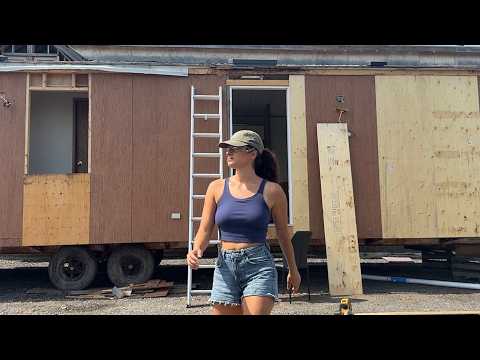
Installing insulation and a vapour control membrane around 31 exposed collar ties in an old, uneven roof is the kind of renovation challenge that tests both patience and determination. What initially seemed like an overwhelming undertaking becomes a lengthy but ultimately satisfying demonstration of persistence, practical problem-solving, and the realities of restoring an older property. The creator and Emily approach the work with a combination of technical preparation, good-natured frustration, and humour, making an otherwise repetitive construction task surprisingly engaging.
The biggest complication comes from the decision to preserve the exposed structural timbers while creating a vaulted ceiling. With collar ties positioned irregularly, sometimes differing by 300 to 400 millimetres, installing consistent runs of battens and sheep's wool insulation requires extensive cutting, notching, and adjustments. The creator explains why a simpler ceiling configuration would have avoided much of this difficulty, but their commitment to the original design adds an interesting dimension to the project. Rather than presenting renovation as a straightforward sequence of improvements, the work demonstrates how architectural preferences can create significant practical consequences.
The insulation installation provides a useful look at the physical demands of working around irregular roof structures. Multiple days are spent cutting material, positioning battens, and manoeuvring around awkward timber connections, with malfunctioning access equipment adding another layer of frustration. One particularly informative detail concerns the sheep's wool insulation, which initially appears unusually thin after being unrolled but gradually expands toward its intended thickness. The creator explains that this process can take up to two weeks, helping viewers understand why newly installed insulation might not immediately resemble its finished condition. However, the demonstration offers relatively little information about insulation performance specifications or how the chosen thicknesses relate to the roof's thermal requirements.
The transition to the Intello humidity-variable membrane introduces the project's most technically interesting stage. The creator describes a system intended to restrict moisture movement under colder conditions while allowing greater vapour transmission when conditions change. His skepticism about how a sheet material can respond to humidity makes the explanation approachable, although the mechanism is simplified and largely supported by references to manufacturer guidance and construction professionals rather than independent evidence. The distinction between a humidity-variable membrane and a conventional vapour barrier is valuable, but a more detailed explanation of moisture management, installation requirements, and potential failure points would have strengthened the educational content.
Considerable attention is given to sealing the membrane around individual timbers, where the practical difficulties become especially apparent. The creator demonstrates two types of Tescon tape, including a split-backing version designed to make awkward corners easier to manage. A six-week adhesion test on matching timber provides a useful firsthand check, while his decision to leave some flexibility in the membrane and tape reflects concern about movement within the roof structure. His uncertainty about whether staple penetrations should receive additional sealing also highlights an unresolved installation question. These observations make the process credible and relatable, although viewers should not treat the creator's individual testing and installation choices as substitutes for manufacturer specifications or professional verification.
The presentation benefits considerably from the couple's natural chemistry and willingness to acknowledge their frustrations. Their conversations about coffee, chocolate rewards, and Emily retrieving a forgotten box of chocolates from the car during heavy rain provide welcome relief from the repetitive construction work. The creator's self-deprecating commentary and occasional equipment troubles reinforce the sense that viewers are following a genuine renovation rather than an artificially effortless transformation. Nevertheless, the extended sequences of cutting, taping, stapling, and working around timber connections sometimes make the viewing experience feel nearly as repetitive as the task itself. A tighter edit could have preserved the scale of the effort without dwelling quite so heavily on its monotony.
One interruption that feels less naturally integrated is the sponsored discussion of hotel booking prices, a browser extension, and NordVPN. Although the creator connects the promotion to the expense of renovating and travelling for work, the segment temporarily shifts attention away from the roof project. Claims about finding the best available hotel prices, online protection, and VPN performance are promotional assertions rather than independently demonstrated conclusions. Fortunately, the renovation eventually returns to a satisfying milestone, with all 31 collar ties sealed and the membrane installation completed. The creator's admission that the dreaded task proved less unpleasant than anticipated provides a fitting conclusion, even though the ceiling boards, plastering, and some adjoining construction details remain unfinished.
Pros
- The unusually irregular roof structure creates a genuinely challenging renovation project, with clear explanations of why preserving exposed collar ties complicates installation.
- Detailed coverage of sheep's wool insulation, batten placement, and material expansion provides useful practical observations.
- The humidity-variable membrane installation introduces important considerations involving moisture movement, airtightness, and compatibility between construction materials.
- Demonstrations of specialized sealing tapes, adhesion testing, and working around awkward timber connections offer valuable firsthand insight.
- The creator openly discusses uncertainties, frustrations, and equipment problems rather than presenting the renovation as effortless.
- Natural humour and interactions between the creator and Emily make an otherwise monotonous construction process more entertaining.
- Completing the insulation and membrane installation around all 31 collar ties delivers a meaningful sense of progress and accomplishment.
Cons
- Repetitive installation sequences occasionally slow the pacing without introducing substantial new information.
- Technical explanations of the humidity-variable membrane rely heavily on manufacturer claims and general professional recommendations, with limited independent verification.
- The insulation discussion lacks detailed performance specifications and a fuller explanation of the roof's thermal design.
- Questions about staple penetrations, long-term movement, and unfinished perimeter sealing remain unresolved.
- The sponsored browser extension and VPN segment interrupts the renovation narrative and includes promotional claims that are not independently substantiated.
- The project reaches an important intermediate milestone rather than showing the completed vaulted ceiling, limiting the opportunity to evaluate the final appearance and performance.
This renovation installment turns an exceptionally tedious construction challenge into an entertaining and informative account of persistence, careful workmanship, and the complications of preserving an older building's character. Its strongest qualities are the practical installation details, candid problem-solving, and engaging personalities, although repetitive pacing, incomplete technical explanations, and an intrusive sponsorship reduce its overall effectiveness. For viewers interested in ambitious DIY renovations and the realities behind architectural improvements, it offers a rewarding look at the considerable effort required to achieve a seemingly simple design decision.