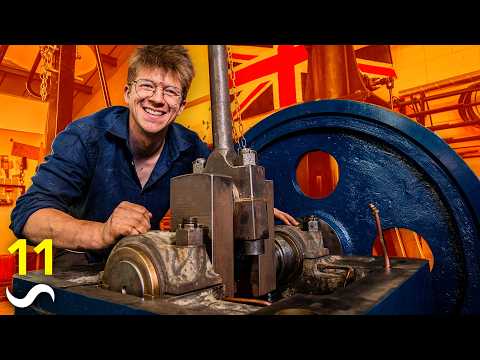
A cracked cast-iron pulley, an oversized motor shaft, and a stubborn keyway turn what initially appears to be a straightforward machining job into an increasingly complicated restoration challenge. With just 21 days remaining before the planned power hammer installation, Alec must repair the pulley, enlarge its bore from 60 to 70 millimeters, and create a secure connection to the replacement motor. The combination of demanding machining operations, unexpected setbacks, and an approaching deadline gives this installment a strong sense of purpose.
The restoration begins with an interesting examination of the pulley's condition and design. Alec questions why the specified SPB drive belt sits unusually deep in its groove before concentrating on repairing a damaged section of the cast-iron casting. His approach involves preheating the pulley, welding with nickel cast-iron electrodes, and allowing it to cool slowly. The explanation makes the repair process accessible without pretending that welding cast iron is easy. However, the uncertainty surrounding the correct belt profile remains unresolved, leaving an important part of the eventual drive system without a definitive answer.
Mounting the enormous pulley in the lathe introduces one of the installment's most engaging technical challenges. Alec openly acknowledges the risks of holding such a large, heavy component with limited chuck engagement and initially manufactures a supporting plug for the live center. Once machining progresses to the bore, that support must be removed, creating additional concerns about rigidity and stability. His decision to adapt an existing boring bar demonstrates resourcefulness, although the unconventional setup and repeated expressions of concern about the workpiece coming loose highlight the need for more systematic safety precautions.
The machining sequence becomes particularly interesting when the newly enlarged bore proves imperfect. Alec discovers a taper that prevents the keyway broach's guide bushing from fitting properly, leading to attempts at honing and carefully adjusting the mating components. Rather than concealing the mistake, he explains how boring-bar deflection or possible lathe alignment problems could have contributed. This willingness to show errors is a major strength, though the investigation never conclusively establishes the cause or fully documents the final bore geometry.
Cutting the 20-millimeter keyway provides the most satisfying mechanical achievement. After purchasing an expensive broaching set, Alec discovers that the broach and guide do not initially fit together as expected. Further modifications are necessary, followed by another obstacle when neither of his hydraulic presses offers enough working clearance. Borrowing Steve's press and fabricating additional support finally allows the broach to advance through the pulley in successive passes with shims. The visible cutting progress, growing confidence, and eventual completion make this an excellent example of practical problem-solving, even if the improvised press arrangement raises legitimate safety questions.
The presentation benefits considerably from Alec's personality and his exchanges with Jamie. Their playful arguments, self-deprecating jokes, and reactions to mechanical frustrations prevent the lengthy machining operations from becoming monotonous. The humor generally complements the workshop activity, particularly when seemingly simple measurements produce unexpectedly stubborn results. Nevertheless, some conversational detours interrupt the technical explanations, while the extended Squarespace sponsorship arrives relatively early and temporarily disrupts the momentum established by the initial repair.
The final motor-fitting sequence delivers another mixture of frustration and reward. Despite careful measurements, the pulley initially refuses to slide onto the shaft, prompting further investigation of keyway burrs, corner radii, and possible surface rust. Heating eventually helps achieve a successful installation, but Alec still needs to manufacture a retaining washer and bolt arrangement to secure the pulley axially. The installment also reveals that the enormous anvil requires blasting and painting, with Paul completing that work. These developments provide encouraging progress while making clear that the power hammer remains unfinished and has not yet undergone an operational test.
Pros
- Provides detailed, hands-on coverage of cast-iron welding, pulley machining, bore enlargement, and keyway broaching.
- Demonstrates creative workshop problem-solving through custom tooling, modified components, and adapted hydraulic press equipment.
- Honestly documents machining mistakes, measurement difficulties, and unsuccessful attempts rather than presenting an artificially smooth restoration.
- Makes technical challenges understandable through practical explanations of workpiece support, boring-bar rigidity, and interference fits.
- Delivers satisfying progress as the repaired pulley receives its new keyway and is successfully mounted on the motor shaft.
- Alec's humor and interactions with Jamie keep a demanding, occasionally frustrating restoration entertaining.
- Maintains continuity with the larger project through the installation countdown and the newly completed anvil painting.
Cons
- Several unconventional machining and pressing arrangements involve substantial mechanical hazards without sufficiently detailed safety precautions.
- The bore taper and initial fitting problems are addressed through adjustments without conclusively identifying their underlying causes.
- The drive belt's questionable fit remains unresolved despite being identified as a potential concern.
- Extended sponsorship material and occasional comedic tangents interrupt the technical progression.
- The pulley still requires its axial retaining hardware, and the completed drive assembly has not been tested under operating conditions.
Alec turns a difficult pulley repair into an entertaining and technically rewarding restoration installment, combining genuine machining challenges with inventive solutions and an engaging workshop atmosphere. Although improvised setups, unresolved dimensional questions, and occasional pacing interruptions limit its instructional precision, the completed keyway and successful motor installation represent meaningful achievements. The result is a compelling demonstration of the patience, persistence, and adaptability required to bring heavy industrial machinery back to life.