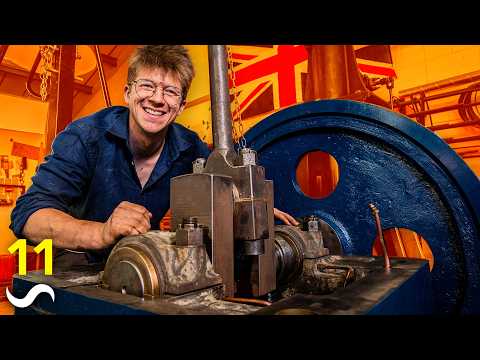
Installing a 500-weight clear-space power hammer turns out to require far more than simply lowering a heavy machine onto a concrete pad. The restoration reaches its foundation-building stage here, with aggregate, sand, reinforcement, a damp-proof membrane, multiple concrete pours, and specialist vibration-isolation material all becoming part of an unusually elaborate installation. That scale gives the project real visual and practical interest, particularly because the work is being attempted in a rented workshop with neighboring businesses to consider.
A brief account of the presenter's childhood introduction to blacksmithing gives the machine additional significance without overwhelming the construction work. Seeing the same make and model of hammer as an 11-year-old apparently helped inspire his interest in the craft, so acquiring and restoring one decades later feels like the completion of a long personal ambition rather than simply another workshop upgrade. The accompanying explanation of the clear-space design also helps establish why this particular hammer is desirable, especially its accessibility around the lower die and its sophisticated self-contained controls.
The foundation itself provides the episode's most useful technical material. Rather than pouring one enormous inertia block directly against the ground, the plan calls for a concrete "bathtub," engineered rubber-and-cork isolators, lateral restraint material, and ultimately a roughly 15-ton block supporting the machine. The presenter explains that the isolation system is intended to reduce vibration transmitted into the surrounding soil and building, and says the supplier calculated the required material using factors including machine and foundation mass, impact frequency, and power. Showing the approximately £3,200 package of specialist isolation material also communicates how expensive this seemingly invisible part of the installation can become.
There is an appropriate amount of uncertainty surrounding the DIY construction. The presenter openly acknowledges that the first slab is his first concrete pour, worries about the pressure on the formwork, and admits that its finished surface is less polished than a professional concrete finisher would likely achieve. More importantly, he addresses criticism of the earlier excavation and acknowledges that relying on apparently solid soil instead of shoring a deep pit was a safety mistake. That correction is valuable, although the project continues to involve substantial improvised work around heavy materials, deep excavations, and concrete, so the presentation should be viewed as documentation of his particular build rather than a comprehensive instructional guide.
The second pour supplies the episode's best combination of suspense and problem solving. Considerable attention goes into reinforcing the tall plywood form against concrete pressure, only for an entirely different problem to appear when the inner shuttering begins to float. Several tons of steel are added to hold it down, turning the presenter's repeated anxiety about everything that might go wrong into a genuine complication rather than manufactured drama. His conclusion that formwork's ability to float should not be underestimated is one of the clearest lessons to emerge from the experience.
Humor keeps an inherently slow construction process entertaining, from awkward trailer maneuvering and deliberately rough carpentry jokes to the recurring insistence that the enormous hole is not a swimming pool. Some of these exchanges run longer than necessary, and the Squarespace promotion interrupts the otherwise compelling transition from the machine's history into the foundation work. Even so, the episode maintains momentum because there is visible progress throughout: the excavation develops into a reinforced slab and concrete enclosure, components of the hammer are protected for later blasting and painting, and the project ends with only the final foundation pour still ahead.
Pros
- Clearly explains why the rented, neighboring workshop calls for a vibration-isolated inertia block rather than a simpler mass of concrete directly on the ground.
- Shows the foundation process in substantial practical detail, including aggregate, sand, membrane, rebar, formwork, specialist isolation material, and two concrete pours.
- Openly acknowledges the earlier failure to shore the deep excavation and explains why that was an unsafe assumption.
- The floating formwork creates a genuine problem that is solved on camera and produces a useful lesson from the DIY process.
- Personal history with the same model of power hammer gives the restoration emotional significance beyond the machinery itself.
Cons
- The lengthy sponsor segment noticeably interrupts the historical and technical explanation of the hammer.
- Some comedic exchanges and construction banter could be tightened without losing the project's personable character.
- Despite useful explanations, the highly consequential foundation work remains a DIY undertaking presented with considerable improvisation and should not be mistaken for a complete professional installation guide.
- The vibration-isolation design is described primarily through the supplier's calculations and the presenter's research rather than detailed engineering figures that would allow viewers to independently assess its expected performance.
An ambitious foundation build turns what could have been routine concrete work into an engaging combination of engineering explanation, DIY experimentation, and genuine problem solving. The willingness to show mistakes and correct an earlier safety lapse adds credibility, while the personal importance of the hammer gives all that hidden concrete a meaningful purpose.