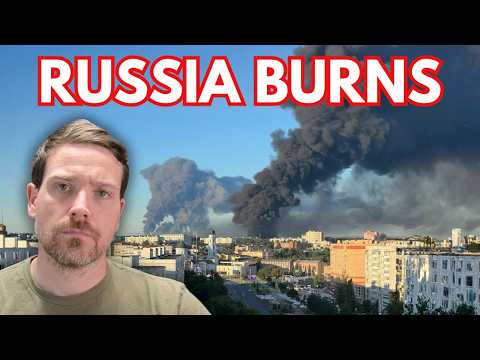
Volodymyr Zelensky’s warning that Russian airspace is becoming increasingly dangerous gives the discussion an immediately consequential starting point. The creator interprets the statement as a sign that Ukraine may intensify drone operations around major Russian airports, potentially forcing repeated closures and discouraging foreign airlines from continuing service. That is a plausible reading of the warning as presented, but the analysis quickly moves from Zelensky’s actual language about danger and drones to much stronger predictions about deliberate attacks on airport infrastructure.
The creator is at his best when drawing on his familiarity with civilian aviation. His objections to directly targeting passenger terminals or commercial aircraft are clear and consistent, and he repeatedly separates those from what he considers legitimate government or infrastructure targets. The discussion of Moscow-area airports also benefits from practical knowledge of Vnukovo in particular, where he identifies government aircraft parking, hangars, fuel storage and other areas while explaining why civilian activity makes indiscriminate attacks especially dangerous.
That aviation perspective gives the ethical argument more substance than a simple partisan reaction would. The creator supports Ukraine while nevertheless arguing that civilian aviation should remain outside the conflict, even when discussing Russian airports. He also recognizes that drones do not need to strike airliners directly to create serious hazards: airport closures, air-defense activity and the possibility of aircraft encountering drones could themselves disrupt civilian operations. This distinction between intentionally targeting civilians and creating dangerous operating conditions is important.
The biggest problem is the certainty attached to claims that remain unverified within the presentation. A reported plan involving large numbers of autonomous drones is treated as effectively confirmed because the creator believes Zelensky’s statement resembles that earlier reporting, despite also acknowledging that Zelensky’s office denied the reported plan existed. Assertions that roughly a thousand drones could be launched over several days, that airport infrastructure strikes are being planned and that specific Moscow facilities may be targeted are presented largely through unnamed information, leaks and interpretation rather than independently demonstrated evidence.
Predictions about Russian retaliation become even more categorical. The creator repeatedly says Russia will destroy Boryspil Airport if Ukraine attacks Russian airport infrastructure and at one point describes that outcome as essentially certain. Nothing presented establishes that Russia has made such a specific retaliatory commitment, so this should be framed as the creator’s expectation rather than an inevitable consequence. The same caution applies to predictions that Putin’s aircraft will immediately be dispersed eastward or that particular government jets are likely drone targets.
The segment on Russian military-blogger reactions adds a useful opposing perspective by explaining their argument that sustained Ukrainian drone pressure could disrupt Moscow airports but consume resources and provoke stronger Russian attacks. Showing falling Russian airline stocks also provides a tangible indication that markets may be reacting to perceived aviation risk, although the presentation does not establish that the movement was caused exclusively by Zelensky’s remarks. Overall, the creator combines relevant aviation knowledge, personal familiarity with the airports and a commendable concern for civilian safety with too much confidence in speculative operational details.
Pros
- The creator’s civilian-aviation background gives the discussion of airport operations, airspace hazards and infrastructure meaningful practical context.
- Clearly distinguishes opposition to attacks on passenger aircraft and terminals from his view of government aviation and certain infrastructure as military-related targets.
- Includes Zelensky’s stated warning at length rather than relying entirely on paraphrase.
- Presents Russian military-blogger arguments about resource costs, airport disruption and possible retaliation, adding some perspective beyond the Ukrainian side.
- Repeated concern about avoiding civilian casualties provides a consistent and responsible ethical framework.
Cons
- Reported or leaked Ukrainian strike plans are frequently treated as substantially confirmed despite the limited evidence presented and an acknowledged official denial.
- Predictions that Russia will inevitably destroy Boryspil Airport are expressed with far more certainty than the available information supports.
- Specific claims about thousand-drone operations, intended targets and future aircraft dispersal rely heavily on unnamed sources and speculation.
- The airport walkthrough sometimes shifts from useful aviation context into conjecture about which facilities Ukrainian forces may attack.
- Stock-market movement is presented alongside the escalation narrative without demonstrating that the warning alone caused the decline.
The creator brings valuable aviation experience and a notably careful stance toward civilian casualties to an alarming discussion of possible Ukrainian drone operations around Russian airports. His practical observations are strongest when explaining aviation risks and airport layouts, but the analysis becomes substantially less reliable when predictions and reported plans are treated as near-certainties. A more disciplined separation between confirmed statements, reported planning and personal expectations would make the argument considerably stronger.