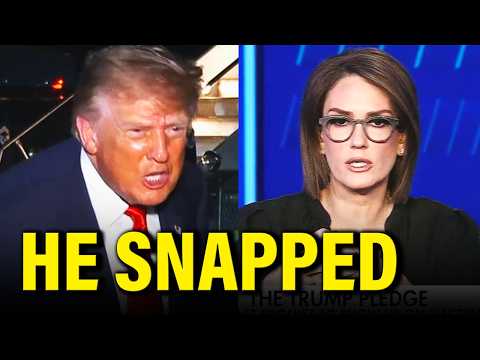
Bill O’Reilly’s markedly different language for Senator Jon Ossoff and Donald Trump gives the commentary a clear point of attack. The presentation contrasts O’Reilly calling Ossoff a “gutter-snipe” and saying he would prefer Vladimir Putin to him with much milder clips in which O’Reilly urged Trump to tone down inflammatory rhetoric. That comparison is concrete enough to support a legitimate question about whether O’Reilly applies substantially different standards to political figures he views differently.
Chris Cuomo’s confrontation with O’Reilly provides the strongest material because he presses that inconsistency directly rather than merely asserting it. Cuomo argues that O’Reilly becomes visibly angrier about Ossoff while treating Trump with comparative gentility, and the clips presented do appear to illustrate a notable tonal difference. O’Reilly responds that he has criticized Trump many times and claims to possess dozens of examples, but the excerpts actually shown are restrained compared with his language toward Ossoff, leaving Cuomo’s narrower criticism largely intact within the material provided.
There is also a worthwhile dispute underneath the personalities about journalistic priorities. The host argues that a president deserves greater scrutiny than a senator because presidential power is vastly greater, while O’Reilly contends that commentators cannot cover every offensive statement and should concentrate on whichever story they are discussing. Both ideas can coexist: limited airtime inevitably requires selection, but repeated differences in whom a commentator chooses to condemn and how harshly can still reveal an editorial double standard. The discussion would have been stronger had it explored that distinction instead of repeatedly declaring O’Reilly’s defense indefensible.
O’Reilly actually introduces one of the segment’s more substantive observations when he argues that partisan vitriol can crowd out useful information about what political parties intend to do if they win elections. Cuomo counters that commentators should embody the standards they demand from politicians, particularly when participating in media environments where personal attacks are common. That exchange briefly expands the discussion beyond Trump and Ossoff into a broader question about political media incentives, but it is quickly pulled back into personal grievances about appearances, radio shows and who treats whom fairly.
The treatment of Natalie Harp raises another important distinction. The commentary argues that criticism involving Harp is not equivalent to attacking an uninvolved private citizen because she is presented as a government employee working closely with the president. At the same time, it correctly acknowledges that public employment would not justify vicious personal attacks. The broader claims about her relationship with Trump and the consequences of Ossoff’s remarks, however, are discussed largely through assertion and disagreement rather than independently demonstrated evidence, so viewers should regard those portions as competing political interpretations rather than settled conclusions.
Presentation is where the piece loses considerable ground. The host repeatedly calls O’Reilly stupid, a “MAGA hack,” and worse while celebrating his supposed humiliation, making the desired verdict obvious long before the argument concludes. Profanity and ridicule can make partisan commentary energetic, but here they also reproduce the kind of personalized political hostility the segment is ostensibly criticizing. Even when the underlying double-standard argument is persuasive, announcing that anything humiliating a political opponent is welcome substantially weakens the credibility of the critique.
The title’s suggestion of a career-ending disaster is similarly unsupported by what is actually shown. What unfolds is an unusually contentious television argument in which O’Reilly struggles to reconcile the severity of his criticism of Ossoff with the softer Trump examples presented, not evidence that his career has ended or suffered any demonstrated professional consequence. As confrontational political commentary, the segment is lively and built around a meaningful inconsistency; as an evidence-driven assessment of O’Reilly’s broader record, it is much narrower and more partisan than its certainty implies.
Pros
- Uses specific contrasting clips to make the central argument about O’Reilly’s differing treatment of Ossoff and Trump tangible.
- Cuomo directly challenges O’Reilly’s reasoning and forces him to defend the apparent difference in tone.
- Raises a substantive question about whether political scrutiny should increase with a politician’s level of power.
- Briefly acknowledges that criticizing a public employee does not automatically justify vicious personal attacks.
Cons
- Relentless insults and celebration of O’Reilly’s humiliation undermine the argument’s criticism of inflammatory political rhetoric.
- The commentary frequently treats its interpretation of O’Reilly’s motives and political allegiance as conclusively established.
- Broader allegations involving Trump, Natalie Harp and political rhetoric receive limited evidentiary development within the presentation.
- The sensational claim that O’Reilly’s career “ends” is not demonstrated by the confrontation shown.
- Potentially substantive discussion about media priorities and political accountability is repeatedly displaced by personal feuding.
A real and fairly well-illustrated question about Bill O’Reilly’s rhetorical double standard gives this rematch more substance than its sensational packaging suggests. Cuomo’s challenge is effective, but the surrounding commentary weakens its own case through partisan triumphalism, personal abuse and certainty that exceeds the evidence presented.