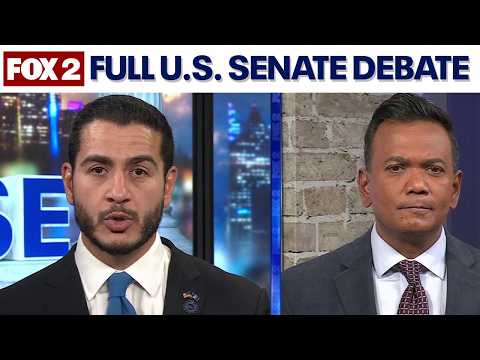
Abdul El-Sayed’s most effective move is repeatedly trying to redirect Jesse Watters from questions about gender, youth medical care, and sports toward healthcare costs, groceries, gas prices, jobs, trade, and campaign finance. Rather than simply refusing the contentious questions, El-Sayed argues that medical decisions involving minors should remain between patients, parents, and doctors, while sports eligibility should be determined by the organizations governing those sports. Whether viewers agree with those positions or not, he gives identifiable answers while making a broader argument that the interview is prioritizing cultural conflict over the economic and healthcare issues central to his campaign.
The exchange over medical care quickly becomes unusually personal. Watters presses El-Sayed about medical procedures involving minors, and El-Sayed responds by asking whether Watters is circumcised to illustrate what he sees as selective outrage over parental authority and childhood medical procedures. The comparison succeeds rhetorically in making Watters uncomfortable with a personal question after asking intimate questions about children, but it does not establish that circumcision and gender-related medical interventions are medically equivalent. The segment would be more informative with clearer distinctions among the specific procedures being discussed rather than allowing provocative terminology to substitute for clinical precision.
El-Sayed performs better when he explains what he actually wants to campaign on. He identifies Medicare for All, reducing the influence of money in politics, household finances, access to doctors, and employment as priorities, then contrasts those concerns with Watters’ questions about sports and gender. Watters counters that these cultural issues matter to voters and says the interview had already covered subjects such as gas prices. That disagreement is worth preserving because it reveals the real conflict: not simply whether El-Sayed will answer difficult questions, but which political subjects deserve disproportionate attention in a nationally televised Senate-candidate interview.
Religion produces another substantive confrontation. After Watters challenges an earlier El-Sayed statement connecting efforts to ban Sharia law with white supremacy, El-Sayed compares Sharia with Christian canon law and argues that Americans should remain free to practice their religions without imposing religious law on others. His central claim is that preemptively banning something he says American Muslims are not attempting to impose unfairly targets a small religious minority. The response explains his reasoning considerably better than the isolated quotation does, although several broader assertions about discrimination and political motives remain arguments presented by El-Sayed rather than independently demonstrated facts here.
Unfortunately, the surrounding commentary frequently abandons the analytical discipline El-Sayed himself is asking for. Jesse Watters is repeatedly described in inflammatory personal terms, while Donald Trump is labeled a pedophile and Jeffrey Epstein’s “best friend,” with the commentary later citing a claim that Trump was mentioned more than 10,000 times in Epstein-related files. Those are exceptionally serious assertions, and no supporting evidence is provided here to establish the labels or what any claimed file mentions demonstrate. The suggestion that Watters’ questioning is intended to protect pedophiles is likewise presented as motive without evidence. That rhetoric weakens an otherwise defensible critique of sensational culture-war interviewing.
The commentary also overstates what the exchange proves about Watters. El-Sayed effectively challenges him, sometimes puts him on the defensive, and consistently attempts to establish a different agenda for the conversation. That is enough material for a strong political-media critique without declaring Watters a “fake Christian,” attributing hidden motives to him, or treating every provocative question as evidence of moral depravity. The better moments come directly from the interview, where viewers can hear the interruptions, evasions, counterarguments, and competing priorities for themselves; the weakest moments occur when the narrator tells viewers what those exchanges supposedly reveal about someone’s character or intentions.
As political confrontation, the piece is energetic and contains several genuinely revealing exchanges about healthcare, religion, sports, economic priorities, and campaign strategy. El-Sayed comes across as prepared to challenge the interview’s framing rather than merely survive it, and the extended clips give enough context to understand several of his positions. Yet the presentation repeatedly undermines its own case through inflammatory accusations, unsupported conclusions, and partisan certainty. A more restrained analysis could have made essentially the same criticism of Watters’ interview style while leaving viewers with a clearer distinction between what happened on screen, what El-Sayed argued, and what the commentator believes it means.
Pros
- El-Sayed repeatedly articulates concrete campaign priorities rather than merely objecting to uncomfortable questions.
- Extended interview exchanges provide useful context for his positions on healthcare decisions, sports eligibility, religious freedom, and economic concerns.
- The disagreement over whether culture-war subjects deserve such prominence exposes a meaningful difference in political and media priorities.
- El-Sayed’s response to the Sharia-law question explains the reasoning behind his position rather than simply rejecting Watters’ framing.
Cons
- Serious accusations about Donald Trump, Jeffrey Epstein, and alleged protection of pedophiles are presented without evidence sufficient to establish those claims.
- The commentary relies heavily on insults and assertions about Watters’ character and motives instead of limiting itself to what the interview demonstrates.
- The circumcision comparison is rhetorically provocative but does not adequately distinguish substantially different medical procedures.
- Partisan framing sometimes overwhelms potentially valuable analysis of how political interviews prioritize and construct culture-war disputes.
El-Sayed’s willingness to challenge the interview’s priorities produces a revealing confrontation about what political candidates and media figures believe voters should be discussing. The underlying media critique has real substance, but inflammatory commentary and inadequately supported accusations make the presentation less rigorous than the interview material deserves.