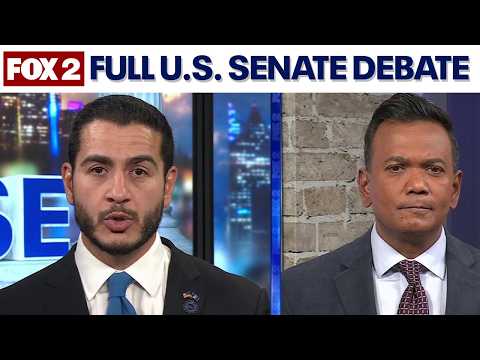
Abdul El-Sayed repeatedly tries to drag a combative Fox News interview away from immigration, religion, guns, transgender issues, and other culture-war questions and toward healthcare, prices, jobs, and the cost of living. That tension gives the exchange its central dynamic: Jesse Watters wants direct answers about El-Sayed’s controversial positions, while El-Sayed often challenges the premise or redirects toward what he considers more important concerns for Michigan voters. The surrounding commentary enthusiastically treats his willingness to push back as evidence that Democrats should approach hostile media more aggressively.
El-Sayed is particularly effective when he refuses to become defensive. He argues that immigration enforcement existed before ICE, challenges Watters over interruptions, questions the priorities behind banning Sharia law, and repeatedly asks why economic affordability receives less attention than cultural controversies. His joke that opponent Mike Rogers is a “beta” works precisely because it temporarily changes the relationship between guest and host; Watters laughs rather than immediately attacking. The commentator correctly identifies this relaxed confidence as an important part of El-Sayed’s performance.
That confidence does not mean every answer is equally convincing. Asked about the Second Amendment, the NFL and race, reparations, and other subjects, El-Sayed sometimes substitutes the issue he would prefer to discuss for the question actually asked. Redirecting toward healthcare costs or football ticket prices may be politically useful, but Watters is justified in identifying several of these responses as evasive. The interview is therefore more revealing as a demonstration of message discipline than as a thorough examination of El-Sayed’s positions.
The economic exchanges contain some of the most substantive disagreements, including wealth taxation, Medicare for All, energy policy, federal spending, tariffs, and military expenditures. El-Sayed argues that extremely wealthy Americans can contribute more while remaining extraordinarily wealthy and consistently frames government policy through its effect on household finances. Watters counters with concerns about government spending, taxation, and individual economic freedom. Both sides cite numerical or factual claims—including polling figures, federal spending, prescription-drug votes, immigration trends, and healthcare preferences—but those claims are largely asserted rather than established within the discussion, making the exchange more useful for understanding competing political arguments than verifying them.
Foreign policy produces a similarly sharp contrast. El-Sayed condemns the Iranian regime while arguing that military action can leave the United States trapped in conflicts without clear exits, and he presents the JCPOA as a preferable approach to nuclear containment. Watters emphasizes damage inflicted on Iran’s nuclear capabilities. The commentator strongly sides with El-Sayed and expands into criticism of the war, disrupted shipping, and Republican thinking, but the highly sarcastic delivery often replaces careful examination of disputed geopolitical claims with ridicule.
The discussion of religion is more focused. El-Sayed argues that legislation against Sharia targets a small Muslim minority over a threat he says is not actually occurring, comparing freedom to practice Islam with the freedom of Christians to follow their own religious rules. The commentator develops this into a broader argument that manufactured controversies can become wedges for excluding minorities from public life. That interpretation is clearly presented as political analysis rather than demonstrated fact, but it is one of the more coherent extensions of El-Sayed’s argument because it engages directly with the reasoning behind the policy dispute.
The commentary is at its weakest when entertainment overwhelms analysis. Extended riffs about international shipping, circumcision, healthcare companies, Rupert Murdoch, Donald Trump’s humor, and caricatures of Republican psychology are energetic and occasionally funny, but they substantially lengthen the piece without consistently clarifying the interview. More importantly, some factual assertions are delivered with absolute confidence despite receiving no supporting evidence here, including claims about medical procedures, polling, media behavior, and political motivations. The commentator is persuasive when dissecting rhetorical technique—especially El-Sayed’s humor, composure, and strategic reframing—but considerably less rigorous when turning those observations into sweeping conclusions about Republicans, liberals, or the media.
Pros
- El-Sayed’s composure, humor, and willingness to challenge Watters directly make the hostile interview unusually engaging and demonstrate effective adversarial-media technique.
- The commentary perceptively examines how El-Sayed redirects culture-war questions toward affordability, healthcare, jobs, and other economic concerns.
- Several exchanges expose genuine ideological differences over taxation, healthcare, immigration enforcement, energy, religious liberty, and foreign policy rather than reducing the encounter entirely to personality.
- The moment involving Mike Rogers provides a concrete example of humor briefly breaking through the interview’s otherwise confrontational rhythm.
Cons
- El-Sayed genuinely avoids directly answering several questions, even when his preferred reframing raises worthwhile issues of its own.
- Numerous political, economic, polling, historical, medical, and foreign-policy claims are asserted without enough evidence in the discussion to establish their accuracy.
- The commentator’s strongly partisan framing sometimes turns analysis into ridicule and attributes broad motives to Republicans, liberals, and media institutions without demonstrating them.
- Long comedic tangents about shipping, circumcision, healthcare companies, Donald Trump, and Rupert Murdoch dilute an otherwise interesting examination of political communication.
El-Sayed’s ability to remain conversational, funny, and focused on his preferred economic message makes the interview compelling even when his answers become evasive. The accompanying commentary offers sharp observations about adversarial interviewing and political framing, but its excessive tangents, partisan certainty, and unsupported factual assertions keep it from becoming an equally strong piece of political analysis.