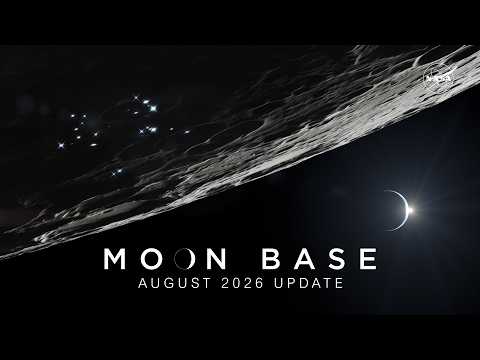
Cosmic imagery carries the entire experience here, with the presentation apparently built around simulated views of space rather than narration, explanation, or storytelling. The only supplied audio content is music, so the piece functions primarily as a visual showcase rather than an educational exploration of the universe.
That minimalist approach has an obvious strength for a subject driven by scale and spectacle. Removing spoken commentary allows the simulated environments to remain the focus, potentially giving the imagery a more contemplative quality than a conventional astronomy video filled with facts, labels, and explanations. Music can reinforce that sense of wonder without constantly interrupting the views.
The simulation framing is also important because it avoids presenting these sights as literal footage captured by a spacecraft or telescope. The premise promises perspectives that viewers would not ordinarily experience directly, making imaginative visualization rather than documentary observation the central attraction. Beyond that distinction, however, there is not enough information provided to assess how accurately particular celestial objects, distances, lighting conditions, or astronomical phenomena are represented.
That lack of commentary substantially limits the video's educational value. There are no descriptions identifying what viewers are seeing, explaining how the simulated perspectives were created, or distinguishing realistic astronomical modeling from artistic interpretation. Anyone hoping to understand the science behind the imagery is therefore given little material to work with.
The absence of narration also means there is almost nothing in the spoken content from which to judge pacing, structure, factual rigor, or the progression between individual sights. A purely audiovisual presentation can succeed without those elements, but it places unusually heavy responsibility on the visuals and music to create variety, momentum, and meaning on their own.
As a concept, the piece is straightforward and potentially immersive: use simulation to provide impossible or inaccessible cosmic viewpoints and let viewers experience them without verbal distraction. That makes sense as atmospheric entertainment, but the minimal informational content prevents a deeper evaluation of either its scientific substance or the specific choices behind its simulated universe.
Pros
- Simulation provides a fitting format for presenting cosmic perspectives that cannot ordinarily be experienced firsthand.
- The absence of narration can preserve a quiet, immersive focus on the imagery.
- Music offers an unobtrusive way to give a visual space showcase atmosphere and continuity.
Cons
- No explanatory narration or substantive spoken information provides context for the simulated sights.
- Viewers are given no basis for judging which visual details are scientifically modeled and which may be artistic interpretation.
- The extremely limited informational content offers little educational value alongside the spectacle.
As a simulation-driven visual experience, the concept has the potential to deliver cosmic spectacle without unnecessary verbal clutter. Its reliance on music and imagery may suit viewers seeking atmosphere, but the lack of context or explanation leaves the scientific and educational side notably underdeveloped.