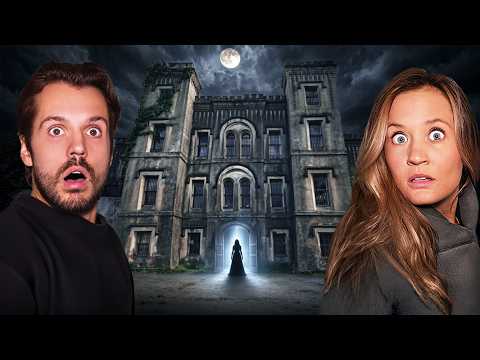
The Duke of Lancaster's deserted bars, deteriorating passenger areas, and remarkably preserved maritime equipment provide an atmospheric setting for an overnight exploration with Sam and Colby. Stranded on the North Wales coast for decades, the former passenger liner offers an unusual combination of maritime history, abandoned entertainment facilities, and alleged paranormal activity. The creators make excellent use of the ship's enormous interior, although the promise of discovering something more haunted than the Queen Mary ultimately proves more ambitious than the evidence they uncover.
The historical introduction establishes a fascinating background, tracing the vessel's construction in Belfast, its passenger service beginning in 1956, and its eventual transformation into the Fun Ship after being deliberately beached in 1979. The account of vintage arcade machines being recovered years later adds an especially intriguing detail. However, the historical explanations become less dependable when the group discusses alleged construction fatalities, passenger deaths, and the attraction's closure. These claims are presented through uncertain recollections and conversations rather than documented records, leaving important aspects of the ship's history unresolved.
Exploring the interior produces some of the most enjoyable material. The Pirate Bar, Lancaster Bar, old cafeteria, crew cabins, and Poseidon-themed lounge reveal how extensively the vessel was adapted for entertainment. Original-looking menus, outdated advertisements, abandoned furniture, and inexpensive food prices create a convincing sense of stepping into another era. The wheelhouse is particularly impressive, with its surviving communications equipment, control panels, and master clock. Unfortunately, occasional speculation about the equipment's origins and historical significance is delivered with more confidence than the available information supports.
The chemistry between the explorers keeps the lengthy walkthrough entertaining. Their unsuccessful search for the bridge, jokes about British food, fascination with the ship's numerous bars, and attempts to recreate a famous Titanic pose create a relaxed atmosphere. Sam and Colby contribute enthusiasm without overwhelming the host's exploration. Nevertheless, repeated expressions of amazement and extended conversations about relatively minor discoveries sometimes slow the pacing. A lengthy merchandise and Patreon promotion also interrupts the momentum just as the exploration reaches one of its more visually interesting stages.
Once darkness falls, the production shifts effectively toward paranormal investigation. Empty corridors, unfamiliar mechanical noises, and the isolation of the beached vessel create genuine suspense without requiring dramatic supernatural encounters. The investigators experiment with REM pods, a music box, recording devices, a spirit box, and an Alice Box, attempting to identify locations where alleged spirits might communicate. Their movement from the crew quarters to the Poseidon Bar and eventually the wheelhouse gives the investigation a recognizable progression, although equipment malfunctions and ambiguous noises are frequently interpreted as potentially paranormal before ordinary explanations receive sufficient consideration.
The strongest investigative sequence occurs in the Poseidon Bar, where apparent equipment responses coincide with jokes about ordering drinks from a supernatural bartender. The unexpected failure of a charged light adds tension, while reported growling and other noises intensify the group's reactions. Earlier, the investigators interpret words such as "servant" and "laborer" as meaningful connections to the crew quarters. These moments are entertaining, but they do not establish communication with spirits. Randomly generated words, unclear recordings, environmental interference, and subjective interpretations provide insufficient evidence to distinguish paranormal activity from coincidence or equipment behavior. To their credit, the investigators occasionally acknowledge uncertainty, including when a supposed recording response cannot be heard consistently.
The final investigation in the wheelhouse offers additional atmosphere but little decisive evidence. The group attempts to contact the captain, interprets several indistinct spirit-box sounds as possible answers, and receives intermittent equipment activations. Time restrictions create urgency, but they also prevent extended testing or meaningful attempts to reproduce the apparent responses. The promised return to the animal-holding area never becomes a substantial concluding investigation. By the end, the creators themselves acknowledge that obtaining convincing evidence aboard such a large vessel is difficult, making the experience more successful as an atmospheric adventure than as proof of a haunting.
Pros
- The Duke of Lancaster provides an exceptionally atmospheric setting, combining abandoned maritime spaces with remnants of its former entertainment attractions.
- The historical introduction offers engaging context about the ship's passenger service, conversion into a car ferry, and later life as the Fun Ship.
- Exploration of the vintage bars, cafeteria, crew cabins, and wheelhouse reveals numerous fascinating details that make the location compelling beyond its paranormal reputation.
- The host's natural chemistry with Sam and Colby produces entertaining conversations, spontaneous humor, and enthusiastic reactions throughout the exploration.
- The transition from daylight exploration to nighttime investigation effectively increases suspense through dark corridors, isolated rooms, and unexplained environmental sounds.
- Multiple investigative locations and devices provide variety, while occasional acknowledgments of uncertainty prevent every ambiguous occurrence from being treated as definitive proof.
Cons
- Claims about deaths aboard the vessel, construction fatalities, and specific historical circumstances lack adequate documentation or independent verification.
- Paranormal interpretations rely heavily on ambiguous electronic responses, indistinct recordings, and equipment behavior without sufficient controls or attempts to eliminate ordinary explanations.
- The suggestion that the ship might be more haunted than the Queen Mary is never supported by a meaningful comparison or convincing evidence.
- Repeated reactions, extended wandering, and occasional confusion about the ship's layout create unnecessary pacing problems.
- A lengthy promotional segment disrupts the exploration, while some speculative explanations of historical equipment and shipboard facilities reduce informational reliability.
- The investigation ends under significant time pressure, leaving several potentially interesting locations unexplored and the most intriguing reported phenomena insufficiently examined.
The Duke of Lancaster proves to be a fascinating destination, and the combination of maritime history, abandoned interiors, and entertaining group chemistry makes this an enjoyable exploration. Although the nighttime investigation generates several unsettling moments, the paranormal evidence remains too ambiguous to justify the more sensational haunting claims. Viewers interested in unusual abandoned locations and atmospheric ghost-hunting entertainment will find plenty to appreciate, even if those seeking a rigorous supernatural investigation are likely to leave unconvinced.