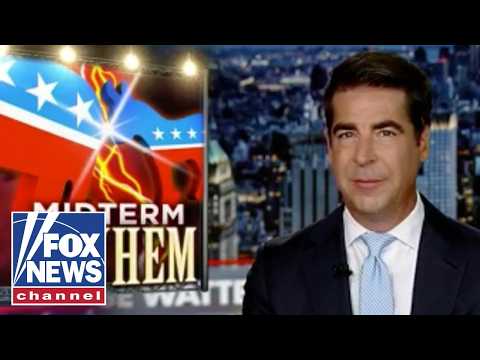
Mass demonstrations against Donald Trump provide the opening for an urgent political commentary that quickly expands into questions about presidential power, international alliances, and American credibility. The host highlights the nationwide No Kings protests, describing thousands of demonstrations involving millions of participants while criticizing Trump's presence at Mar-a-Lago. Footage of protesters marching through Washington, D.C., establishes the public opposition at the center of the story. However, the presentation offers limited independent documentation of crowd estimates or evidence that Trump's Florida visit represents a retreat directly caused by the demonstrations.
JD Vance's remarks about presidential authority become an early target, with the host playing excerpts from an interview in which Vance compares American executive decision-making with the bureaucratic systems of Russia and China. The clips provide useful opportunities to examine Vance's argument that American presidents can exercise considerable practical authority despite operating within a democratic system. Unfortunately, the host frequently substitutes insults and sweeping denunciations for a sustained examination of constitutional limits, executive powers, or Vance's underlying reasoning. The confrontational delivery communicates outrage effectively but sacrifices opportunities for more substantive political analysis.
The discussion becomes more detailed when addressing Ukraine's reported difficulties with Starlink connectivity. Citing Financial Times reporting and statements attributed to Volodymyr Zelenskyy, the host describes restrictions affecting Ukrainian drones and interceptors, including a reported connection limit at approximately 161 kilometers per hour. The explanation makes the potential military consequences understandable, particularly for operations dependent on satellite communications. However, the conclusion that Trump and Elon Musk deliberately imposed these restrictions to force Ukraine's surrender goes beyond what the presented evidence independently establishes. The reported technical testing raises legitimate questions, but distinguishing those questions from proven intent would considerably strengthen the argument.
American economic dealings with Russia receive similarly forceful treatment. The host discusses an executive order described as waiving sanctions under the Graham Act, then cites statements attributed to Russian envoy Kirill Dmitriev concerning potential cooperation involving diesel, uranium, fertilizers, aluminum, rare earth minerals, and energy projects. These specifics give the segment greater informational substance than its more rhetorical passages. Nevertheless, the presentation treats the described sanctions waiver, prospective commercial agreements, and wider geopolitical motivations as parts of a largely settled narrative without sufficiently separating documented actions from proposed transactions and interpretations. The suggestion that Russian diesel supplied to America could originate in Iran is explicitly speculative and would benefit from supporting evidence.
The escalating maritime conflict around the Strait of Hormuz introduces another substantial subject. The host describes reported Iranian attacks on commercial vessels, refers to videos purportedly showing damaged tankers, and discusses possible casualty-free vessel-loss totals ranging far beyond the acknowledged minimum. The immediate reporting style creates urgency, and references to maritime monitoring organizations suggest an attempt to connect the commentary with operational developments. Yet the distinction between confirmed attacks, Iranian claims, unreported incidents, and estimates remains inadequate. Speculation that 75 or 80 tankers may have been destroyed is particularly consequential and cannot be treated as established simply because some incidents might go unreported.
Canada provides a more constructive contrast through an interview excerpt featuring Prime Minister Mark Carney. His remarks about Canadian consumers choosing domestic products, businesses diversifying trade relationships, and the country building greater economic independence offer a clearer explanation of how political tensions can influence everyday decisions. The host connects this message to concerns about dependence on American military technology, contrasting the F-35 with Sweden's Gripen fighter. Although the argument about reliability and strategic trust is worth considering, the comparison does not examine the aircraft's capabilities, maintenance arrangements, or procurement implications in sufficient detail to support a definitive purchasing conclusion. Still, Carney's own remarks are among the presentation's more useful contributions.
The overall production maintains a rapid pace through interview excerpts, reported developments, protest imagery, and pointed commentary. Its greatest advantage is the ability to connect several major political and international issues around a consistent theme of trust in American leadership. Its greatest weakness is that the relentless condemnation often makes important distinctions between evidence, allegation, and interpretation difficult to maintain. The promised nationwide protest coverage also takes a secondary role as the discussion moves into Ukraine, Russia, Iran, and Canada. Repeated personal attacks and a closing promotional pitch for the host's book further weaken the journalistic focus, leaving an energetic presentation that is more effective at reinforcing its political viewpoint than carefully testing its claims.
Pros
- Footage of the No Kings demonstrations provides a timely and recognizable starting point for discussing public opposition to the administration.
- Direct excerpts from JD Vance and Mark Carney allow viewers to hear the political figures' remarks rather than relying entirely on the host's characterization.
- Specific discussion of Starlink restrictions and their potential consequences for Ukrainian drone operations makes a complicated military technology issue accessible.
- References to proposed Russian economic agreements, sanctions policy, and maritime security connect separate international developments into a coherent political argument.
- Carney's discussion of Canadian economic independence offers a practical perspective that contrasts with the predominantly confrontational commentary.
- Energetic delivery and frequent supporting clips maintain momentum across a broad range of subjects.
Cons
- The headline emphasis on nationwide protests is not matched by sustained coverage, independently substantiated crowd figures, or evidence that the demonstrations prompted Trump's movements.
- Personal insults and inflammatory language frequently replace detailed examination of the opposing political arguments.
- Claims that Trump and Musk deliberately restricted Ukrainian military capabilities to force surrender are presented with greater certainty than the cited reporting establishes.
- The discussion of Russian sanctions, economic agreements, and potential Iranian connections does not consistently distinguish confirmed developments from speculation.
- Estimates of tanker destruction substantially exceed the stated minimum without sufficient independent verification or a transparent methodology.
- The wide range of subjects dilutes the central protest story, while the extended book promotion distracts from the closing political analysis.
A passionate and wide-ranging political commentary connects domestic protests with consequential questions about American foreign policy, economic relationships, and international trust. Its direct interview excerpts and specific geopolitical details provide useful material, but the frequent exaggeration, insufficient verification, and aggressive partisan framing undermine its analytical credibility. Viewers seeking an emphatic perspective will find plenty of energy, while those looking for measured reporting and carefully supported conclusions may find the presentation considerably less convincing.