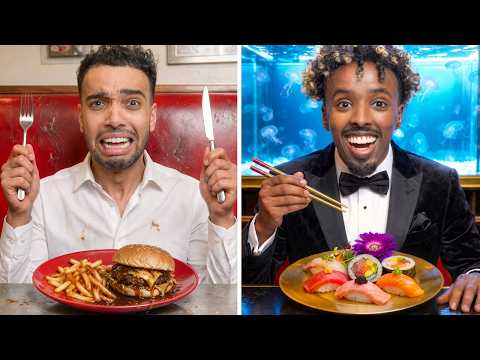
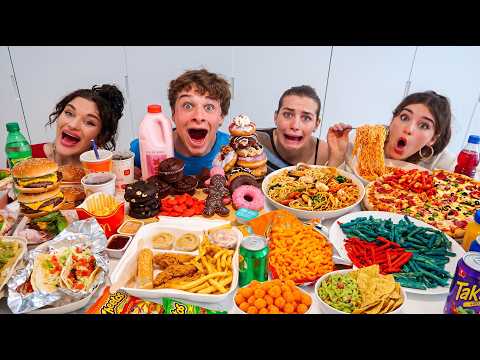
A five-dollar fast-food meal eaten beside a pile of half-clean clothes establishes exactly what kind of food comparison this is going to be. Rather than treating price as a reliable measure of quality, the host repeatedly pits cheap delivery staples against extravagant restaurant orders and judges them according to taste, convenience, and whether the extra expense feels remotely justified. The deliberately shabby bedroom setting makes the contrast funnier, especially once $250 burgers, $300 Chinese dinners, and catered sushi start arriving at the same folding-table-style setup.
The burger comparison captures the format at its best. McDonald's earns enthusiastic praise largely for value and familiarity, while the much more elaborate Sipping Guzzle order arrives with Wagyu, pickles, an alcoholic truffle milkshake, collectible cards, and elaborate packaging. The host clearly enjoys the expensive meal, particularly the tenderness of the beef and the pickles, but still questions whether it functions as a burger or warrants anything close to its cost. Declaring McDonald's the winner is partly a recurring channel joke, yet the segment still illustrates the video's broader argument that theatrical presentation can lose much of its appeal once expensive restaurant food becomes takeout.
Delivery quality becomes an important variable in the fried-chicken section. Wingstop's wings receive relatively straightforward observations about acidity, seasoning, tenderness, and the difference between flats and drumettes. The expensive Korean fried chicken suffers because it apparently spent more than an hour in transit, making several sides soggy before they could be judged fairly. The host acknowledges that problem instead of pretending the food arrived under ideal conditions, and although the actual chicken earns strong praise, the comparison is compromised enough that the cheaper option's victory says as much about takeout resilience as cooking skill.
The pasta and Chinese sections are similarly strongest when the commentary focuses on specific textures and preparation. Cheap pasta is described as gummy and factory-made but inexpensive enough to retain some value, while dishes from Al Millino Prime draw distinctions among creamy sauces, crisp guanciale, truffle richness, underseasoning, and steak cookery. The Chinese comparison adds useful attention to roast meats, chili chicken, lotus root, noodles, and Peking duck preparation. Some background claims about restaurant history and ingredients are presented conversationally rather than substantiated, however, and the host's explanation of konjac includes oversimplified nutritional language about calories and energy expenditure that should not be treated as an established dietary conclusion.
Pizza produces one of the clearer victories because the expensive option earns its praise through identifiable qualities rather than price alone. The inexpensive slice is criticized for a gummy center despite its appealing appearance, whereas the higher-end pies are judged on crispness, tomato flavor, Parmesan, béchamel, toppings, and structural consistency from crust to tip. The humor about accidentally financing pizza in installments is absurd enough to fit the surrounding presentation while reinforcing just how far the comparison has drifted from ordinary takeout economics.
The catered sushi finale changes the scale of the concept entirely. Bringing a chef and service setup into a small apartment creates the most distinctive sequence, and the detailed progression through salmon and ikura, toro and caviar, uni and truffle, scallop, mushrooms, crab, miso-marinated fish, hand rolls, and desserts gives the tasting more depth than several earlier categories. Comments about citrus, shallots, roe, pickles, miso, matcha, truffle, and contrasting textures are specific enough to communicate why individual bites succeed. The joking interactions with the staff are intentionally awkward and occasionally crude, but they also prevent an inherently luxurious private-chef experience from becoming overly reverential.
That same comic style is the main limitation across the tour. Sexual jokes, exaggerated insults, deliberately grotesque food descriptions, and recurring bits about isolation often overpower potentially useful culinary observations, while the comparisons themselves are not controlled tests: delivery times, portion sizes, restaurant formats, and even entire service experiences vary dramatically. Still, the host is unusually willing to criticize expensive food, praise cheap food, and admit when circumstances may have damaged a dish. The result works less as a definitive ranking of New York takeout than as an entertaining examination of how price, packaging, travel time, freshness, and spectacle alter the experience of eating restaurant food at home.
Pros
- Price comparisons regularly focus on whether expensive dishes deliver meaningful improvements in flavor, texture, preparation, or experience rather than assuming higher cost means higher quality.
- Specific observations about crispness, acidity, seasoning, rendered fat, creaminess, truffle, pickling, bread texture, and delivery degradation give many tastings useful culinary detail.
- The apartment setting creates a consistently funny contrast with increasingly extravagant meals, culminating effectively in a fully catered sushi service.
- The host openly acknowledges compromised delivery conditions and frequently criticizes expensive dishes that fail to justify their price.
- The sushi, pizza, Peking duck, and pasta segments provide enough preparation and ingredient detail to move beyond simple reaction-based eating content.
Cons
- Delivery delays, differing service formats, enormous price disparities, and inconsistent ordering conditions make several cheap-versus-expensive comparisons inherently uneven.
- Crude sexual jokes and exaggerated food insults are so frequent that they sometimes distract from stronger observations about the dishes themselves.
- Historical, nutritional, and ingredient explanations are occasionally presented without supporting context, including an oversimplified claim about konjac and calorie expenditure.
- Some verdicts are driven partly by recurring channel jokes or personal preference rather than a clearly consistent judging standard.
- Several expensive meals are effectively being judged as takeout even though their presentation and freshness appear designed primarily for on-site dining.
The chaotic bedroom setting gives an otherwise familiar cheap-versus-expensive format a distinctive identity, and the best segments show genuine attention to how restaurant food survives delivery and whether luxury pricing translates into better eating. Uneven comparison conditions and relentless crude humor limit its usefulness as a serious food guide, but the willingness to criticize prestige dishes and describe specific flavors keeps the tour from becoming empty extravagance. The catered sushi finale provides an appropriately excessive and surprisingly detailed conclusion.