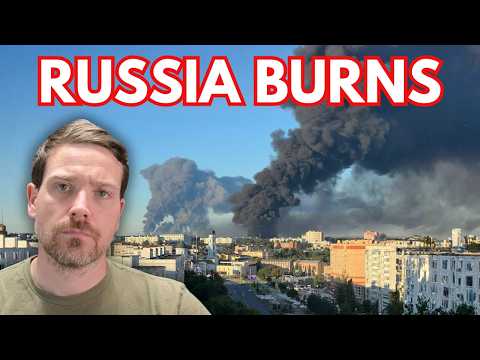
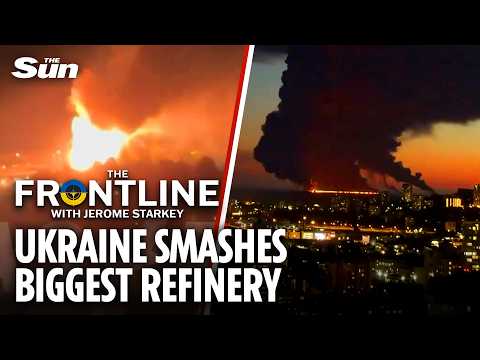
Ukraine’s reported strike on gas facilities roughly 3,000 kilometers inside Russia provides a striking centerpiece for an update focused on the expanding reach of Ukrainian drones. The presentation effectively conveys why attacks in northern Siberia would represent a significant development, while also showing some restraint by acknowledging uncertainty about whether visible flames came directly from a strike or from emergency flaring after operations were disrupted. That distinction is valuable, although the broader claim of a successful strike still rests primarily on Ukrainian reporting and limited imagery presented here.
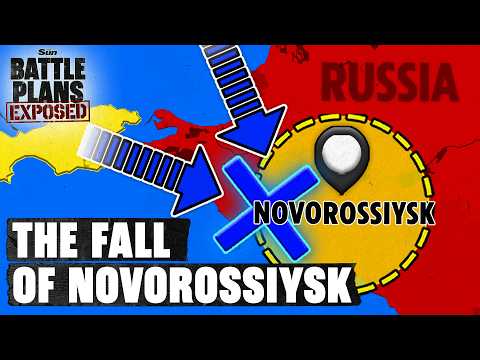
The discussion of attacks around Novorossiysk follows a similar pattern of combining reported developments with more speculative interpretation. Ukrainian statements, satellite imagery, fires, and open-source assessments are used to build a picture of pressure on the Black Sea Fleet and port infrastructure, but conclusions such as severe damage to the Admiral Essen and Russian air defenses being unable to handle Ukrainian drones are stated more confidently than the evidence shown warrants. The recurring “Bingo board” device gives viewers an accessible way to track previously targeted ships and facilities, yet it also lends a game-like tone to events involving an active war.
A broader strategic argument emerges as the update moves from Black Sea ports to Dagestan, grain exports, energy infrastructure, and occupied Ukrainian territory. The host portrays these strikes as a coordinated effort to undermine Russian logistics, exports, military operations, and economic activity rather than as isolated attacks. That framework helps connect a large number of developments, but some sweeping consequences—such as claims that Russian agriculture is facing catastrophe, that millions are effectively without basic services, or that particular ports can be knocked offline—would benefit from more independent evidence and qualification. The acknowledgment that disruption to Russian grain exports could also harm global food security is one of the segment’s more useful complications.
Coverage becomes less disciplined when it turns to Russia’s domestic economy and recruitment practices. The description of Wildberries effectively treats the company’s collapse and alleged theft by its owners as settled despite the presentation providing little supporting material beyond reported unpaid obligations and inventory restrictions. Similarly, allegations that police are detaining men over minor offenses, receiving recruitment bonuses, and coercing military contracts are serious enough to require careful sourcing. Instead, the host quickly moves from those claims into jokes and speculation about how such recruits might perform, reducing the analytical value of potentially important information.
The treatment of Russian attacks on Ukrainian civilians is emotionally forceful and includes statements from Ukrainian officials, descriptions of reported casualties, and footage described as showing residential damage. The host clearly distinguishes one alarming drone incident involving Zelensky’s aircraft from an assassination attempt, which demonstrates welcome caution. Elsewhere, however, intent is frequently asserted as fact: individual attacks are characterized as deliberately targeting civilians, and Russia’s overarching war objective is described as killing Ukrainians who refuse Russian identity. Those conclusions may reflect the host’s interpretation or quoted Ukrainian and Russian rhetoric, but the presentation does not provide enough evidence to establish every specific claim about targeting decisions or overarching intent.
One of the more substantive sections examines whether attacks on civilians can undermine Ukrainian morale. A cited survey reporting that 71% of respondents in government-controlled Ukraine considered themselves happy is interesting, particularly because the host explains the movement among respondents who had previously answered ambiguously rather than simply treating the headline figure as self-explanatory. The comparison with wartime bombing campaigns, introduced through comments from Poland’s foreign minister, provides a historical framework for arguing that attacks on cities can strengthen rather than collapse public resistance. Still, the host converts that argument into the absolute assertion that targeting civilians “never” produces the intended political effect, a much broader historical conclusion than the examples presented can establish.
The closing discussion of Patriot missiles gives the update a useful forward-looking dimension by explaining a proposed arrangement in which allies provide existing interceptors now and replenish their stocks with later deliveries. Along with the lighter segments involving the seized Russian research vessel, a reporter in Kherson, and Patron the retired detection dog, it prevents an already dense update from becoming entirely dominated by strike footage and battlefield claims. Overall, the host is energetic, highly informed about the narrative he is presenting, and effective at connecting military, economic, and civilian developments, but the analysis repeatedly shifts between confirmed information, partisan interpretation, prediction, and speculation without consistently marking where one ends and another begins.
Pros
- The reported 3,000-kilometer drone strike is placed within a broader discussion of Ukraine’s expanding long-range capabilities and campaign against Russian infrastructure.
- Uncertainty is explicitly acknowledged in several places, including the cause of visible fires in Siberia and the drone incident involving Zelensky’s aircraft.
- Connecting strikes on ports, energy infrastructure, naval assets, and air defenses gives the update a coherent strategic framework rather than presenting events as disconnected headlines.
- The discussion of Ukrainian public sentiment explains the cited survey’s underlying response changes instead of relying only on its headline percentage.
- The Patriot interceptor discussion clearly explains the logic behind supplying Ukraine from existing allied stocks and replenishing them later.
Cons
- Several battlefield and damage assessments rely heavily on Ukrainian statements, limited imagery, or open-source interpretation but are subsequently discussed with greater certainty than that evidence supports.
- Serious allegations involving Russian recruitment practices and Wildberries receive little sourcing or competing context before the host reaches sweeping conclusions.
- Claims about deliberate targeting, Russian war objectives, agricultural collapse, and the effects of attacks on civilian morale sometimes move from interpretation to asserted fact without sufficient qualification.
- Jokes and the recurring Bingo-board framing occasionally trivialize subjects involving military destruction, civilian hardship, and an ongoing war.
- The rapid movement through numerous strikes, economic developments, political speculation, and human-interest clips limits the depth available for verifying or contextualizing individual claims.
The update is strongest when it connects reported Ukrainian deep strikes to a broader strategy of pressuring Russian military and economic infrastructure while openly acknowledging gaps in what available imagery can prove. Its breadth and energetic presentation make it informative as a strongly pro-Ukrainian war update, but frequent leaps from reported evidence to confident conclusions weaken its reliability as rigorous analysis.