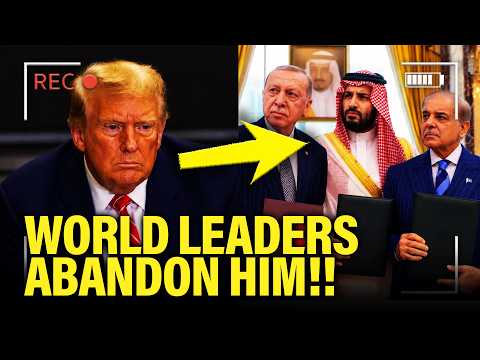
A meeting between Hakeem Jeffries and Jared Kushner becomes an effective opening example of how quickly ordinary political maneuvering can be interpreted as betrayal. Rather than joining the outrage, the discussion emphasizes that congressional leadership depends on internal coalition-building skills that voters cannot easily assess from outside. The argument that meeting Kushner does not itself establish capitulation is appropriately cautious. Less convincing is the subsequent suggestion that the story was leaked specifically to anger Democrats and destabilize them, since motive is inferred rather than demonstrated.
That contrast between useful restraint and confident speculation persists throughout the discussion. Questions about an October surprise are sensibly answered with uncertainty, while the possibility of oil constraints, economic weakness and trade conflict is presented as a collection of vulnerabilities rather than a specific prediction. The sections on Minnesota mining and Big Bend National Park similarly serve the broader argument that political opposition can produce tangible results. Yet complicated regulatory developments are compressed into victories over the administration without enough detail about the relevant legal authorities, permitting processes or durability of the decisions to establish the full picture.
Canada provides the centerpiece for a much larger argument about American power. The explanation connects tariffs, trade agreements, sovereignty, alliances and Mark Carney's vision of cooperation among middle powers into a coherent account of a changing international system. The historical framing is ambitious and often illuminating, particularly when distinguishing a rules-based system of alliances from a model in which powerful states dominate weaker neighbors. There are nevertheless significant accuracy and precision problems: NAFTA is incorrectly placed under the Obama administration even though it took effect decades earlier, and the discussion repeatedly moves from Trump's pressure on Canada and Latin America to the stronger characterization of an intended system of American "vassal states" without establishing that interpretation as fact.
The presentation of Canada's response also illustrates the program's tendency to mix concrete political developments with sweeping conclusions. Retaliatory tariffs, economic performance, Senate races and individual Democratic candidates are woven together to argue that the trade confrontation could hurt Republicans electorally. That is a plausible political thesis, but assertions about comparative job creation, inflation, economic growth and Republican electoral weakness are delivered largely from memory and without enough sourcing or numerical context to judge them. The conversational admission that some tariff figures are not remembered precisely is refreshingly candid, but it also highlights the limitations of an analysis built around consequential economic claims.
Iran receives an even more dramatic treatment. The discussion argues that American military action has strengthened Iran, damaged U.S. regional credibility, endangered bases and demonstrated the limits of military power without reliable alliances. Those are serious strategic questions, and connecting military capacity to diplomacy and alliance networks is one of the discussion's more substantive themes. But descriptions of Iran becoming the Middle East's dominant power, effectively holding off the United States and Israel, controlling regional access and potentially driving permanent changes to the American military presence are stated with much greater certainty than the supporting material permits. References to unnamed experts do little to resolve that evidentiary problem.
The historical turn toward the Progressive Era gives the closing political argument more depth. Linking debates over American influence abroad to domestic questions of education, sanitation, labor and inequality offers a useful way to think about the relationship between national legitimacy and international power. The distinction drawn between the Cuban and Philippine dimensions of the Spanish-American War also signals that the history is being treated as more complicated than a single story of American imperialism. Still, the historical analogy eventually becomes a vehicle for a contemporary Democratic message, and the long catalogue of favored politicians makes the analysis feel increasingly like partisan encouragement rather than an examination of whether those figures actually offer coherent answers to the problems identified.
The informal delivery is simultaneously charming and limiting. The running concern about a cake creates an unusually human atmosphere, and the speaker is comfortable acknowledging uncertainty, correcting slips and moving between audience questions and larger themes. That spontaneity, however, produces factual errors, repeated phrases, unfinished thoughts and claims recalled approximately rather than documented carefully. The closing tribute to Dolly Parton turns toward humanitarianism, literacy and individual civic responsibility in a warm way, but within the presentation itself her death is treated as established without any supporting verification, illustrating why a discussion this dependent on breaking political and cultural developments needs firmer factual discipline.
Pros
- Offers a useful explanation of why congressional leadership requires different skills from national electoral popularity and resists treating Jeffries' meeting with Kushner as proof of betrayal.
- Connects tariffs and the Canada dispute to a broader examination of alliances, sovereignty, trade and competing models of international power.
- Makes alliance networks, rather than military strength alone, central to its analysis of American influence abroad.
- Uses historical material on the Progressive Era and American expansion to give contemporary arguments a wider intellectual framework.
- The conversational format allows genuine uncertainty and occasional qualification rather than pretending every question has a definitive answer.
Cons
- Major factual and historical claims are frequently presented without enough sourcing, including an incorrect attribution of NAFTA's creation to the Obama administration.
- Interpretations of Trump's intentions toward Canada, Mexico and Latin America repeatedly become assertions about creating "vassal states" without sufficient evidence establishing that motive.
- The Iran analysis moves rapidly from strategic setbacks to sweeping conclusions about Iranian dominance and the destruction of American power.
- Economic statistics, tariff figures and electoral claims are sometimes recalled approximately, weakening arguments that depend heavily on those details.
- The increasingly celebratory catalogue of Democratic politicians shifts the presentation from political analysis toward partisan advocacy.
- The loose, hurried delivery produces repetition, verbal corrections and insufficient verification of consequential breaking-news claims.
The discussion is at its best when examining how alliances, trade relationships and domestic political institutions contribute to national power, and its historical perspective gives those questions unusual breadth. Its central weakness is evidentiary discipline: documented developments, remembered statistics, political interpretations and sweeping forecasts too often occupy the same level of certainty. The result is engaging and intellectually ambitious commentary that would be substantially stronger with tighter sourcing, factual verification and clearer boundaries between analysis and advocacy.