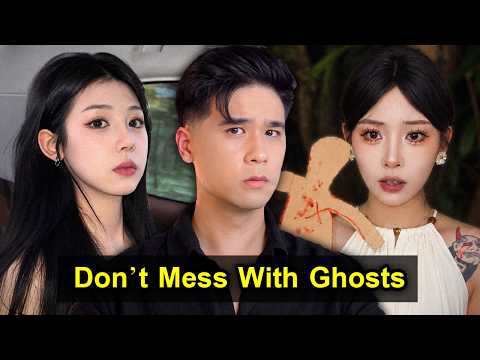
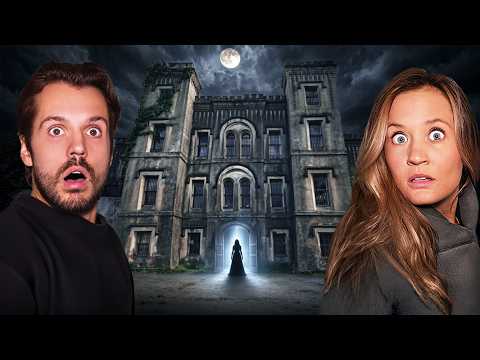
The Kalogeras Sisters head into Halloween determined to contact the supernatural, armed with questionable research, unusual offerings, and considerably more enthusiasm than preparation. Their adventure begins in supposedly haunted woods before expanding into bathroom mirror rituals, Japanese urban legends, and an improvised elevator challenge. Rather than delivering convincing paranormal evidence, the experience becomes a comedy of mistakes, nervous reactions, and constant disagreements about how ghost summoning is supposed to work.
The opening woodland expedition establishes the group's entertaining chemistry almost immediately. Halloween costumes become a source of embarrassment and ridicule, while attempts to create a frightening atmosphere repeatedly collapse into arguments and jokes. The sisters and their companions discuss previous unsuccessful Ouija board experiments, insist that they genuinely want to encounter something supernatural, and debate whether their surroundings are haunted enough to produce results. Their conflicting attitudes create an amusing dynamic, particularly when someone demands that everyone take the rituals seriously only to undermine the moment with another ridiculous comment.
Shopping for offerings provides some of the funniest material, largely because nobody seems certain what a ghost would actually appreciate. Suggestions range from water and desserts to increasingly inappropriate items, with the group questioning whether spirits can eat, drink, or become offended by their gifts. Their eventual selection of treats and bottled water turns a supposedly ominous supernatural preparation into an absurd shopping expedition. Although this sequence highlights their spontaneous humor, it also runs longer than necessary, with repeated arguments and tangents delaying the actual ghost-hunting activities.
The woodland ritual itself demonstrates how effectively the group can turn ordinary mishaps into entertainment. Battery-operated candles are chosen to avoid fire hazards, but the participants struggle with missing supplies, uncertainty about ritual instructions, and disagreements over whether blood is necessary. The suggestion of drawing blood is abandoned rather than acted upon, while attempts to establish a serious atmosphere repeatedly dissolve into nervous laughter. The biggest complication arrives when Noah loses the keys after rolling around in the grass, forcing the group to call for help and interrupting their supernatural investigation. The resulting frustration is more entertaining than anything the ritual produces.
The subsequent Bloody Mary attempts introduce a more recognizable horror tradition, but the execution remains deliberately chaotic. Participants repeat the familiar name in front of mirrors, argue about whether spinning is necessary, and repeatedly interrupt one another with jokes and attempts to frighten the group. The discussion also briefly introduces Hanako-san, a Japanese school bathroom ghost legend, although the exploration is superficial and complicated by confusion over which stall should be used. These sequences provide amusing reactions but little meaningful explanation of the folklore, and the repeated failures gradually make the activities feel interchangeable.
The final elevator experiment offers an especially clear example of the production's preference for comedy over convincing paranormal investigation. After discovering a ritual supposedly requiring a specific sequence of floors in a ten-story building, the group attempts to adapt it to a house with only three floors. The original legend's mysterious woman and alternate dimension provide an intriguing premise, but changing the instructions makes the experiment impossible to evaluate even by the story's own rules. When nothing unusual happens, the participants jokingly blame the presence of another person in the elevator. The ending preserves their playful determination but offers no substantial payoff to the supernatural premise.
Throughout the adventure, the group's strongest asset is its natural conversational energy. Embarrassing costumes, sarcastic exchanges, exaggerated fears, and unexpected logistical problems generate frequent entertainment without requiring a genuine ghostly encounter. However, the constant overlapping dialogue, profanity, repetitive shouting, and abrupt changes of direction can become exhausting. Most importantly, no convincing paranormal occurrence is established, and ordinary sensations such as feeling unwell, hearing noises, or experiencing changes in the weather are occasionally connected to supernatural possibilities without supporting evidence. The result works considerably better as a Halloween comedy vlog than as an investigation of unexplained phenomena.
Pros
- The Kalogeras Sisters and their companions display lively chemistry, with spontaneous teasing and contrasting reactions creating much of the entertainment.
- The shopping expedition turns the simple question of what ghosts might appreciate into an amusing series of increasingly absurd suggestions.
- The lost-key incident introduces an unexpected real-world complication that produces genuine frustration and memorable comedy.
- Multiple supernatural traditions, including Bloody Mary, Hanako-san, and the elevator ritual, provide variety beyond the initial woodland setting.
- Choosing battery-operated candles and abandoning the proposed blood ritual demonstrate sensible limits during otherwise chaotic activities.
- The group's willingness to laugh at unsuccessful experiments helps maintain a playful Halloween atmosphere.
Cons
- Excessive shouting, overlapping conversations, and repetitive jokes sometimes make the dialogue difficult to follow.
- The lengthy shopping sequence and repeated ritual failures weaken pacing without contributing much additional suspense.
- Supernatural traditions receive limited explanation, and several experiments are attempted without following their stated instructions.
- The participants occasionally suggest paranormal explanations for ordinary experiences without establishing evidence of supernatural activity.
- Despite numerous summoning attempts, the adventure ends without a convincing encounter or particularly satisfying conclusion.
The Kalogeras Sisters deliver an energetic Halloween adventure that succeeds primarily through chaotic humor, entertaining personalities, and unpredictable mishaps rather than genuine supernatural suspense. The variety of rituals keeps the premise moving, but repetitive interruptions, inconsistent preparation, and the absence of meaningful paranormal evidence limit its effectiveness. Viewers who enjoy personality-driven comedy will find plenty to laugh about, while those hoping for a frightening or carefully conducted ghost hunt may be disappointed.