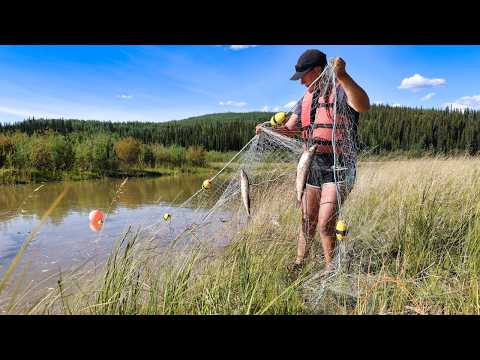
Wet lichen turns an already demanding hike into a genuine hazard, and an early fall onto a rock gives the day an immediate reminder of how quickly remote work can go wrong. The host escapes with a scraped elbow and continues, but the combination of slippery bedrock, a damaged safety cap on his bear spray and several kilometers of hiking establishes that simply reaching this property carries consequences. Fresh wolf scat and uncertainty over who previously marked the trail with pink ribbons add atmosphere without being pushed into an unsupported conclusion; he ultimately treats the ribbons as more likely the work of an ordinary visitor than deliberate harassment.
Animal damage provides another complication before the rebuilding work even starts. The canvas tent has been ripped open in multiple places, with the host considering a bear or possibly a wolverine as the culprit rather than pretending to know exactly what happened. His improvised tape repairs are plainly temporary, and the sequence effectively conveys the difficulty of maintaining even basic shelter at an isolated site. The nearby wasps, uneven tent floor and previous squirrel damage reinforce how many small problems compete for attention alongside the much larger cabin project.
Much of the day is devoted to the least glamorous part of rebuilding: cleaning up what remains of the old structure. Rotten lumber goes toward a winter burn pile, while shingles, tiles and other material are separated for later removal. The host says he investigated the applicable disposal rules and was warned that improperly burning prohibited materials could result in an enormous fine, so he is careful to distinguish what he believes can legally be burned from what must be hauled away. That explanation is useful context for a cleanup process that might otherwise look unnecessarily laborious, although the specific regulatory claims and potential penalty are presented through his account rather than independently established here.
The new cabin begins to take clearer shape when he explains the 35-meter setback from the lake and reduces the planned footprint from 20-by-20 feet to 20-by-16. According to his description of the lease conditions, the old waterfront cabin had to come down and its replacement must sit farther inland; he also says a shed and outhouse have been approved. These details make the project easier to understand because the location of the new posts and the inability to reuse the old platform are tied to stated constraints rather than arbitrary design decisions. Less reassuring is how difficult the post holes are proving to dig, with roots and hard ground making even one hole an hour-long job.
The attempt to solve that problem with a rented gas-powered auger becomes the day's most engaging logistical subplot. A rental company confirms that an auger is available, leading to the idea of flying into a larger nearby lake and carrying the machine across the bog. Instead of magically resolving the problem, the episode follows the calls, poor cell reception, scouting hike and airline's concerns about water depth, shoreline access and unfamiliar conditions. When the airline ultimately declines because its equipment and available information do not make the landing workable, the host accepts the decision rather than pressuring anyone to take an unnecessary aviation risk.
Cleanup around the old cabin supplies the most tangible payoff. Large windows, rotten framing, loose nails and an enormous amount of broken glass are gradually removed or contained, while usable metal siding and propane tanks are identified for possible reuse. There is an appealing honesty to spending substantial screen time on monotonous glass collection rather than reducing the rebuild to dramatic before-and-after moments. At the same time, repeated handling of glass, nail-filled debris and unstable rotten material can be uncomfortable to watch, particularly after the earlier fall, and stronger visible protective precautions would make some of this work more reassuring.
By evening, there is no spectacular construction milestone: the float-plane plan has failed, the new posts are not installed and plenty of debris remains. Yet the site is noticeably more organized, hazardous glass has been substantially reduced, reusable materials have been separated and the host has a clearer plan to concentrate on posts and floor framing during the next visit. That makes the installment unusually effective at showing what remote rebuilding actually involves—physical exhaustion, failed ideas, waste management, transportation constraints and incremental progress rather than a conveniently uninterrupted sequence of construction victories.
Pros
- The slippery hike, elbow fall and difficult access establish the genuine physical challenges surrounding the project without manufacturing additional drama.
- The host avoids confidently identifying the animal responsible for the tent damage or assigning sinister motives to whoever marked the trail.
- Cleanup and disposal receive meaningful attention, including separating materials the host says cannot legally be burned from the winter burn pile.
- The 35-meter setback and revised 20-by-16 cabin footprint provide useful context for why the new structure cannot simply occupy the old platform.
- The unsuccessful float-plane plan is documented unusually well, showing the scouting, rental inquiry, airline discussions and eventual safety-based rejection rather than skipping directly to a solution.
- Extensive glass, nail and debris removal creates visible progress while honestly representing the tedious side of reclaiming the property.
Cons
- Handling broken glass, exposed nails, unstable debris and slippery terrain sometimes appears more casual than the hazards warrant.
- Several regulatory and disposal details, including the stated potential fine, are relayed confidently without enough information here to establish their exact scope or applicability.
- Long stretches of repetitive debris moving and glass collection make the middle portion slower than necessary, even though that monotony is partly the point.
- The extended float-plane discussion ultimately consumes substantial time for an option that never becomes viable.
Failed transportation plans and exhausting cleanup prove more revealing than a neatly packaged construction milestone, giving the rebuild a convincing sense of difficulty and uncertainty. Some repetitive editing and uneasy work around sharp debris hold it back, but the willingness to show setbacks alongside measurable progress makes this a satisfying and unusually grounded cabin-project installment.