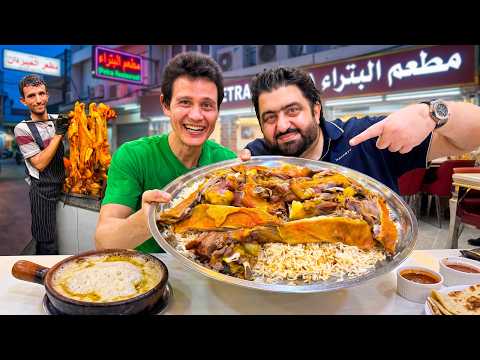
A massive pot of Kabuli pulao provides both the centerpiece and the clearest window into Afghan food culture here. Watching carrots, lamb, raisins, sesame oil, cumin, rice, and broth assembled in careful layers gives the meal more substance than a simple tasting segment would, particularly because the cooking depends on judging liquid, timing, texture, and steam across an unusually large batch.
The strongest stretch follows that preparation from beginning to serving rather than rushing toward the reaction shot. The host repeatedly emphasizes the skill involved, and the visible process supports that point: meat is positioned deliberately, rice is monitored as liquid is added, and the finished pulao must be portioned so each plate receives an appropriate mix of rice, lamb, carrots, and raisins. Some of the commentary becomes repetitive—especially descriptions of aroma, infusion, and anticipation—but the underlying footage gives those reactions a solid culinary foundation.
Bilal adds valuable context once the food reaches the table. He describes pulao as a central dish at Afghan meals while also challenging the assumption that “Kabuli” simply means the dish originated in Kabul, instead explaining it as a cooking method and identifying this particular version as Uzbek Kabuli pulao associated with northern Afghanistan. Those historical and linguistic points are presented as his explanation rather than independently established here, so they are best understood as contextual claims rather than definitive culinary history. Even so, they broaden the segment beyond enthusiastic eating.
The tasting is vivid without pretending to be objective. Tender lamb, fluffy rice, sweet carrots, raisins, sesame oil, cumin, clove-like notes, onions, chili, and salad are all described in relation to one another, giving viewers a reasonably clear impression of the dish’s balance. The host’s tendency toward superlatives can make different foods sound equally extraordinary, but moments such as contrasting the rich pulao with sharp salad and green chili are more useful than generic declarations that something tastes incredible.
An Afghan-style fast-food wrap provides a lighter middle section, combining fries, hard-boiled egg, processed meat, vegetables, seasoning, and sauces inside bread. The preparation is easy to follow, and the host does a good job identifying texture and acidity as the main appeal rather than forcing the food into the conventional idea of a burger. It is enjoyable material, although it receives less cultural context than the pulao and mainly functions as an energetic transition between larger stops.
The handmade ice cream sequence is similarly concise but distinctive. Milk, sugar, and cardamom are described as the base, followed by laborious hand-churning and a serving topped with rich kaymak, nuts, and sometimes additional milk. Mentioning that Ahmed Shah has reportedly made the ice cream there for 35 years gives the stop a welcome human detail, while the physical churning process makes the craftsmanship immediately understandable even without a deeper explanation of the technique.
Chopin kebab ultimately competes with the pulao for the most memorable food of the day. Bilal explains the name as referring to shepherd’s kebab, and the close attention to alternating meat and fat, charcoal cooking, minimal seasoning, rib pieces, and a dried grape-seed condiment makes the tasting unusually specific. Claims about the lamb’s regional origin, pasture raising, and distinctive flavor are again offered conversationally rather than verified, but they fit naturally into a segment primarily concerned with how ingredient sourcing affects the eating experience. The result is an engaging food tour whose exuberance occasionally overwhelms its precision, yet whose strongest sections genuinely illuminate preparation, technique, and local eating traditions.
Pros
- The Kabuli pulao preparation is shown in unusually thorough detail, from layering the meat and carrots to balancing rice, liquid, steam, and serving portions.
- Bilal contributes useful cultural and culinary context rather than functioning only as a dining companion.
- Tastings frequently identify specific contrasts in texture, richness, sweetness, acidity, smoke, and spice instead of relying entirely on generic praise.
- The Afghan burger, handmade ice cream, and Chopin kebab add variety while remaining connected to everyday and traditional food experiences.
- Close attention to charcoal grilling, hand-churning, ingredient sourcing, and large-batch cooking gives the tour a strong sense of craft.
Cons
- Repeated superlatives and descriptions of aromas, tenderness, and anticipation sometimes make the commentary feel inflated and repetitive.
- Historical, linguistic, and sourcing claims supplied during conversation are not independently substantiated, so some cultural explanations remain anecdotal.
- The Afghan burger and ice cream stops receive considerably less context than the pulao, creating an uneven level of depth across the tour.
- Occasional misidentifications that are corrected in conversation, such as initially mistaking dried grape seed for sumac, highlight the limits of the host’s immediate commentary.
Detailed cooking footage and an informed local companion turn an enthusiastic eating tour into a worthwhile introduction to several Afghan specialties. The presentation can be excessively breathless, but its attention to preparation, texture, and culinary technique gives the excitement something substantial to rest on. The pulao and Chopin kebab segments are especially effective at showing why the food matters beyond simply declaring that it tastes good.